
Reset


ACADEMY
Academy 14213 1/800 USS Nim...
$40.95
USS Nimitz (CVN-68) is a US nuclear powered aircraft carrier. The keel for this unit was laid in 1968, the launch took place in May 1972, and the commissioning to the US Navy took place in 1975. The total length of the ship is 332.8 meters, the overall width is 76.8 meters, and the full displacement is about 92,000 tons. The maximum speed does not exceed 32-33 knots. The on-board armament currently includes: two Sea Sparrow missile launchers, two RIM-116 launchers and two 20 mm Vulcan Phalanx CIWS sets. The aircraft carrier can take on board up to 90 aircraft of such types as, for example: F / A-18 Super Hornet, EA-18 Growler, E-2A Hawkeye or Sikorsky MH / SH-60.
USS Nimitz (CVN-68) is the lead ship of the aircraft carrier class of the same name. The ships of this type - until the introduction of the Gerald Ford class units - were the largest ships in history. They were also the first class of nuclear-powered carriers in the history of the US Navy. From the outset, they were planned as the backbone of the US Navy strike force, and were expected to work closely with other shielding ships, such as destroyers, frigates, and submarines. They are almost a symbol of the dominance of the US Navy in the seas and world assessments. The leading vessel of this class is the USS Nimitz (CVN-68), which was built at the Newport News Shipbuilding in Newport News, Virginia. The ship did not manage to take part in the Vietnam War (1964 / 1965-1975), and the first major operation in which she took part was the unsuccessful operation Orli Szpon in 1980. A year later (1981), two F-14 Tomcats took off from the aircraft carrier, which shot down two Libyan Su-22s during a skirmish over the Gulf of Great Sirte. In 1985, the aircraft carrier operated in the Lebanon region. USS Nimitz also took an active part in the First Gulf War (1990-1991) and the Second Gulf War in 2003. USS Nimitz remains in active service, but it is expected to be withdrawn from the line around 2022.
This is an injection-plastic ship model kit.


ACADEMY
Academy 14210 1/800 Carrier...
$41.95
USS Kitty Hawk (CV-63) was an American classic-propelled aircraft carrier. The keel for this unit was laid in 1956, the launch took place in May 1960, and the commissioning to the US Navy took place in 1961. The total length of the ship was 323 meters, the overall width was 86 meters, and her displacement was about 84,000 tons. The maximum speed did not exceed 33 knots. The on-board armament initially consisted of Terrier rocket launchers (later replaced by Sea Sparrow launchers, and later - by RIM-116 launchers) and up to 4 sets of Vulcan Phalanx CIWS cal. 20 mm. The aircraft carrier could take up to 85-90 aircraft on board.
The USS Kitty Hawk (CV-63) was the lead ship of the carrier class of the same name - Kitty Hawk. The ships of this type were essentially a modernized version of the Forrestal ships. The main changes concerned the enlargement of ships, changes to the layout of the airlifts and the flight deck. The USS Kitty Hawk (CV-63) was built at New York Shipbuilding. Shortly after entering service, the carrier was directed to the Pacific and assigned to the United States' 7th Fleet. In the years 1962-1964, the unit courteously visited the ports of Japan and the Philippines. Since 1965, the USS Kitty Hawk on-board aircraft attacked targets in North Vietnam during the Vietnam War. In 1980, the unit underwent modernization and extended service life under the SLEP program. Four years later (1984), there was a collision between the aircraft carrier and a Soviet Victor-class submarine. Ultimately, the USS Kitty Hawk was decommissioned in 2009.
This fantastic kit includes a highly detailed superstructure and mast, finely engraved hull and deck details, deck elevators, and more. A full complement of 58 aircraft including fighters, bombers, helicopters, and E-2 Hawkeye Airborne Early Warning aircraft. Deck vehicles are also included in this kit. A comprehensive decal sheet, precise colour chart and a large display stand complete this marvellous kit.
Features
Highly detailed mast & superstructure
Various deck aircraft & vehicles included
Display stand with nameplate included
Requires plastic cement and paint.
ACADEMY
Academy 14209 1/800 USS Car...
$42.95
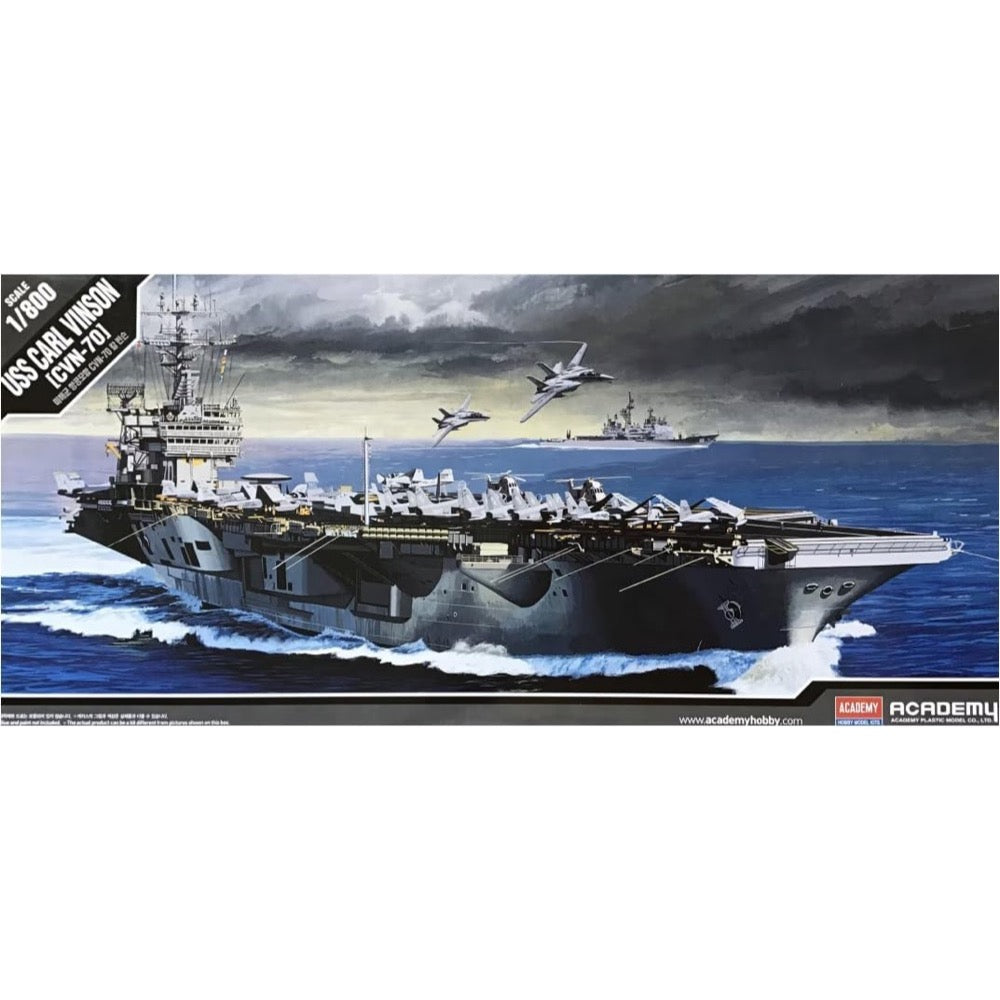
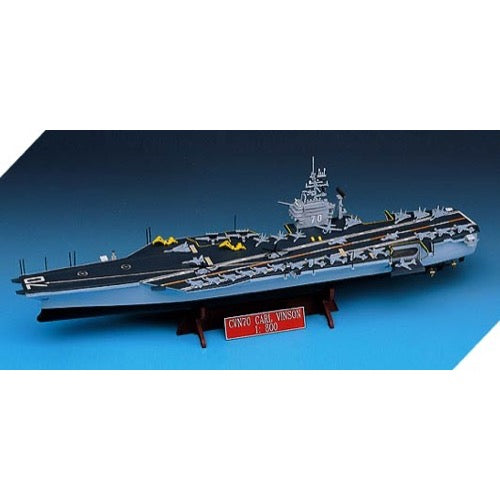
The Academy 14209 CVN-70 U.S.S.CARL VINSON model kit is a perfect replica of the US aircraft carrier. The kit is made of plastic and comes with detailed instructions for assembling. The kit is perfect for those who love to collect military replicas or for those who have served on this carrier. The kit is easy to assemble and has a high level of accuracy in its detailing. The carrier’s length measures 80cm, and the model kit is at a 1/800 scale. If you are an experienced model kit enthusiast or just starting, this kit is perfect for you. Like all model kits, this one will require some effort to put together, but it is well worth the effort. The level of detail you get with this kit is amazing. Once assembled, this model will look stunning when displayed with other replica military kits or by itself. This model also makes a perfect gift for any military or navy enthusiast.
Contents
The assembly instruction
Frames with plastic parts
Decals
Base
Specification
Scale: 1/800
Size: 42,2 x 8,2 x 8,6cm


ACADEMY
Academy 12353 1/48 USN F4U-...
$31.95
The revolutionary design of the F4U Corsair was created in 1938 in response to the request of the US Navy to design a high-speed fighter stationed on board aircraft carriers. Chance Vought took on the challenge, with the goal of fitting the most powerful of the available engines (i.e. the Pratt-Whitney Double Wasp engine) into the smallest possible airframe. The key was to place the clunky landing gear in the inverted, crooked wings that became the hallmark of the aircraft. The flight of the prototype took place on May 29, 1940, and the US Navy received its first serial Corsair on July 31, 1942. However, tests carried out by the US Navy on aircraft carriers revealed some flaws in the design, which meant that the first production series of the aircraft went to squadrons of the Marine Corps and operated from land bases. The first unit received by the F-4 was the VMF-124 at Gudalcanal. It quickly turned out that the new machine definitely surpasses all enemy machines and, in several respects, also the F-6 Hellcat. At the same time, however, it was very difficult to pilot and required great attention when landing. Interestingly, only up to 20% of Corsair missions took off from the decks of aircraft carriers, and throughout almost the entire war they remained primarily a machine of the Marine Corps. After the end of World War II, the F-4 Corsair remained in the line and took part in the Korean War (1950-1953). Technical data (version F4U-4): Maximum speed: 731 km / h, speed of climb: 19.7 m / s, maximum ceiling 12649 m, maximum range: 1115 km, armament: fixed - 6 M2 machine guns, caliber 12, 7mm and 4 20mm Browning cannons, sling - up to 1800 kg of bombs.
This model kit from Academy brings us an accurate reproduction of the single-seat F4U-4 Corsair, an aircraft that was active from World War II to the Korean War! The cockpit interior and details of the landing gear are achieved with a modest number of parts; decals for four versions from the Korean War are included, including Thomas Jerome Hudner Jr., who was awarded the Medal of Honor at the Battle of Nagatsuko.
This is an injection-plastic aircraft model kit.
Features
Size: 21.1cm long, 26cm wingspan when completed
Includes: Decals for 4 versions


Mamoli Mini
Mamoli Mini 1/35 Moby Dick
$ PRICE IN PROGRESS!
This cabin cruiser fishing boat is the most elaborate of all the "Gozzo" designs whilst preserving all of the original functions of the great fishing boats. The cabin offers greater comfort for extended voyages.
The model of the ship is firmly connected with the legendary White Whale. Suitable for beginning modelers.
Contains
Machine cut parts
Complete metal parts
Instructions
Ship stand
Specifications
Length 270 mm
Height 90 mm


REVELL
Revell 05620 1/96 Spanish G...
$237.95
Spanish Galleon - On the Trail of Maritime History
Immerse yourself in the fascinating world of historic seafaring with this detailed model kit of the Spanish Galleon. The kit combines historical authenticity with high-quality model building and offers you the opportunity to recreate a piece of maritime history.
The Spanish galleon had a decisive influence on the golden age of seafaring in the 16th and 17th centuries. As a hybrid between warship and merchant ship, it revolutionized maritime trade and naval warfare. These mighty ships not only transported valuable goods between the continents, but also formed the backbone of the Spanish Armada. Its robust construction and ability to carry both cargo and cannons made it the preferred type of ship of its time.
Features
Faithful replica of a historic sailing ship with authentic details and precise workmanship
High-quality plastic model kit with precise workmanship for optimal building pleasure
Multilingual, illustrated assembly instructions for smooth assembly
High-quality paper decals and flag board for authentic design
Includes
Complete plastic model kit with all necessary components
Detailed, multilingual building instructions with step-by-step explanations
High-quality peel-off sheet for authentic lettering and details
Historically designed paper flag board
Yarn for rigging

AIRFIX
Airfix A10280V 1/72 German ...
$83.95
Restricted by the terms of the Treaty of Versailles, the German Kriegsmarine exploited a loophole by designing a fleet of fast, wooden-hulled attack craft they referred to as Schnellboots. Expertly designed, these vessels were perfected over time and by the outbreak of the Second World War, they had become a devastatingly effective part of Germany’s naval strength. Powered by three diesel engines and featuring a triple rudder arrangement, Germany’s E Boats were some of the fastest warships in the world. With their low profile, high manoeuvrability and torpedo armament, if they penetrated any Allied convoy, they could destroy several vessels and make their escape before coming under return fire.


REVELL
Revell 05414 1/150 Swedish ...
$78.95
Swedish Regal Warship Vasa - Majestic model of the legendary warship
Immerse yourself in the fascinating history of the Swedish Navy with this detailed model kit of the Vasa. The faithful ship model allows you to recreate one of the most important warships of the 17th century in your home.
Features
Exceptionally detailed hull with historically accurate decorations and structures
Artfully designed transom with filigree sculptures based on historical models
Precisely crafted masts and rigging with prefabricated shrouds for authentic looks
True-to-the-original cannons with separately designed piece gates
Textured sails and two different weights of rigging yarn for a realistic appearance
Contents
High-quality plastic model kit with all necessary components
Detailed, multilingual building instructions with clear illustrations
High-quality decals for authentic captions
Colorful paper flag board
High-quality display stand for optimal presentation
The model kit convinces with its extraordinary attention to detail and high-quality workmanship. The precisely designed components enable smooth assembly. Thanks to the detailed assembly instructions, even less experienced model builders can set it up.


REVELL
Revell 05240 1/200 ETV Wake...
$68.95
ETV Waker Model Kit - Scale replica of the legendary Coast Guard Ship
With this detailed model kit of the ETV Waker, you can transform a piece of maritime history into an impressive exhibit. The faithful replica of the Dutch Coast Guard ship offers you the perfect opportunity to put your model building skills to the test.
Features
Scale replica with authentic details such as the signature helipad
High-quality plastic parts for precise assembly and long durability
Two detailed cranes demonstrate the technical equipment of the original
Included display stand for optimal presentation of the finished model
Contents
Complete plastic model kit with all necessary components
Multilingual, illustrated building instructions for easy assembly
High-quality decal sheet for true-to-the-original lettering
Yarn for the realistic representation of ropes and rigging
Sturdy display stand for presentation
The model kit allows you to build a miniature replica of the 67.5-meter-long coast guard ship. The two true-to-the-original Stork diesel engines, each with an output of 4,600 hp, are reproduced in just as much detail as the striking helicopter landing deck.


TAMIYA
Tamiya 31614 1/700 Waterlin...
$44.95
Serving from 1943 to 1991, the BB-62 New Jersey is the most decorated battleship in U.S. Naval history. Launched in 1942, the New Jersey was one of 4 Iowa class battleships built by the U.S. Navy. Like other Iowa class ships she boasted a 45,000 ton displacement, an amazing 212,000hp, was packed with three turrets of 50 caliber 40.6cm triple guns, and despite her large size, with hull stretching over 270m, was designed narrow enough to pass through the Panama Canal. Following serving in major battles in the Pacific during WWII, she was then deployed to both the Korean and Vietnam wars. In 1982, she was upgraded with modern technology and weapon's systems enabling her to launch Tomahawk cruise missiles and Harpoon anti-ship missiles. Following providing fire support during the Lebanon conflict she served in the Gulf War, and then was finally decommissioned for the last time in 1991.Features 1/700 scale Waterline Series model of the BB-62 New Jersey following 1982 reforms. Authentically reproduced hull via left-right halves.
Accurate reproduction of changes made in 1982 including lattice style mast, and Tomahawk and Harpoon launchers.
40.6cm triple guns are moveable thanks to use of polycaps.
SH-60B Seahawk helicopter included for quality realistic finish.
Includes a detailed painting reference chart.


TAMIYA
Tamiya 31911 1/700 U.S. Nav...
$20.95
The Yorktown's Faithful Protector
The USS Hammann (DD412) was commissioned in August 1939, the fourth ship in the 1,500-ton Sims class of destroyers. Her hull had a raised sheer strake to protect from higher waves, while the use of a single funnel allowed a large area at the stern for her impressive ordnance. She was equipped with four 12.7cm guns, four single 12.7mm machine guns and eight torpedo tubes. After rescuing survivors of the stricken aircraft carrier USS Lexington in the Battle of the Coral Sea in May 1942, the Hammann screened another aircraft carrier, the USS Yorktown, in the Battle of Midway in June of that year. While attempting to salvage the Yorktown, which had been badly damaged by Japanese aircraft, she was torpedoed by the Japanese submarine I-168, and swiftly sank. She received two battle stars for her service in two major naval battles of WWII.
Features
1/700 scale plastic model assembly kit. Length: 151mm.
The form of the ship including raised sheer strake is faithfully reproduced by the one-piece hull.
Ordnance is recreated with fine attention to detail, including the ship's 12.7cm guns, 53.3cm torpedo tubes, depth charge tracks, and 12.7mm single machine guns.
Also features auxiliary equipment such as stern deck lifeboats and funnel-side cutters, in addition to Mk. 37 gun fire control system, mast and more.
This model omits the portion of the hull below the waterline to enable it to be displayed as if it were at sea.


TAMIYA
Tamiya 31907 1/700 Waterlin...
$12.95
Witness to a Famous Moment in Japan's History
During WWII, 175 of the 2,000 ton Fletcher-class destroyers were built for the U.S. Navy and they served as the main destroyers of both the Pacific and Atlantic fleets. One such Fletcher-class ship was the USS Cushing (DD-797) which was completed in 1944. Taking lessons learned in battle, she was a late-production ship fitted with increased anti-aircraft armament and a square-shaped bridge which offered greater visibility. In addition to five 12.7cm guns and a quintuple 533mm torpedo launcher, she was armed with five twin 40mm cannons and seven single 20mm cannons. From her deployment in 1944, she took part in actions such as the attacks on Taiwan and the Battle of Leyte Gulf, and at the end of the war she entered Tokyo Bay with the USS Missouri and witnessed the signing of the surrender documents.
Features
The square-shaped bridge and additional AA armament which characterized late-production Fletcher-class ships are accurately reproduced.
Five 12.7cm guns, AA armament, torpedo launcher, and depth charge launchers are all highly detailed.
Sharply rendered radar antennae and other small parts add to the purposeful appearance of the destroyer. Decals included to depict ship numbers and the U.S. flag.
Camouflage patterns used by the U.S. Navy are clearly explained by the instruction manual and color illustrations on the back of the package.


TAMIYA
Tamiya 31349 1/700 Waterlin...
$43.95
A Pearl Harbor Escort
The Abukuma was a smartly designed 5500 ton light cruiser completed in 1925 as the sixth ship of the Nagara class. Armed with seven 14cm guns and four dual 61cm torpedo launchers and with a top speed of 36 knots, she had significant offensive capabilities. During a training exercise in October 1930, the Abukuma lost its bow, so it became the only ship in the Nagara-class to have the high double curved bow for better seaworthiness. While undergoing modernization, the Abukuma was fitted with powerful two quadruple 61cm torpedo launchers. During the Pacific War, it served as the flagship for the 1st Destroyer Squadron and as an escort for the Pearl Harbor attack force. She also took part in "the miraculous operation," the withdrawal from Kiska. Abukuma's luck ran out in October 1944, when she met her final fate at the Battle of Leyte Gulf.
Abukuma Specifications
Displacement: 5,170 tons (At time of construction)
Length: 162.15m, Width: 14.17m
Propulsion: 4 steam turbines.
Speed: 36 knots
Armament: 14cm guns x7, quadruple 61cm torpedo launchers x2
Features
This is a 1/700 scale plastic assembly kit of the Japanese Light Cruiser Abukuma.
Length 230mm. Classic design with long, narrow hull and 3 funnels accurately reproduced.
The hull divides into left and right parts. The Abukuma was the only ship with a double curved bow in the Nagara-class. The ship's fine details like the telegram lines are realistically reproduced.
Model depicts the ship as she appeared at the time of Pearl Harbor, with quadruple torpedo launchers, seven 14cm guns, various anti-aircraft equipment, and a uniquely shaped shelter-style deck.
The 140mm guns and catapult can turn freely.
It would be interesting to compare the Abukuma to other 5,500 ton light cruisers in the Kuma-class and Nagara-class.
Completed in 1925, the Abukuma was the last ship in the Nagara-class of light cruisers/destroyer flotilla leaders and took part in many major naval engagements in the Pacific War. Due to a collision with the cruiser Kitakami during an exercise in 1930, the Abukuma featured a different bow shape than her sister ships and was thus easily distinguishable. Fast and well-armed with seven 140mm guns and eight torpedo tubes, the cruiser first saw action in Chinese waters, protecting transports near Shanghai. It then acted as flagship for the destroyers that escorted the Pearl Harbor carrier strike force in December, 1941. The Abukuma was also present at several battles in the South Pacific as well as the Aleutian Islands, before finally being sunk off the coast of the Philippines by U.S. aircraft in 1944.


TAMIYA
Tamiya 31428 1/700 Waterlin...
$11.95
To make up for increasing destroyer losses during WWII, the Japanese Navy created the "Tei Type" destroyers which featured simplified construction. The first ship of this class was the Matsu, which was completed in April 1944. To reduce construction time and save materials, the hull and bridge design comprised of simple straight edges and surfaces. This model accurately reflects the unique features of the "Tei Type" destroyers, including the 2nd funnel which was offset to the right. The main turrets and large numbers of 25mm anti-aircraft guns fitted during the end of the war are also highly detailed and offer an insight into the desperate fight against US air superiority.
Length: 143mm. Image shows assembled and painted kit.

TAMIYA
Tamiya 31460 1/700 Shimakaze
$32.95
In May 1943, the Japanese Navy's next-generation destroyer Shimakaze was commissioned at Maizuru Naval Arsenal. Her high temperature, high pressure kampon boilers generated 75,000hp and propelled the 3,000-ton Shimakaze at what was a then record speed for a Japanese destroyer of 40.9 knots; she was also an imposing offensive presence, sporting three twin 12.7cm gun turrets and three quintuple torpedo tube mounts. It wasn't long before she saw action, in July 1943 taking part in the evacuation of Japanese troops from Kiska in the Aleutian Islands, and after that she was called further south, where she would eventually meet her end in November 1944, sunk during a transport mission to relieve the embattled garrison of the island of Leyte. The Shimakaze was to end up the only ship of her class, partially due to carriers and their aircraft reducing destroyer effectiveness, and compounded by the lack of production capacity as Japan felt the squeeze of a worsening war situation. Despite her fleeting service life, however, she was still able to prove that she was a worthwhile design, as the fastest and most powerful of the Japanese destroyers.
Features
This is a 1/700 scale plastic model assembly kit of the Japanese Navy Destroyer Shimakaze. Length: 185mm. The slimline hull is recreated using left and right halves.
Separate deck parts feature exquisite molding, with details such as anchor chains.
Slide-molded 12.7cm twin gun turret depictions offer excellent accuracy.
Main guns and quintuple torpedo tube mounts are assembled using poly caps to allow their rotation.
Features a faithful rendering of the bridge and mast.
Decals are included in the kit to recreate linoleum deck sections and more.
The model finishes at the waterline, allowing recreation of the Shimakaze at sea.
The slimline hull is in left and right halves, with excellent attention to exterior detail.
Superstructures are also recreated with aplomb, such as the bridge, complex mast and funnels.
Slide-molded 12.7cm twin guns offer superb detail, and rotate thanks to the use of poly caps.
Poly caps are installed in quintuple torpedo tube mounts, too, for realistic turning.
The included set of decals includes depictions of Japanese characters and deck linoleum sections.


TAMIYA
Tamiya 31615 1/700 Prince o...
$34.95
The British Battleship Prince of Wales was the second ship of the King George V class. Soon after her completion in March 1941, she was involved in the historic hunt for the German battleship Bismarck. In October she was deployed to South-East Asia to fortify the important British post of Singapore. However, her short career of a mere 9 months came to a dramatic end when intercepted by Japanese bombers in what was to be known as the Battle of Malaya. Tamiya is proud to add the Prince of Wales as she stood during this historic naval battle to our high quality Water Line Series. Kit also features Japanese planes Type 96 "Nell" and Type 1 "Betty" attack bombers for a complete set to accurately recreate battle scene.
On December 8, following the outbreak of the Pacific War, the Prince of Wales left Singapore after receiving intelligence that Japanese troops had begun to land in Malaya. The British Eastern Fleet under Admiral Philips, including the Prince of Wales, intended to meet the enemy at the Kuantan and attack a Japanese convoy. However, the intelligence was wrong and Kuantan was "as quiet as a rainy Sunday afternoon". On her way back to Singapore in the morning of December 10, the Prince of Wales was spotted by a Japanese scout plane. She was soon after attacked and badly damaged by Japanese Type 96 "Nell" and Type 1 "Betty" attack bombers. With her speed reduced, she came under waves of aircraft attacks, until she exploded and sunk stern first.
Features
Highly detailed 1/700 scale model of the Prince of Wales.
Overall length: 322mm
Fine detailed weapons, including 35.6cm L45 quadruple guns, dual-purpose 13.3cm twin guns and 40mm Pom-Pom guns.
Kit includes 1/700 scale Type 96 "Nell" (3 units) and Type 1 "Betty" (4 units) Japanese bombers.
Stand and base is included to depict Japanese fighter bombers in flight.


TAMIYA
Tamiya 78029 1/350 US Battl...
$153.95
An Intimidating Presence
The Iowa-class was the final, and largest of four U.S. battleship classes that were commissioned during WWII. The third of them was the USS Missouri, in June 1944. It was assigned to the Pacific Theater and participated in action around Okinawa, Iwo Jima and the main Japanese islands. In fact the signing ceremony of Japan's surrender documents took place on the Missouri's decks on September 3, 1945. Following the end of the Korean War, she was mothballed at the reserve fleet anchorage. Come 1986, however, she was refitted with various modern weaponry such as Tomahawk and Harpoon missiles, in addition to Vulcan and Phalanx weapons, to rejoin the U.S. Navy. Along with her sister ship the Wisconsin, the Missouri was deployed in the Gulf War in 1991 and fired some 28 Tomahawk cruise missiles on the first day of the conflict. In total, she fired in excess of 750 16-inch rounds in support of land troops. In March 1992 she was decommissioned once more after some 50 years of service, and she now resides in Pearl Harbor as a museum ship.
Features
1/350 scale plastic display model assembly kit of the USS Battleship Missouri as she appeared in the Gulf War of 1991.
Length: 774mm, Width: 94.5mm, Height: 182mm.
Exceptionally detailed scale reproduction includes accurate depictions of the bridge, Tomahawk launcher deck, aft deck, dome-shaped radar, No.1 turret ventilator, deck ventilator and more.
Narrow beam, bow and 4 screws on the hull are all faithfully recreated.12.7cm DP gun turrets, Mk 38 fire director and Mk 13 radar are also depicted.
Modelers can choose from 2 sets of photo-etched parts to recreate air- and surface-search radars and discone antenna.
Includes wire to recreate cables
Comes with display stand.


TAMIYA
Tamiya 77510 1/700 USS Horn...
$22.95
The compact 1/700 scale is the perfect size for collecting your model fleet and the amount of detail included will surprise you. This is a plastic assembly kit. Paint, tools and glue not included.


TAMIYA
Tamiya 77502 1/700 HMS Rodney
$16.95
This is an assembly kit of the battleship HMS Rodney, which was completed in 1927 and went on to participate in many well-known actions such as escorting convoys to Malta, the invasion of North Africa and Normandy, and of course the sinking of the German battleship Bismarck. Its revolutionary design consisting of three triple 40.6cm gun turrets all mounted forward of the bridge has been accurately reproduced. The bridge, funnel, and mast near the stern are also brimming with detail. Line it up with the HMS King George V to recreate the major players that sank the Bismarck.


TAMIYA
Tamiya 12622 1/350 Ship Cre...
$13.95
Expanding the Horizons
The 1/350 scale Crew Set compliment other large 1/350 scale warships such like the famous Japanese Battleship Yamato (78002) and Submarine 1-400 (78019), as well as the U.S. Aircraft Carrier Enterprise (77514).
Features
The set includes a total of 24 figures for each of the 6 different positions such as saluting, pointing to a direction, and one arm behind their back totaling 144 pieces.
The viewing pleasure of displayed warships are raised once set together with the Crew Set.
The plastic Crew set are easy to paint and glue adding to the delicate finish.


TAMIYA
Tamiya 31805 1/700 Prinz Eu...
$35.95
Tamiya presents a plastic model assembly kit of the Heavy German Battle Cruiser, Prinz Eugen.
The Germania Belst Company from Kiel constructed the Prinz Eugen as the third and last Admiral Hipper Class Heavy Cruiser to be commissioned by the Kriegsmarine. Admiral Hipper Class Heavy Cruisers were characteristically larger than heavy cruisers from other countries, and the huge Prinz Eugen was elongated an additional 5 meters. With a displacement tonnage measuring at over 14,000tons this enormous German cruiser packed the firepower of four 20.3cm twin gun turrets for its main armament. In May of 1941 the Prinz Eugen participated in Operation Rheinubung to intercept trade ships in the Atlantic. On this mission she joined forces with the Battleship Bismarck to help sink the British Battle Cruiser Hood and inflict considerable damage on the British Battleship Prince of Wales. In February of 1942, the Prinz Eugen, together with the German battleships Scharnhorst and Gneisenau left their docks at Brest for Norway on an unexpected dash through the British Channel in broad daylight. Known as Operation Cerberus, this was to be one of the riskiest, yet best prepared and best coordinated operations carried out by German forces in the Second World War. After arriving safely in German waters, Prinz Eugen was active in the strategic withdrawal from the Russian front, firing thousands of shells at encroaching Russian forces when she provided support for evacuation ships carrying German troops and civilians. One of the few German cruisers to survive World War II, the Prinz Eugen now rests in the warm waters of the Marshal Islands. After enduring two atomic bomb tests she lies capsized in the calm shallows of the Kwajelein Atoll.
Features
1/700 scale, total length: 303mm, total width: 31mm.
Equipment and armament faithfully recreated. Prinz Eugen can be assembled as it appeared in two different operations: Operation Rheinubung, 1941 and Operation Cerberus, 1942. In Operation Cerberus, Prinz Eugen was equipped with 5 additional 20mm AA-gun quadruple turrets for the "Channel Dash."
Every detail of the ship's form is accurately recreated down to the subtle line separating the left and right side of the ship's hull. Weaponry, searchlight, and the minutest onboard equipment are all portrayed in breathtaking detail.


TAMIYA
Tamiya 31212 1/700 IJN Carr...
$34.95
This is an assembly kit of the Junyo, an aircraft carrier converted from a passenger liner in July 1942. In October of the same year, she participated in the Battle of Santa Cruz, where her aircraft were involved in the sinking of the U.S. aircraft carrier Hornet. The distinctive passenger liner bow and the 26 degree forward angled funnel integrated with the bridge island have been accurately reproduced. Smaller parts such as the main mast, anti-aircraft armament, and a full set of aircraft are also included and are rich in detail.
Length: 311mm.


TAMIYA
Tamiya 31910 1/700 Vampire ...
$21.95
The British V Class warships have established the basic style for present day destroyers. The Vampire was built in England and was commissioned as a warship in 1917. Later in 1933, it was transferred into the Royal Australian Navy. In December 1941, she was deployed to fight in Malaya and was involved in the rescuing of crewmen from the sinking British battle cruiser Repulse. In April the following year, the Vampire was sunk near the British Colony Ceylon.
Features
This is a 1/700 plastic model assembly kit of the Royal Australian Navy Destroyer Vampire, Length: 136mm.
On the front and rear deck, the main batteries can be found on either side of the bridge tower. It is said that the placement of the torpedo tubes and the like is to be of epoch making for those days, which is precisely reproduced in the model.
The main batteries and torpedo tubes are moveable. You are able to enjoy the setting of your choice.
A Naval ensign sheet and the ships numbering decals are included.