

Reset

ACADEMY
Academy 12535 1/72 USN F/A-...
$49.95
McDonnell-Douglas / Northrop F / A-18 Hornet is an on-board fighter and attack aircraft capable of operating in all weather conditions. The roots of the F / A-18 go back to 1974 and the F-17 prototype, which was of interest to the US Navy command this year. The contract for the serial construction of the aircraft was concluded in 1976. In order to accelerate the work, the Northrop concern entered into cooperation with the McDonnell-Douglas concern. As a result, on November 18, 1978, the test flight of the prototype took place, and a year later, successful landings on the aircraft carrier. Since 1982, the aircraft has been delivered to linear units with General Electric F404-GE-402 engines as the propulsion unit. Technical data (version F / A-18 C): Maximum speed: 1915 km / h, speed of climb: 254 m / s, practical ceiling 15 240 m, maximum range: 3340 km, operating radius: 280-740 km, armament: fixed- Single 20mm M61A-1 six-barrel cannon, underslung - up to 7700 kg of cargo.
Strike Fighter Squadron 103 (abbreviation VFA-103) is an American in-flight air unit created in May 1952. Currently, the most characteristic hallmark of the VFA-103 aircraft is the pirate flag, in English called Jolly Rogers, on the horizontal stabilizers. It was also the source of the squadron's unofficial name. The first aircraft on which the VFA-103 pilots flew were the FG-1D Corsair. In 1957, the unit was rearmed with the F-8 Crusader, as one of the first in the US Navy. At the turn of 1964/1965, the VFA-103 began to be armed with the new F-4 Phantom machines. In 1983, however, it was rearmed with the new Grumman F-14A Tomcat fighters, armed with AIM-54 Phoenix missiles. Currently, the basic aircraft of the unit is the F / A-18F Super Hornet. Strike Fighter Squadron 103 pilots took an active part in the Vietnam War (1964 / 195-1975) and in both Persian Gulf Wars (1990-1991 and 2003).
This is an injection-plastic jet aircraft model kit.

ACADEMY
Academy 12534 1/72 F/A-18C ...
$41.95
The McDonnell-Douglas / Northrop F / A-18 Hornet is a carrier-based combat and attack aircraft capable of operating in all weather conditions. The roots of the F / A-18 go back to 1974 and the prototype of the F-17, which was of interest to the US Navy command that year. The contract for the serial construction of the aircraft was concluded in 1976. In order to speed up the work, Northrop entered into cooperation with McDonnell-Douglas. As a result, on November 18, 1978, the test flight of the prototype took place, and a year later - successful landings on the aircraft carrier. Since 1982, the aircraft has been delivered to linear units with General Electric F404-GE-402 engines as the propulsion unit. The aircraft is produced in several versions. The first were the F-18A (fighter) and F-18B (trainer). Foreign orders from Spain, Canada and Australia appeared quickly. In 1987, a version of the F-18C was created, adapted to the use of AMRAAM missiles. A year later, the two-seater F/A-18D version of the F-18 entered service, adapted for operation in all weather conditions, which could serve as an attack aircraft. On its basis, the reconnaissance version of the R/F-18D was created. The newest versions (the so-called Super Hornet) -F/A-18E and F/A-18F are highly modified versions of the F/A-18D. They are characterized by an increased length of the fuselage, wingspan and their area. They also have new General Electric F414 engines and significantly expanded and modernized avionics. They were first presented in 1995. The EA-18G Growler electronic warfare aircraft was also created on the basis of the F-18. All versions of the F/A-18 met with the favor of pilots, are characterized by a low failure rate, ease of operation and very good flight parameters. Hornets took part in the operation against Libya in 1986 and Operation Desert Storm in 1991. Technical data (version F/A-18 C): Maximum speed: 1915 km/h, rate of climb: 254 m/s, practical ceiling 15 240 m, maximum range: 3340 km, operational radius: 280-740 km, armament: fixed- single six-barreled 20 mm M61A-1 cannon, underslung - up to 7700 kg load.
This is an injection-plastic jet aircraft model kit.


ACADEMY
Academy 12533 1/72 USAAF B-...
$56.95
$69.99
In May 1934, the US Army published the conditions with which it should meet the modern multi-engine bomber it needed. It was required that it could take up to 907 kg of bombs on a route from 1640 to 3540 km, while maintaining a speed of 322 to 402 km / h. While, according to the US Army, the term multi-engine meant that there should be more than one engines, Boeing invited to present its concept adopted the use of four engines for the Boeing 299 (later designated B-17). Work on the machine began in mid-June 1934. On July 28, 1935, the Boeing 299 took off for its first flight. It took place on a 3,380 km route with an average speed of 406 km / h. Technical data (for the B-17G): Maximum speed: 510 km / h, practical ceiling: 10,670 m, operating radius: 1,760 km, armament: fixed - 13 machine guns cal. 12.7 mm, suspended - up to 5800 kg, normally - 2742 kg bombs.Technical data (for the B-17G): Maximum speed: 510 km / h, practical ceiling: 10,670 m, operating radius: 1,760 km, armament: fixed - 13 machine guns cal. 12.7 mm, suspended - up to 5800 kg, normally - 2742 kg bombs.
From Academy comes a 1/72 scale kit of the USAAF B-17E "Pacific Theater". It features a precisely engraved cockpit and landing gear, as well as accurately detailed panel lines and rivets. Decals are included.
This is an injection-plastic jet aircraft model kit.


ACADEMY
Academy 12530 1/72 P-47D & ...
$42.95
The Republic P-47 Thunderbolt is an American, single-engine fighter and fighter-attack aircraft, built in a low wing configuration with a classic tail. Considered one of the best American fighters of World War II. The flight of the prototype took place in 1941, and serial production continued in the years 1942-1945. The P-47 can be described as the workhorse of the US Air Force in both Europe and the Pacific. Although the 2000HP R-2800 Double Wasp engine, turbine and exhaust system made the plane very large and heavy, it was not a barrier to achieving great performance. The F-86 was the first mass-produced fighter capable of exceeding the speed of sound. The North American F-86 Saber was the U.S. primary fighter during the Korean War that was able to compete and successfully fight the Mig-15. It is estimated that the ratio of combat losses of both these machines is 2: 1 in favor of the American machine. Technical data (F-86F version): Maximum speed: 1,106 km / h, climb speed: 45.7 m / s, maximum altitude 15,100 m, maximum range: 2,454 km, armament: fixed - 6 M2 Browning 12 machine guns 7mm sling - up to 2400 kg of bombs and rockets.
This is an injection-plastic jet aircraft model kit.
ACADEMY
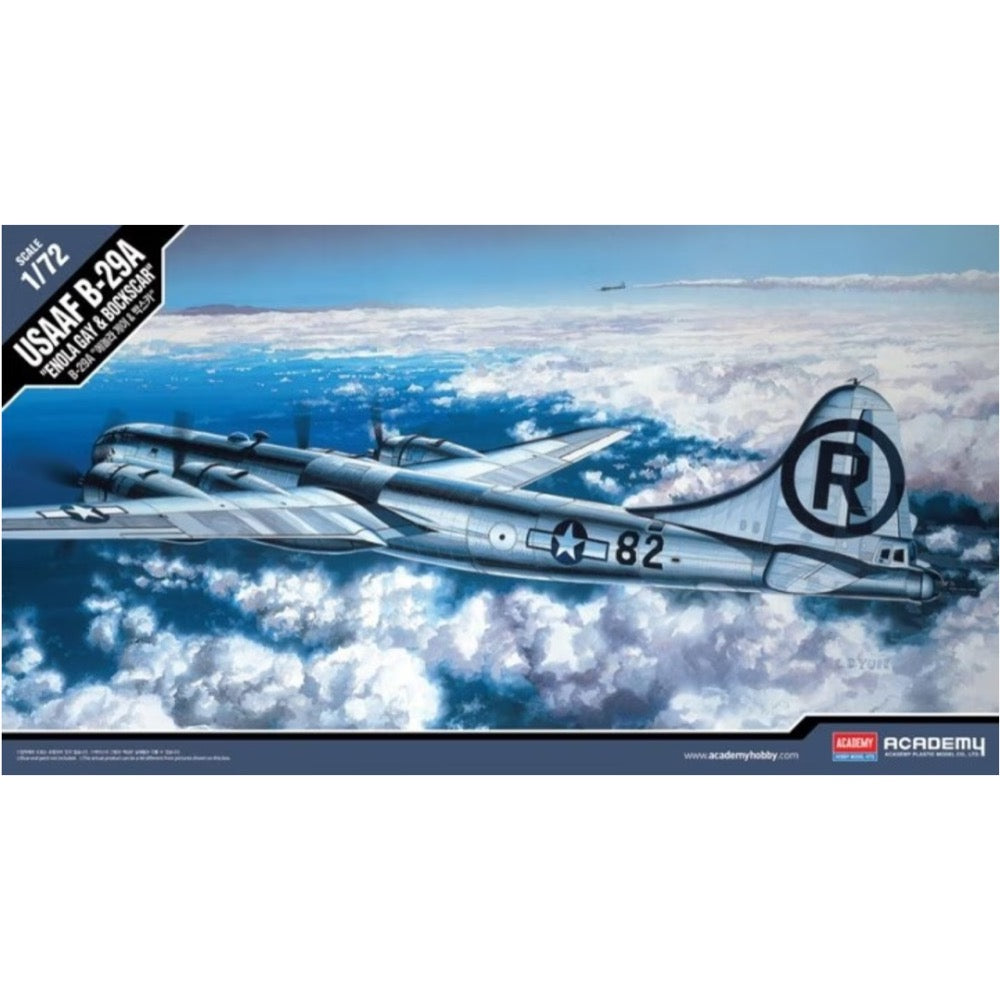
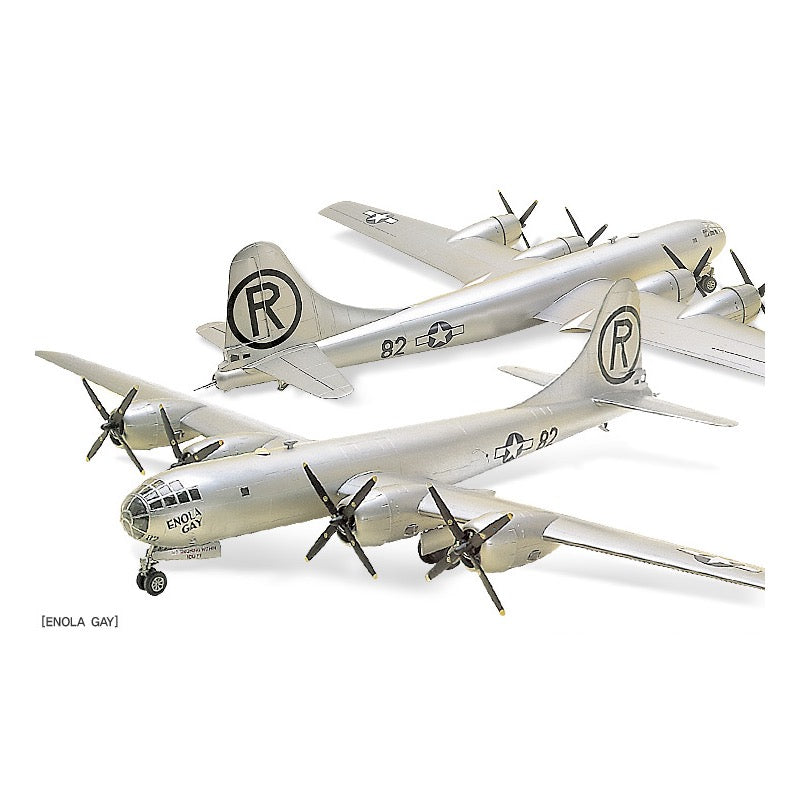
Academy 12528 1/72 B-29A "E...
$59.95
$74.99
The outbreak of World War II made USAAF strategists realize that they should focus on long-range bomber projects identified as VHB (Very Heavy Bomber). When it turned out that such an aircraft could also be used over the Pacific, the designation VLR (Very Long Range) seemed more appropriate. Such a project was launched in early 1940 by General Henry Arnold. Technical data: Maximum speed: 575 km/h, practical ceiling 9144 m, operational range: 5230 km, armament: fixed - most often 11 Browning machine guns caliber 12.7 mm. underslung - up to 9072 kg of bombs.
This is an injection-plastic jet aircraft model kit.


ACADEMY
Academy 12521 1/72 USN F-8E...
$41.95
The Vought F-8 Crusader was an American in-flight fighter and attacker from the post-war period. The drive, in the F-8E version, was provided by a single engine Pratt and Whitney J57-P-20A with 47.6 kN thrust without afterburner. The first flight of this machine took place in 1955. Its serial production started shortly after. In total, over 1,200 machines of this type were built. The length of the aircraft was 16.53 meters with a wingspan of 10.87 meters. In the F-8E version, the on-board armament consisted of four 20mm Colt Mk.12 cannons. The machine could also take a load of bombs, unguided and guided missiles.
The Vought F-8 Crusader was developed for the US Navy as a successor to the completely unsuccessful Vought F-7U-1 Cutlass. It was characterized by a much more conservative design, but it was also much easier to pilot, operate and operate. Equally important, it also turned out to be significantly less failure-prone than its predecessor. It also had a much better maximum speed (the first serial supersonic deck fighter!), Maneuverability and good take-off and landing characteristics from the deck of an aircraft carrier. In general, a very successful plane was created, which remained in service with the US Navy as a fighter until 1976, and in the French naval aviation - until 1999! In the course of serial production, many versions of this aircraft were created, including: F-8U-1 (first production version), F-8U-2N (night fighter) and F-8E (FN)[wersja dla marynarki francuskiej] . Vought F-8 Crusader aircraft took an active part in several armed conflicts, but were used particularly intensively during the Vietnam War of 1964 / 1965-1975.
Academy brings us their 1/72 USN F-8E VF-162 The Hunters scale model aircraft kit. It features accurately detailed panel lines, rivet details, and cockpit and landing gear detailing. One can assemble the finished piece with the air brakes open or closed. Various weapons are also included, as well as some 'cartograf' premium quality decals.
This is an injection-plastic jet aircraft model kit.

ACADEMY
Academy 12520 1/72 USMC F/A...
$39.95
McDonnell-Douglas / Northrop F / A-18 Hornet is an on-board fighter and attack aircraft capable of operating in all weather conditions. The roots of the F / A-18 go back to 1974 and the F-17 prototype, which was of interest to the US Navy command this year. The contract for the serial construction of the aircraft was concluded in 1976. In order to accelerate the work, the Northrop concern entered into cooperation with the McDonnell-Douglas concern. As a result, on November 18, 1978, the test flight of the prototype took place, and a year later, successful landings on the aircraft carrier. Since 1982, the aircraft has been delivered to linear units with General Electric F404-GE-402 engines as the propulsion unit. The plane is produced in several versions. The first were the F-18A (fighter) and F-18B (training). Foreign orders from Spain, Canada and Australia appeared quickly. In 1987, a version of the F-18C was created, adapted to the use of AMRAAM missiles. A year later, the F / A-18D, a two-seat version of the F-18, entered service in all weather conditions, and could be used as an attack aircraft. On its basis, the reconnaissance version of the R / F-18D was created. The newest versions (the so-called Super Hornet) -F / A-18E and F / A-18F are very modified versions of the F / A-18D. They are characterized by an increased length of the fuselage, wingspan and their surface. They also have new General Electric F414 engines and a decidedly expanded and modernized avionics. They were presented for the first time in 1995. The EA-18G Growler electronic warfare plane was also created on the basis of the F-18. All versions of the F / A-18 met with favor of pilots, they are characterized by low failure rate, ease of use and very good flight parameters. Hornets took part in the operation against Libya in 1986 and in the Operation Desert Storm in 1991. Technical data (version F / A-18 C): Maximum speed: 1915 km / h, speed of climb: 254 m / s, practical ceiling 15 240 m, maximum range: 3340 km, operating radius: 280-740 km, armament: fixed- Single 20mm M61A-1 six-barrel cannon, underslung - up to 7700 kg of cargo.
This is an injection-plastic jet aircraft model kit.


ACADEMY
Academy 12507 1/72 F-35A Li...
$39.95
The Lockheed Martin F-35 Lightning II is a single-seat, single-engine multirole fighter built by Lockheed Martin as a fifth-generation aircraft to meet the needs of the USAAF, US Navy, US Army and US Marine Corps. The aircraft was originally designated X-35 JSF, but in 2006 it was changed to F-35 Lightning II. Despite the fact that the main recipient will be the US government, the project is also co-financed by other countries, especially Great Britain, Italy and the Netherlands. The main contractors are the following companies: Lockheed Martin, Northrop Grumman and BAE Systems. The overriding goal of the JSF idea is to create a universal aircraft, manufactured for all types of armed forces, which will allow for far-reaching standardization of spare parts and a significant reduction in costs. Ultimately, three versions of the F-35 (A, B and C) are to be created, which will have more than three quarters of identical components. The main task of the F-35 of all versions is to attack land targets, fulfill the tasks of a combat aircraft, air combat and electronic warfare. It should be noted that the F-35 is created with low-intensity conflicts in mind, unlike its larger "relative" F-22. Which does not change the fact that thanks to the power unit used (Pratt-Whitney F135 engines), avionics and stealth properties, it is one of the most modern multi-role aircraft in the world. The first serial F-35 was created in February 2006. To date (2013), 63 aircraft of this type have been created. Technical data (version F-35A): Maximum speed: 1930 km/h, maximum ceiling 18288 m, maximum range: 2220 km, armament: fixed - one four-barrel General Dynamics GAU-22/A 25mm cannon, underslung - up to 8100 kg of payload.


ACADEMY
Academy 12488 1/72 AH-64A A...
$16.95
The McDonnell-Douglas (Boeing) AH-64 helicopter was selected as the winner in the competition with Bell's YAH-63 in December 1976. The name Apache stuck to the helicopter in 1981. This highly efficient machine has four-blade rotors driven by two General Electric T700-701 turbine engines with a capacity of 1696HP. The vestigial wings are fitted with conventional trailing edge flaps, and a plate tail improves longitudinal steering. The two-man crew takes seats one after the other in the armored cabin. The pilot's seat is in the rear, and the weapon operator / gunner is in the front. The key to the universal use of the helicopter are the TADS systems on the gunner's stand and the PNVS systems used by the pilot. The TADS is a target-tracking laser marker and rangefinder set and a forward-facing infrared sensor that is duplicated by the normal optics. The PNVS system is a developed FLIR system that allows you to pilot a helicopter just above the ground in order to prevent or delay detection by the enemy's anti-aircraft defense. Apache helicopters took part in the operation in Panama in 1989, during the Desert Storm in 1991, or the last conflict in Iraq (2003). At the end of 1990, the construction of a new version of the helicopter began, equipped with a Martin / Westinghouse Longbow millimeter radar installed above the head to control the weapons. It is used to control the Rockwell AGM-114 Hellfire anti-tank missiles. Technical data: Top speed: 300 km / h; climb speed 12.7 m / s, maximum range (without external tanks): 689 km, armament: 30mm Hughes M230A1 Chain Gun fixed-1 cannon, and outboard armaments - most often Hellfire missiles.
This is an injection-plastic aircraft model kit.

ACADEMY
Academy 12485 1/72 P-51D Mu...
$15.95
The North American P-51 Mustang is an American, single-engine, long-range fighter and attack aircraft with a classic tail and all-metal construction. The flight of the prototype took place on October 26, 1940. The P-51 Mustang has earned a reputation as one of the best, if not the best, WWII fighter. Replacing the Allison V-1710-39 engine from the first project with a Rolls-Royce Merlin motor (P-51 Mustang Mk.Ia version) made the Mustang, like never before, reached perfection. Technical data (P-51D version): length: 9.83m, wingspan: 11.28m, height: 4.08m, maximum speed: 703km / h, rate of climb: 16.3m / s, maximum range: 2755km, ceiling practical: 12800m, armament: fixed - 6 12.7mm M2 machine guns, suspended - up to 908 kg of bombs or 10 127mm HVAR rocket launchers.
This is an injection-plastic jet aircraft model kit.


ACADEMY
Academy 12481 1/72 F6F-3/5 ...
$19.95
The Grumman F6 Hellcat is an American, single-engine, WWII, semi-shell fighter in a low wing design. The F6 Hellcat was developed as a development of the successful F4F design. When designing it, 18-month-long experience with the operation of F4F in the Pacific and numerous comments of pilots fighting on Wildcat airplanes was used. Structurally, the F6 Hellcat resembled its predecessor with one major change. Technical data (for the F6F-5 version): Top speed: 620 km / h, climb speed: 14 m / s, practical ceiling 11,400 m, maximum range: 1,755 km, armament: fixed - six 12.7mm Browning machine guns Suspended - up to 1800 kg of bombs or an additional fuel tank.
This is an injection-plastic jet aircraft model kit.
ACADEMY
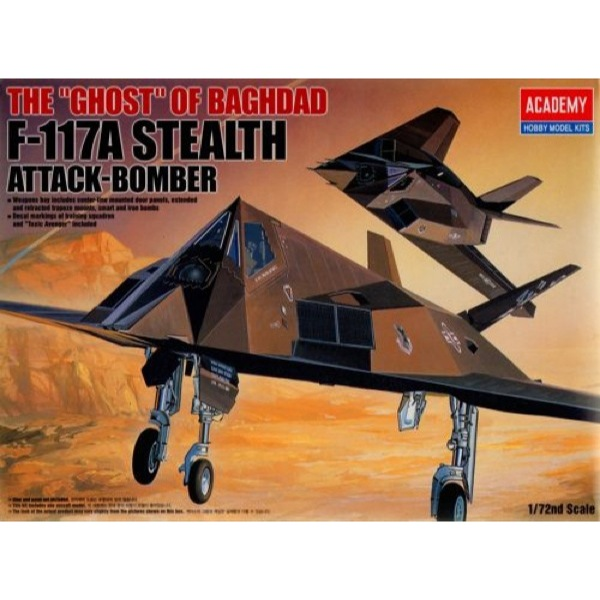
Academy 12475 1/72 F-117A S...
$27.95
The Lockheed F-117 Nighthawk is one of the most innovative designs in the history of aviation and the first mass-produced aircraft with Stealth properties. The concept of an aircraft invisible to radars appeared already during World War II, but it was not until the 1970s that the development of technology made it possible to implement it. In the F-117 it was achieved thanks to the use of many parallel actions. Technical data: Maximum speed: 1040 km / h, operating ceiling 13 700 m, maximum range: 1850 km, armament: fixed - the aircraft has no fixed armament.
This is an injection-plastic jet aircraft model kit.

ACADEMY
Academy 12474 1/72 P-47D "E...
$19.95
The Republic P-47 Thunderbolt is an American, single-engine fighter and fighter-attack aircraft, built in a low wing configuration with a classic tail. Considered one of the best American fighters of World War II. The flight of the prototype took place in 1941, and serial production continued in the years 1942-1945. The P-47 can be described as the workhorse of the US Air Force in both Europe and the Pacific. Although the 2000HP R-2800 Double Wasp engine, turbine and exhaust system made the plane very large and heavy, it was not a barrier to achieving great performance. Technical data (P-47D version): length: 11m, wingspan: 12.42m, height: 4.47m, maximum speed: 697km / h, rate of climb: 15.9m / s, maximum range: 2900km, practical ceiling: 13,100m, armament: fixed - 8 12.7mm M2 machine guns, suspended - up to 1100 kg of bombs or unguided missiles.
This is an injection-plastic jet aircraft model kit.
ACADEMY
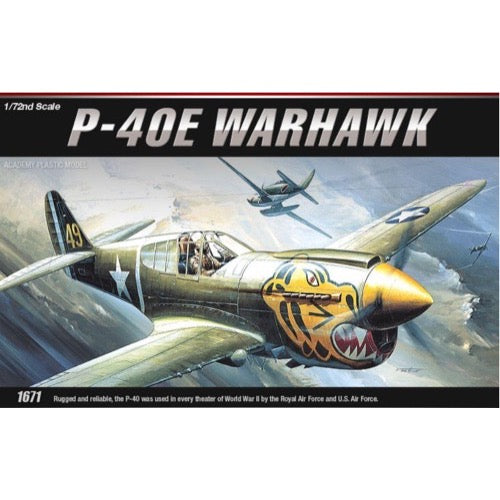
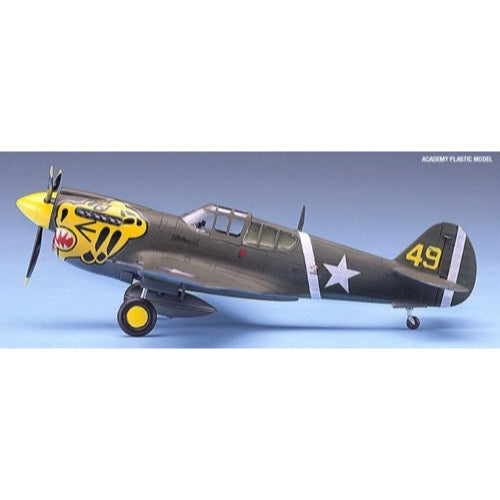
Academy 12468 1/72 P-40E Wa...
$17.95
The Curtiss P-40 Warhawk is an American, single-engine, metal fighter-attack aircraft in a low wing configuration with a classic tail. The flight of the prototype took place in 1938, and serial production was carried out in the years 1938-1944. Technical data (P-40E version): length: 9.66m, wingspan: 11.38m, height: 3.76m, maximum speed: 580km / h, rate of climb: 11m / s, maximum range: 1100km, practical ceiling: 8800m, armament: fixed - 6 M2 machine guns, caliber 12.7 mm, suspended - up to 900 kg of cargo.
This is an injection-plastic jet aircraft model kit.

ACADEMY
Academy 12467 1/72 Messersc...
$18.95
The Messerschmitt Bf-109 is a German metal-structure single-engine fighter in a low wing configuration with a classic tail. It turned out to be the basic and most produced Luftwaffe fighter during World War II. The flight of the prototype took place on May 29, 1935, and serial production continued in the years 1936-1945. In total, it is estimated that a total of about 35,000 Messerschmitt Bf-109 fighters of all varieties were produced, many of which ended up in the Czech and Israeli air forces after the war. Technical data (version Bf-109 G-6): length: 8.95 m, wingspan: 9.92 m, height: 2.6 m, maximum speed: 640 km / h, rate of climb: 17 m / s, maximum range: 850 km, maximum ceiling 12000m, armament: fixed - 2 MG131 13mm machine guns and 1 MG151 20mm cannon, suspended - 250 kg bombs, or 2 Wfr missile launchers. Gr. 21.
This is an injection-plastic jet aircraft model kit.
ACADEMY
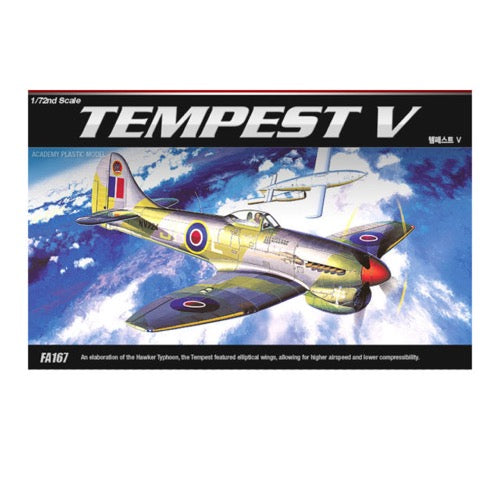
Academy 12466 1/72 Tempest V
$18.95
The Hawker Typhoon did not perform well as a fighter plane, but later served as a bombing fighter, especially when it was equipped with rocket launchers. High-altitude flight performance and climb were unsatisfactory, and in 1941 an attempt was made to counter this by using a wing with a thinner profile and elliptical contour. Technical data: length: 10.26m, wingspan: 12.49m, height: 4.9m, maximum speed: 695km / h, climb speed: 23.9m / s, maximum range: 1190km, maximum ceiling 11125m, armament: permanent - 4 20mm Hispano Mk.II cannons, sling - up to 454 kg of bombs or 8 RP-3 missiles.
This is an injection-plastic jet aircraft model kit.


ACADEMY
Academy 12465 1/72 P-40M/N ...
$20.95
P-40 M/N Warhawk with Australian Decals 1/72 Scale Model Kit by Academy
The Curtiss P-40 Warhawk is an American single-engined, single-seat, all-metal fighter-bomber that first flew in 1938. The Warhawk was used by most Allied powers during World War II, and remained in frontline service until the end of the war. It was the third most-produced American fighter of World War II
Features
Fully engraved panel lines and rivet detail
Highly detailed cockpit interior and landing gear bay
Optional position of canopy and landing gear door
Can be choice to 'M' or 'N' type
3 frames with details
Decal (sticker)
Detailed instructions in English
History of The P-40 Warhawk
The Curtiss P-40 Warhawk is an American, single-engine, metal fighter-attack aircraft in a low wing configuration with a classic tail. The flight of the prototype took place in 1938, and serial production was carried out in the years 1938-1944. The last of the Hawk family of planes - the Curtiss P-40 Warhawk was, apart from the Republic P-47 and the North American P-51 Mustang, the most widely built American fighter. At the end of production in December 1944, the number of machines exceeded 15,000. Technical data (P-40E version): length: 9.66m, wingspan: 11.38m, height: 3.76m, maximum speed: 580km / h, rate of climb: 11m / s, maximum range: 1100km, practical ceiling: 8800m, armament: fixed - 6 M2 machine guns, caliber 12.7 mm, suspended - up to 900 kg of cargo.

ACADEMY
Academy 12464 1/72 P-51B Mu...
$20.95
The North American P-51 Mustang is an American, single-engine, long-range fighter and attack aircraft with a classic tail and all-metal construction. The flight of the prototype took place on October 26, 1940. The P-51 Mustang has earned a reputation as one of the best, if not the best, WWII fighter. Replacing the Allison V-1710-39 engine from the first project with a Rolls-Royce Merlin motor (P-51 Mustang Mk.Ia version) made the Mustang, like never before, reached perfection. Technical data (P-51D version): length: 9.83m, wingspan: 11.28m, height: 4.08m, maximum speed: 703km / h, rate of climb: 16.3m / s, maximum range: 2755km, ceiling practical: 12800m, armament: fixed - 6 12.7mm M2 machine guns, suspended - up to 908 kg of bombs or 10 127mm HVAR rocket launchers.
This is an injection-plastic jet aircraft model kit.


ACADEMY
Academy 12456 1/72 P-40B Wa...
$11.95
The Curtiss P-40 Warhawk is an American, single-engine, metal fighter-attack aircraft in a low wing configuration with a classic tail. The flight of the prototype took place in 1938, and serial production was carried out in the years 1938-1944. The last of the Hawk family of planes - the Curtiss P-40 Warhawk was, apart from the Republic P-47 and the North American P-51 Mustang, the most widely built American fighter. Technical data (P-40E version): length: 9.66m, wingspan: 11.38m, height: 3.76m, maximum speed: 580km / h, rate of climb: 11m / s, maximum range: 1100km, practical ceiling: 8800m, armament: fixed - 6 M2 machine guns, caliber 12.7 mm, suspended - up to 900 kg of cargo.
This is an injection-plastic jet aircraft model kit.


ACADEMY
Academy 12455 1/72 M-27 Flo...
$14.95
Mikojan-Guriewicz MIG-27 (NATO: Flogger) is nothing more than a developed version of the MIG-23 aircraft, having the nature of an assault machine. Successively developed variants of that aircraft gradually differed more and more from the original design, and finally the designation of the MIG-23BK model was replaced with a new one - MIG-27K. In addition to the K specification, three other MIG variants were produced 27: the M version, which is in fact a simplified K version, the D version - i.e. older machines rebuilt to the M standard, and the L version - produced under license in India, called there Bahadur, i.e. the Brave. A total of just over 1000 MIGs 27 were produced. The power unit was the Khachaturov R-29B-300 engine. Technical data: length: 17.2 m, wingspan (maximum): 13.97 m, height: 4.82 m, maximum speed: 1.6 Ma, climb speed: 200 m / s, maximum range: 2500 km, practical ceiling: 15 500 m, armament: fixed - one GSz-6-30 six-barrel 30mm cannon, suspended - up to 4000 kg of cargo.
This is an injection-plastic jet aircraft model kit.

ACADEMY
Academy 12454 1/72 Messersc...
$18.95
The Messerschmitt Bf-109 is a German metal-structure single-engine fighter in a low wing configuration with a classic tail. It turned out to be the basic and most produced Luftwaffe fighter during World War II. The flight of the prototype took place on May 29, 1935, and serial production continued in the years 1936-1945. In total, it is estimated that a total of about 35,000 Messerschmitt Bf-109 fighters of all varieties were produced, many of which ended up in the Czech and Israeli air forces after the war. Technical data (version Bf-109 G-6): length: 8.95 m, wingspan: 9.92 m, height: 2.6 m, maximum speed: 640 km / h, rate of climb: 17 m / s, maximum range: 850 km, maximum ceiling 12000m, armament: fixed - 2 MG131 13mm machine guns and 1 MG151 20mm cannon, suspended - 250 kg bombs, or 2 Wfr missile launchers. Gr. 21.
This is an injection-plastic jet aircraft model kit.
ACADEMY
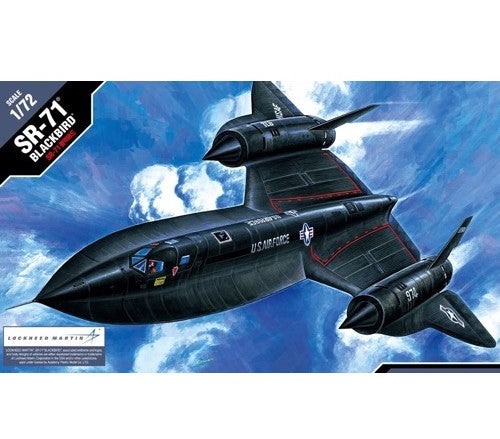
Academy 12448 1/72 SR-71 Bl...
$45.95
The Lockheed SR-71A is a long-range espionage aircraft operated by the United States Air Force with an enormous maximum speed of over Mach 3. Work on the A-11 (prototype YF-12 / SR-71) began in secret in 1959 according to guidelines given by the CIA, which needed a spy plane even more perfect than the U-2, and it is believed that by 1968, when it was completed production, about 30 machines were assembled, including the training SR-71B. The nickname Blackbird, of course, comes from the black paint that is completely painted on the plane. It has a dual role to play. Firstly, it is a special material that makes it difficult to detect Blackbird by radar, and secondly, the black color is most effective in neutralizing the huge temperatures to which the fuselage is exposed during flights at 3 times the speed of sound. The planes were officially withdrawn from service in the USAF in the late 1980s, and some of them went to NASA. Technical data: length: 32.74m, wingspan: 16.94m, height: 5.64m, maximum speed: 3.56Ma, rate of climb: 60m / s, maximum ceiling: 36500m, maximum range: 5150km, armament: permanent- the plane is unarmed.
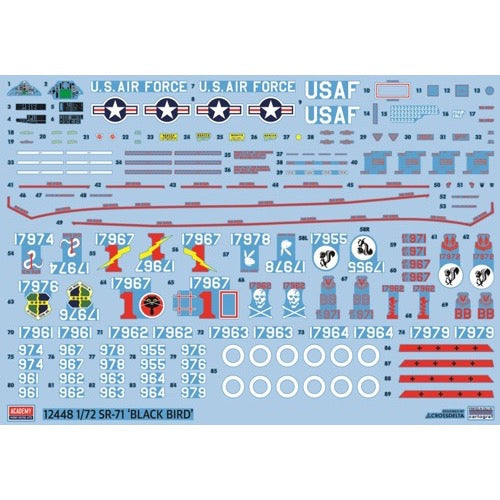
The SR-71 supersonic, high-altitude strategic reconnaissance aircraft that was adopted by the U.S. Air Force is now available as a 1/72 kit from Academy! Each panel line of the product is expressed with precise molding. Decals (made by Cartograf) include 12 types, including the 9th Strategic Reconnaissance Wing "Ichiban" that had been deployed to Kadena Air Base.
This is an injection-plastic jet aircraft model kit.


ACADEMY
Academy 12447 1/72 Sopwith ...
$8.95
The British Sopwith Camel, a wooden biplane fighter aircraft from World War I. It owes its nickname to the "hump" in front of the pilot's cockpit, which housed machine guns. The Camel was the successor to the successful Sopwith Pup fighter. The first flight of the prototype took place in December 1916, and deliveries to front-line units began in the summer of 1917. The first series batches required great skills from the pilots and showed an asymmetry of flight characteristics unseen in other Allied machines. Over time, however, the Camel gained a reputation among pilots as a very maneuverable, solid machine with a good rate of climb. It was a worthy rival for German machines from the Albatros or Fokker factories. Several versions of the Camel were created during the war. The most important of them are: F.1 - fighter, F.1.3 - night fighter, TF1 - attack aircraft (Trench Fighter), 2F.1 - carrier-based fighter. Thanks to the start of serial production by eight different aircraft manufacturers, it was possible to produce as many as 5,490 machines during the war. Technical data: Maximum speed: 185 km/h; rate of climb 5.5 m/s, maximum ceiling 6,400 m, armament: 2 Vickers machine guns, caliber 7.7 mm, firing through the propeller. In the assault version, Lewis machine guns, caliber 7.7 mm.
This is an injection-plastic jet aircraft model kit.
ACADEMY
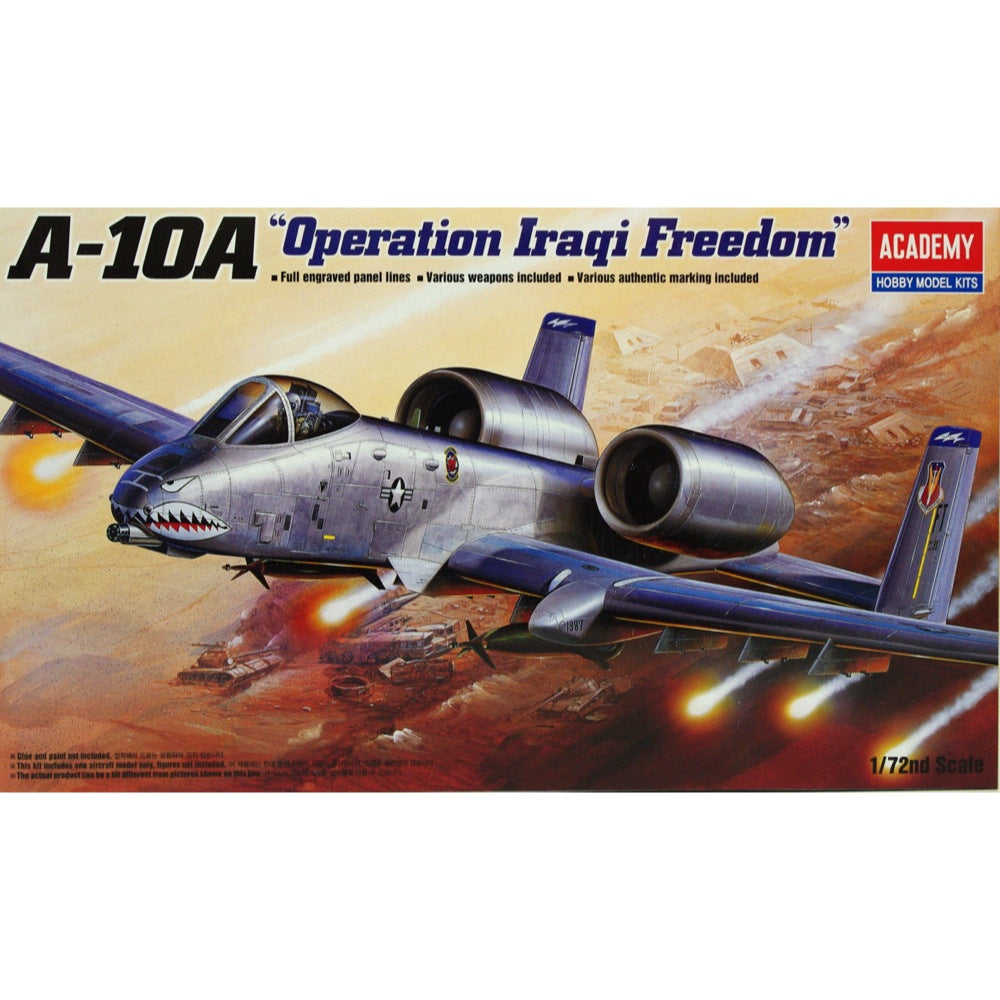
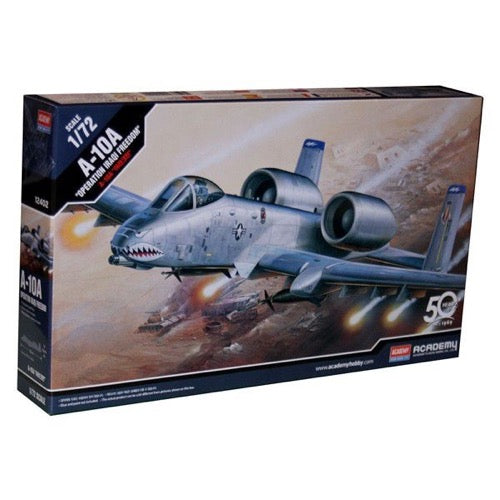
Academy 12402 1/72 A-10A "O...
$22.95
The Fairchild-Republic A-10 Thunderbolt II is a turbo-fan powered single-seater attack aircraft. The prototype flight took place in 1972, and serial production took place in 1975-1984. In total, 715 examples of this aircraft were built. The main task of the A-10 was to combat armor of the Warsaw Pact in central and western Europe. It was also supposed to balance the quantitative advantage of the USSR over NATO troops in armored weapons. Such a task resulted in the fact that the plane is characterized by a great resistance to damage, unheard of in other assault machines, the armor of the cockpit and a very high overall durability of the structure. The A-10 is also manoeuvrable - at 275 km / h, the turning radius is 300 meters, increasing to just 400m with a speed increase of 550 km / h. The main armament is the 30mm GAU-8 / A rapid-fire cannon. In addition, the plane can carry from 6,500 to 7,300 kg of weapons depending on the amount of fuel transferred. The A-10 Thunderbolt II was used in combat in Operation Desert Storm, where it performed excellently and proved its high value. Technical data: Top speed: 706 km / h; maximum range: 3950 kg, climb speed 30.5 m / s.
This is an injection-plastic jet aircraft model kit.