

Reset


ACADEMY
Academy 12363 1/48 USN XF5F...
$32.95
Experimental twin-engine carrier fighter aircraft developed by Grumman for the U.S. Navy in the late 1930s.
Powered by two Wright R-1820 Cyclone counter-rotating radial engines, the Skyrocket’s top speed was 358 mph and could climb 10,000 ft in just over four minutes. During diving tests the Skyrocket reached a speed of 485 mph.
One prototype was built and its first flight was on April 1st 1940. At the time it was the Navy’s largest fighter, with a wingspan of 42 ft and length just under 29 ft.
The unique Skyrocket served for research purposes until being dismantled after an accident in late 1944.
The reissue kit by Academy includes parts for the early truncated-nose & short engine nacelles and the late long-nose & extended engine nacelles, originally released by Minicraft as two separate kits.


ACADEMY
Academy 12361 1/48 USN T-34...
$31.95
Training aircraft used by U.S. Navy.
The Beechcraft T-34 Mentor was an American military low-wing metal training aircraft from the Cold War and modern times. The flight of the prototype took place in 1948, and the plane entered service in 1953. About 2,300 machines of this type were created in the course of production. The propulsion, in the T-34C version, was provided by a single Pratt and Whitney Canada PT6A-25 turboprop engine with 550 HP. The length of the aircraft was 8.75 meters with a wingspan of 10.16 meters. The machine did not have a permanent on-board armament.
The T-34 Mentor aircraft was initially developed as a grassroots initiative by Beechcraft Aircraft Corporation, which aimed at creating a training and training aircraft that was cheap to produce and operate. It was planned to be an economical alternative to the T-6 Texan. The assumptions of the Beechcraft company partially proved successful and in 1953 the T-34 aircraft began to be used by the US Air Force, and later also by the US Navy. In the course of production, three main military versions of this aircraft were created: T-34A (version dedicated to USAF), T-34B (version dedicated to US Navy) and T-34C (version with turboprop engine). It is worth adding that the machine was also quite successful on foreign markets and was or is still operated in countries such as Argentina, Chile, France, Japan (license production) and Turkey.
Features
Reboxed Minicraft with new decals
Detailed cockpit
Landing gear.
Includes
Choice of 3 markings:
T-34B BuNo 140950, USN Training Sqn 5 (VT-5), 1976;
T-34B BuNo 144090, USN Training Sqn 5 (VT-5), 1984;
T-34B BuNo 140702, USN Training Sqn 1 (VT-1), Air Station Saufley Field FL, 1976.Masking for canopy included.


ACADEMY
Academy 12357 1/48 IL-2m3 "...
$56.95
The Academy 12357 Il-2m3 Berlin 1945 1:48 scale model pays homage to one of the most important attack aircraft in aviation history, the famous Il-2m3 . Designed by Soviet engineer Sergei Ilyushin, this aircraft was known for its exceptional durability, being able to survive damage that would be fatal to other aircraft. The version of the Il-2m3 featured in this model was specifically designed to improve performance and increase firepower, which was crucial during the final stages of the war, including the Battle of Berlin in 1945.
The 1:48 scale model kit from Academy allows you to recreate this historic aircraft with attention to detail. It consists of plastic elements that the modeler must assemble and paint themselves. The high quality of the molds and details means that the finished model faithfully reflects the original aircraft, making it attractive to modeling enthusiasts and history buffs. The kit includes detailed assembly instructions, as well as stickers that allow you to recreate the authentic paint scheme used in 1945. Thanks to this, the modeler can indulge in their passion for creation and at the same time appreciate the historical significance of this aircraft.
Features
Includes decals with seven marking options for various units
Detailed cockpit and accurately replicated propeller and armament
Paint index for authentic color finishing
Ideal for historical aircraft enthusiasts and model builders


ACADEMY
Academy 12353 1/48 USN F4U-...
$31.95
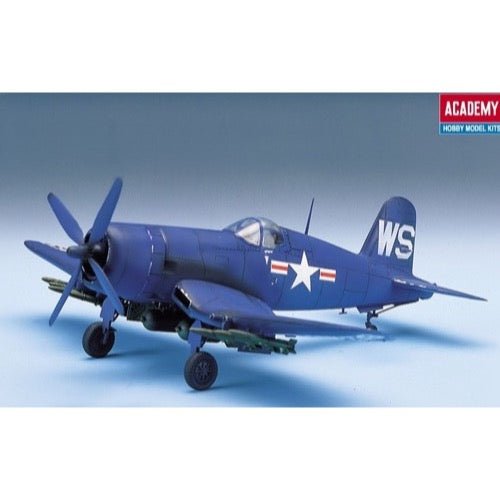
The revolutionary design of the F4U Corsair was created in 1938 in response to the request of the US Navy to design a high-speed fighter stationed on board aircraft carriers. Chance Vought took on the challenge, with the goal of fitting the most powerful of the available engines (i.e. the Pratt-Whitney Double Wasp engine) into the smallest possible airframe. The key was to place the clunky landing gear in the inverted, crooked wings that became the hallmark of the aircraft. The flight of the prototype took place on May 29, 1940, and the US Navy received its first serial Corsair on July 31, 1942. However, tests carried out by the US Navy on aircraft carriers revealed some flaws in the design, which meant that the first production series of the aircraft went to squadrons of the Marine Corps and operated from land bases. The first unit received by the F-4 was the VMF-124 at Gudalcanal. It quickly turned out that the new machine definitely surpasses all enemy machines and, in several respects, also the F-6 Hellcat. At the same time, however, it was very difficult to pilot and required great attention when landing. Interestingly, only up to 20% of Corsair missions took off from the decks of aircraft carriers, and throughout almost the entire war they remained primarily a machine of the Marine Corps. After the end of World War II, the F-4 Corsair remained in the line and took part in the Korean War (1950-1953). Technical data (version F4U-4): Maximum speed: 731 km / h, speed of climb: 19.7 m / s, maximum ceiling 12649 m, maximum range: 1115 km, armament: fixed - 6 M2 machine guns, caliber 12, 7mm and 4 20mm Browning cannons, sling - up to 1800 kg of bombs.
This model kit from Academy brings us an accurate reproduction of the single-seat F4U-4 Corsair, an aircraft that was active from World War II to the Korean War! The cockpit interior and details of the landing gear are achieved with a modest number of parts; decals for four versions from the Korean War are included, including Thomas Jerome Hudner Jr., who was awarded the Medal of Honor at the Battle of Nagatsuko.
This is an injection-plastic aircraft model kit.
Features
Size: 21.1cm long, 26cm wingspan when completed
Includes: Decals for 4 versions


ACADEMY
Academy 12338 1/48 USAAF P-...
$41.95
During WWII, this aircraft was considered the pinnacle of American fighter aircraft. The aircraft’s development drew on the specifications of the Royal Air Force and the addition of the Rolls Royce Merlin engine. The Mustang became a magnificent powerhouse of versatility and efficiency. Paired with its firepower and long-range capabilities, the Mustang asserted itself as a capable escort fighter. Following WWII, the Mustang saw use in Korea, as well as other conflicts until the 1980s. This kit authentically recreates the P-51 from the USAAF as used in North Africa. The fully assembled model is 27.2cm long and 9.8cm tall.
Features
Highly detailed Interior, cockpit and landing gear
Includes
Plastic and transparent parts to assemble USAAF P-51
Water slide decals
Finishing decals for four fighters:
P-51 41-37322 of 154th OS. 68th OG, USAAF at Morocco, North Africa, March 1943
P-51 41-37367 "Betty Jean" of 111th TRS, 68th RG (was OG), USAAF at Anzio temporary airstrip, Italy, Jan. 1944
P-51 "WU-B" of No. 225 Squadron RAF, Marylebona, Algeria, May 1943
Mustang Mk.1A FD442, Air Fighting Development Unit, RAF Wittering, James "One-armed Mac" Maclachlan, June-July 1943
Detailed manual


ACADEMY
Academy 12334 1/48 USMC PBJ...
$57.95
United States Marine Corps and Navy twin-engine medium bomber produced by North-American Aviation. A variant of the USAAF B-25 Mitchell, the PBJ-1D was introduced in 1942 and saw service in the Pacific War. Powered by four Pratt & Whitney R-2600-13 engines with a maximum speed of 330mph and a range of 1,600 miles. The PBJ-1D was armed with a nose-mounted 7.62 mm machine gun, a dorsal turret with two .50 calibre machine guns, and a ventral turret with two .50 calibre machine guns, and could carry up to 2,000 pounds of bombs
The North American B-25 Mitchell is an American medium bomber from the Second World War. The B-25 is a high-wing, all-metal structure with a retractable three-point landing gear and a double tail tail. The propulsion was two Wright Cyclon engines with the power from 1300KM to 1850KM, depending on the version. The flight of the prototype took place in 1940, and a year later mass production started. During the war, numerous versions of this bomber were produced, including B-25G (with a 75mm gun in the bow of the hull), B-25H (with a 75mm gun and 6 machine guns in the bow of the machine) and the B-25J (with 8 machine guns of 12.7mm in the bow of the fuselage). B-25 planes fought mainly in the Pacific and the Mediterranean basin. A number of them were handed over to Great Britain and the USSR under the lend-and-lease agreement, where they made their combat debut at Stalingrad. From 1943, the Polish 305 squadron flew on the B-25. The B-25 was famous primarily for its daring brave bomb attack on Tokyo in April 1942 (the famous Doolittle raid). Technical data: Maximum speed: 442 km / h, speed of climb: 4 m / s, maximum ceiling 7,600 m, maximum range: 4,300 km, armament: permanent - depending on the version, from 4 to 12 12.7mm Browning machine guns or combination of the 75 mm and km guns. suspended - up to 2700 kg of bombs.
Features
Select from 6 markings
Highly detailed cockpit, bomb bay and landing gear
Accurately engraved panel lines and rivets
Masking seal included


ACADEMY
Academy 12315 1/48 USMC F-4...
$87.95
$99.99
Entering service with the US Military in 1960, the F-4 Phantom II began as a fleet defense fighter for the USN. In 1963, the aircraft was adopted as the USAF’s lead fighter bomber. It was a Cold War icon with its large size, breaking fifteen world records, holding onto five of those records into 1975. The aircraft was produced from 1960-1981, with 5,195 built and operating in eleven other countries. This model includes over 425 plastic parts to recreate a Phantom II serving with the Gray Ghosts as part of Marine Fighter Attack Squadron 531 (VMFA-531).
Features
highly detailed nterior, cockpit and ejection seat
Pedals and control sticks
Instrumental panel
Engraved panel lines and rivets
TER (Triple Ejector Rack) and MER (Multiple Ejector Rack) pylons
Transparent canopy, open or closed
Includes
Plastic and transparent parts to assemble Phantom II as F-4B or F-4N version
14 sprues with more than 425 parts
Position optional parts
Pilot figures
Three drop tanks
Arsenal of Air-Air Weapons, including bombs and air-to-air missiles :
12 MK-82
AIM-9
AIM-7
Cartographic decals
Finishing decals for three fighters:
F-4N BuNo. 152323 VK/200, VMFA-531 ‘Grey Ghosts’, CAG USS Coral Sea, April 1980
F-4B BuNo. 153066 VW-3, Maj. Carl E.R. Black and Bob Schmitt, VMFA-314 ‘Black Knights’, Chu Lai, November 1, 1968
F-4B BuNo. 152274 VW-5, Maj. E.C. Paige and D.D. Rodmond, VMFA-314 ‘Black Knights’, Da Nang, March 14, 1966
Detailed manual


ACADEMY
Academy 12313 1/48 F8F-1/2 ...
$39.95
The Grumman F8F Bearcat is a late-war American single-engine transport fighter. The prototype flight took place on August 21, 1944, and the F8F entered service in February 1945, reaching the Pacific in May of the same year. However, the aircraft did not take an active part in World War II. The heart of the F8F was the powerful Pratt-Whitney R-2800-34W Double Wasp engine with 2400KM and 2800KM supercharged. The Bearcat was lighter than the Hellcat, was significantly faster, and had a much better rate of climb. The F4 Corsair was also ahead of the competition in many respects. Interestingly, many design solutions in the F8F were taken from captured German Fw-190s. F8Fs were used in combat by France in the Indochina War (1946-1954). They were also exported to South Vietnam and Thailand. Technical data (F8F-2 version): Maximum speed: 720 km/h, rate of climb: 25.3 m/s, maximum ceiling 12190 m, maximum range: 1400 km, armament: fixed - four suspended 20mm M2 cannons - up to 908 kg load.
This is an injection-plastic aircraft model kit.


ACADEMY
Academy 12312 1/48 RAF & Ex...
$56.95
$64.99
The Hawker Hunter was one of the most successful and most widespread fighters of the 1950s. It was designed by British constructor Sir Sydney Camm in 1948 as a day fighter, successor to the Gloster Meteor. The first prototype flew in July 1951, while the first machine in the F.1 production series entered service exactly three years later. The Hunter FGA.9 was a version adapted to carry out attacks against ground targets, also equipped with the more powerful Rolls-Royce Avon 207 engine, instead of the Avon 203 from the F.6 model, and thus with a better payload and range. The changes also included redesigning and strengthening the wings. A total of almost 2,000 Hawker Hunter machines of all types were built, of which about 700 were then resold to foreign recipients after decommissioning. Belgium, Sweden, Peru and India. The Hawker Hunter machine was involved in, among others. in the Suez Crisis in 1956, in the Second Kashmir War (1965) and in the Bangladeshi War of Independence in 1971. Technical data (Hunter F.6 version): length: 14m, wingspan: 10.26m, height: 4.01m, maximum speed: 1150km / h, rate of climb: 87.4m / s, maximum range with overhead tanks: 3060km , maximum ceiling 15240m, armament: fixed - 4 30mm ADEN cannons, suspended - up to 3400 kg of cargo.
This is an injection-plastic aircraft model kit.


ACADEMY
Academy 12305 1/48 F-4J "VF...
$90.95
$109.99
The McDonnell-Douglas F-4 Phantom is a long-range, twin-engine, two-seater multi-role fighter designed for operations in difficult weather conditions. The flight of the prototype took place on May 27, 1958, and serial production began in 1961. Originally, the F-4 was intended only as a stormtrooper, but from 1955 on, the design work went towards meeting the US Navy's need for a new on-board fighter. The F-4 Phantom turned out to be a very successful machine, produced in several versions, exported to many countries and produced under license. The first versions are models from A to D intended for fighter-bombers. The next version is the F-4E, produced since 1967 as a long-range fighter. Reconnaissance versions were also created: RF-4B, RF-4C and RF-4E. The latest versions are the F-4F and F-4G Wild Weassel - these are electronic warfare planes and designed to fight the enemy radars. The F-4 took part in the Vietnam War, the conflicts in the Middle East (1967, 1973) and the Iran-Iraq War (1980-1988). In total, 5,057 F-4 Phantom aircraft were built. Technical data (version F-4E): Maximum speed: 2370 km / h, speed of climb: 210 m / s, maximum ceiling 18300 m, maximum range: 2600 km, armament: fixed - 1 20mm M61A-1 cannon, Suspended - up to 7255 kg of bombs and rockets.
Strike Fighter Squadron 103 (abbreviation VFA-103) is an American in-flight air unit created in May 1952. Currently, the most characteristic hallmark of the VFA-103 aircraft is the pirate flag, in English called Jolly Rogers, on the horizontal stabilizers. It was also the source of the squadron's unofficial name. The first aircraft on which the VFA-103 pilots flew were the FG-1D Corsair. In 1957, the unit was rearmed with the F-8 Crusader, as one of the first in the US Navy. At the turn of 1964/1965, the VFA-103 began to be armed with the new F-4 Phantom machines. In 1983, however, it was rearmed with the new Grumman F-14A Tomcat fighters, armed with AIM-54 Phoenix missiles. Currently, the basic aircraft of the unit is the F / A-18F Super Hornet. Strike Fighter Squadron 103 pilots took an active part in the Vietnam War (1964 / 195-1975) and in both Persian Gulf Wars (1990-1991 and 2003).
This is an injection-plastic aircraft model kit.


ACADEMY
Academy 12284 1/48 T-33A Sh...
$37.95
The Lockheed T-33 Shooting Star is an American, single-engine, full-metal low-wing training aircraft. The T-33 was created on the basis of the F-80 by remodeling the internal surface and adding a second pilot's seat. The first T-33 took off in March 1948. and production ended in 1959. 5,691 aircraft of this type were built. The T-33 was also used as a shield towing plane during shooting training. The RT-33A version was produced as a reconnaissance aircraft with a camera in the nose of the plane. The T-33 was widely exported to 39 countries around the world, including Germany, France, Belgium, Brazil and Canada. Technical data: length: 11.49 m, wingspan: 11.86 m, height: 3.57 m, maximum speed: 970 km / h, practical ceiling: 14 600 m, maximum range: 2050 km, armament: fixed - 2 M3 12 machine guns , 7mm, suspended - up to 907 kg of bombs.
Specification
Scale: 1/48
Material: Polystyrene plastic
Assembly: Requires glue
Paint: Not included
Decals: Multiple marking options available


ACADEMY
Academy 12282 1/48 P-38 Com...
$47.95
The World War II Lockheed P-38 had a unique design with twin booms, a piston engine in each, and a central nacelle for the cockpit and armament. From June 1941, this aircraft was used extensively in the Pacific Theater. This powerful fighter was used for interception, dive bombing, ground attack, night combat, radar and visual surveillance, bomber pathfinding, evacuation missions, and as a long-range escort fighter equipped with underwing drop tanks. Academy's 1/48 scale kit includes parts to assemble the P-38 in one of four variants including the P-38J, P-38J Droopsnoot, P-38L Pathfinder and F-5E Photo Recon.
Features
Highly detailed interior and cockpit
Landing gear and compartment
Fully Engraved panel lines
Authentic PVC tires
Contents
Plastic and transparent parts to assemble P-38 in one of four variants
Four finishing options:
P-38J
P-38J Droopsnoot
P-38L Pathfinder
F-5E Photo Recon
Detailed manual
ACADEMY
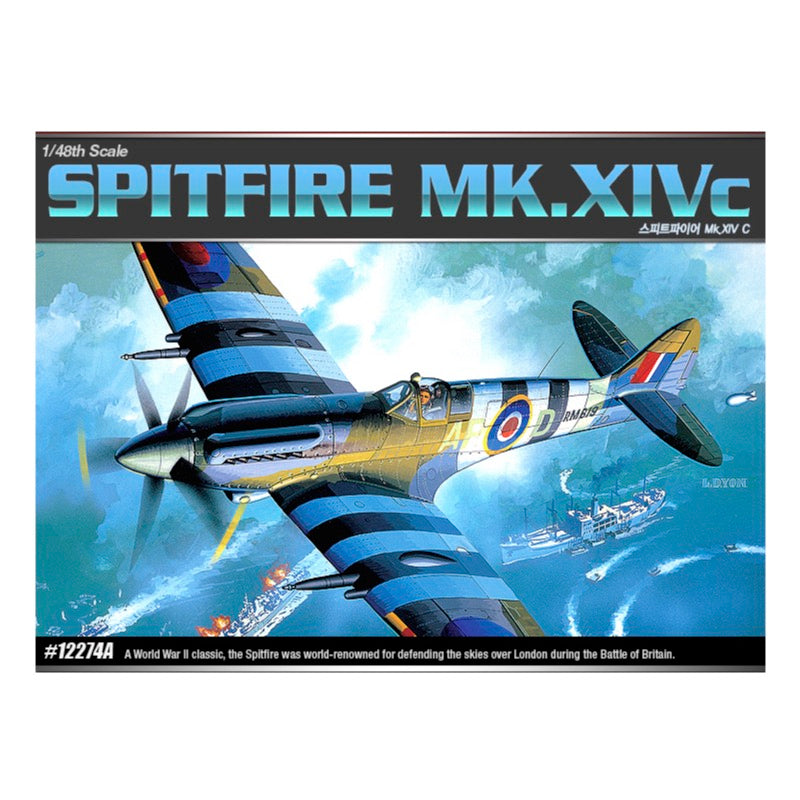
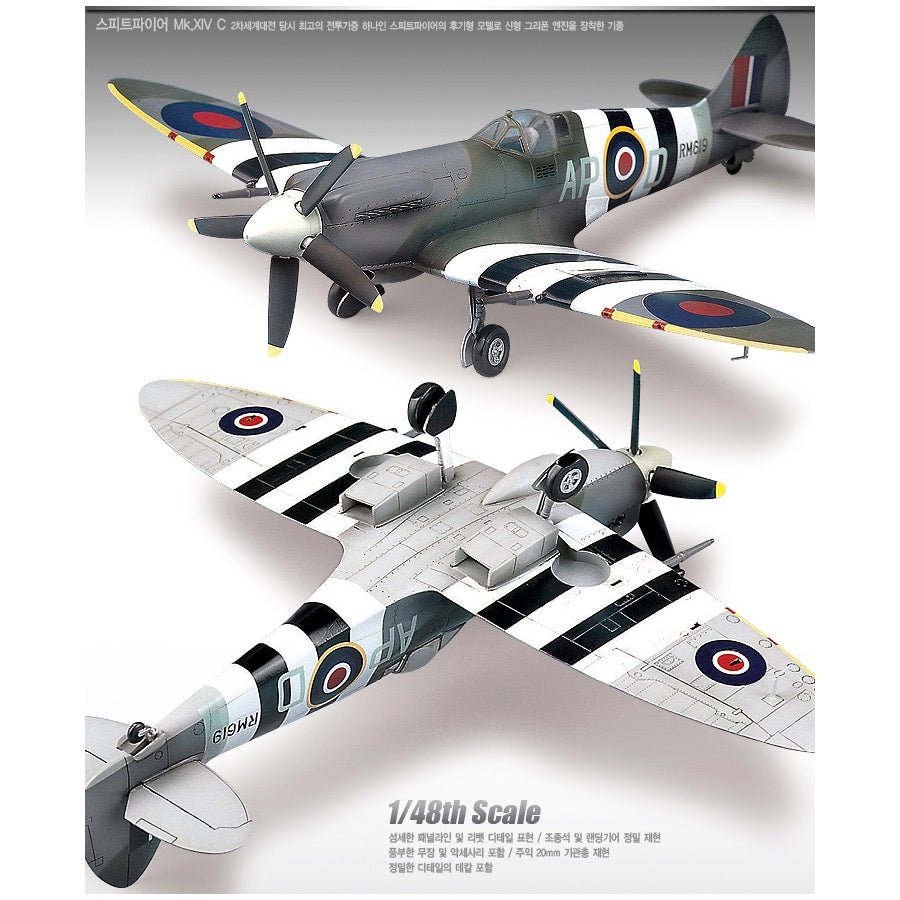
Academy 12274 1/48 Spitfire...
$31.95
History was forever made on October 5, 1944 when a Spitfire XIV of No.610 Squadron was the first Allied aircraft to shoot down a turbojet-powered Messerschmitt 262A Swallow!
Designed as an experimental Mark V fore-runner of future Griffin-engined Spitfires, it proved so promising, it was named the Mark XIV and rushed into production. Over 1,000 aircraft of this type were manufactured and deployed before the end of World War II.
It was the Mark XIV that finally had the range and maneuverability to go against the FW-190 on equal terms. Powered by the two-stage Griffin type 65 engine, the Mark XIV differed from the earlier Spitfires by its larger rudder and elevators, five-bladed ROTOL propeller and four 20mm cannon mounted in its type "C" or "E" wing.
Besides its successful battle history, in particular shooting down over 300 V-1 Flying Bombs, many aviation enthusiasts regard the Spitfire Mark XIV as one of the most beautiful fighter airplanes ever designed.
Features
Fully engraved panel lines and rivet detail.
Highly detailed cockpit interior and cannon bays..
Optional position canopy, weighted tires, fuel tank and weapons bay covers.
ACADEMY
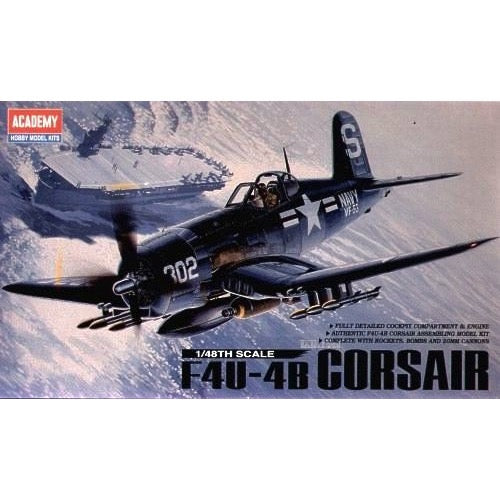
Academy 12267 1/48 Vought F...
$27.95
The Corsair, which the Japanese called Whispering Death, is a legend of the Second World War. The Vought F4U Corsair was powered by a Pratt & Whitney 2,000 HP radial engine. This powerful engine required a large Hamilton Standard 13' 4" Propeller to use the full power of the engine. The F4U was the first American fighter aircraft to exceed 400 MPH. This model faithfully recreates the F4U-4B Corsair in a 1/48 scale.
Features
1/48 scale model kit
High-quality plastic parts
Features highly detailed interior, cockpit and engine
Consistent with bombs, rockets and 20mm cannons
Includes
Plastic and transparent parts to assemble F4U-4B Corsair
Arsenal of Air-Air Weapons
Waterslide decals
Detailed manual
ACADEMY
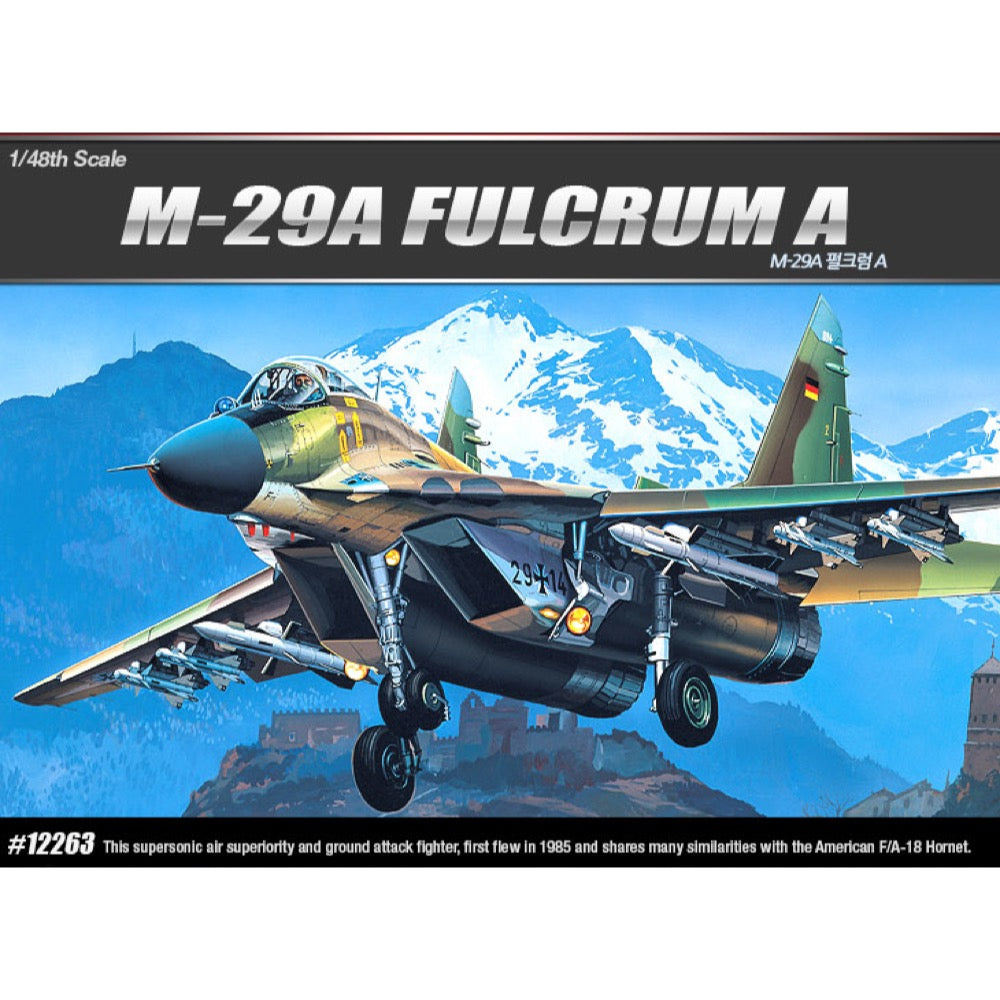
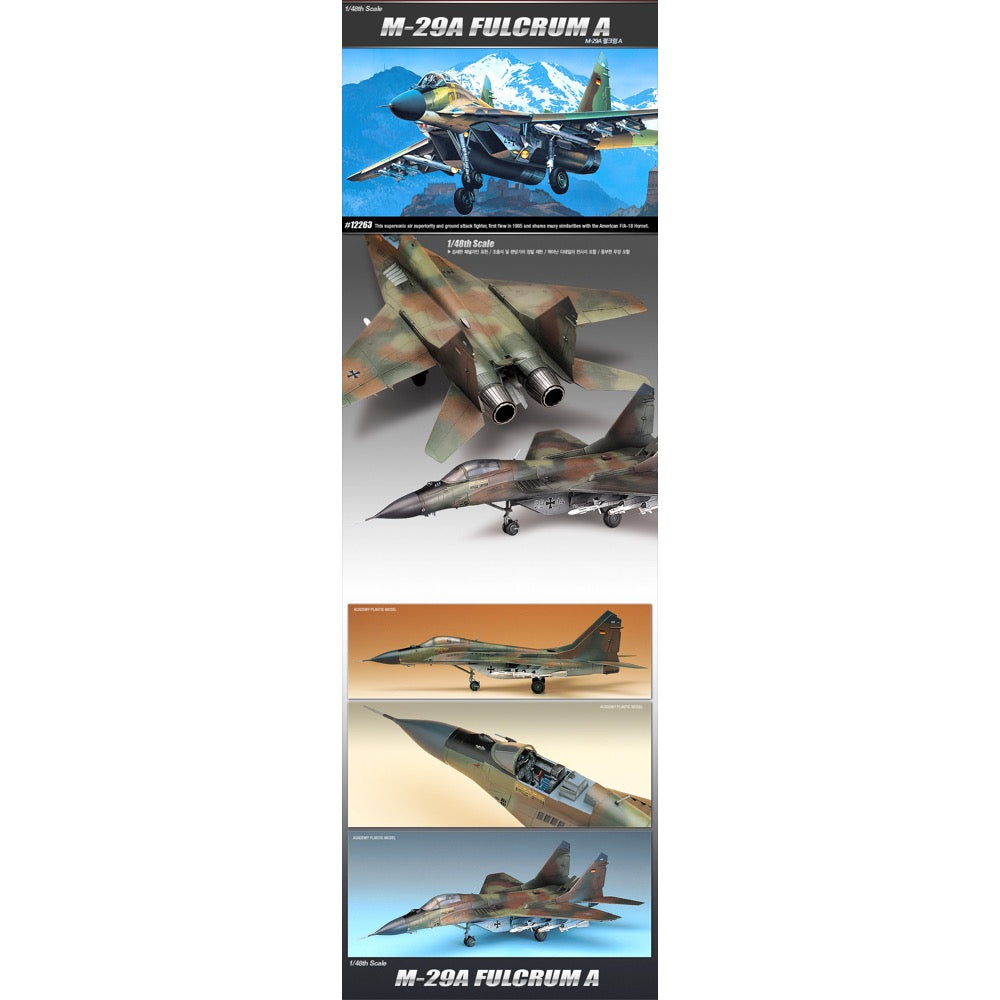
Academy 12263 1/48 M-29A Fu...
$39.95
Academy's very nice MiG-29A, widely regarded as the best kit of this aircraft in 1/48 scale.
Features
Detailed cockpit
Full weapons load and optional position FOD screens and airbrakes.
Markings are given for 1 aircraft each of the East German Air Force and post-reunification German Luftwaffe.


ACADEMY
Academy 12259 1/48 F-16A/C ...
$38.95
This Academy 12259 F-16A/C Fighting Falcon 1/48 model kit is a great way to experience the remarkable design and power of the iconic American multirole jet fighter. A superb dogfighter, the F-16 has been a success on the export market and has been produced for over 4,000 customers since 1976. This model kit features the classic F-16 bubble canopy, side-mounted control stick, and reclined pilot seat. Now you can enjoy the F-16's unmatched versatility and performance in model form.


ACADEMY
Academy 12248 1/48 Mirage I...
$19.95
The Dassault Mirage III / 5/50 is a French single-engine fighter-attack aircraft with a delta-shaped lobe, without horizontal tail. In late 1955, Dassault began building a single prototype that retained the delta wing and an enlarged fuselage that could accommodate one SNECMA Atar 101G1 engine. The resulting Mirage III-001 was flown on November 17, 1956, to reach a flight speed of 1.52Ma after just two months. Technical data (version IIIC): length: 14.77m, wingspan: 8.22m, height: 4.25m, maximum speed: 2.2Ma, climb speed: 83m / s, maximum range (with additional tanks): 4000km, maximum ceiling 17000m, equipment: fixed - two 30mm DEFA 552 cannons, suspended (Mirage 5) - up to 4200 kg of cargo.
Features
Fully engraved panel lines and rivet details
Highly detailed cockpit interior and landing gear
Authentic French Air Force Marking included
1:48 scale plastic model kit from Academy, requires paint and glue.


ACADEMY
Academy 12235 1/48 Tomahawk...
$ PRICE IN PROGRESS!
The Curtiss P-40 Warhawk is an American, single-engine, metal-framed, low-wing fighter-attack aircraft with a classic tail. The prototype first flew in 1938, and serial production took place in 1938-1944. The last of the Hawk family, the Curtiss P-40 Warhawk, was, apart from the Republic P-47 and North American P-51 Mustang, the most widely built American fighter. By the time production ended in December 1944, the number of aircraft had exceeded 15,000. The development of the design began in 1937, when the prototype airframe of version 75 was adapted to accommodate the Allison V-1710-11 inline engine with a power of 1,167 HP. The aircraft became the first American design capable of flying at a speed of over 483 km/h. The version for the RAF was called the Tomahawk Mk IIA. The aircraft had self-sealing fuel tanks and two 7.7mm machine guns mounted in the wing. The Tomahawk MkIIB had American radio equipment and were armed with six 7.7mm machine guns. Some American P-40s were modernized in 1941 for reconnaissance duties. They received the designation RP-40. At the same time, work was underway at Curtiss on the conversion of the Hawk 81-A. The changes included the installation of an Allison V-1710-39 engine with 1,167 hp, providing constant power to an altitude of 3,563 meters, adaptation to the installation of four 12.7mm machine guns in the wing and the installation of an under-fuselage unit that could be used to carry one 227 kg bomb or a jettisonable additional fuel tank. The US Army placed an order for these aircraft in September 1940, assigning them the designation P-40D. Over the next three years, Curtiss made every effort to expand the P-40's capabilities, creating numerous new versions of the aircraft. Despite these efforts, the Warhawk's performance was lower than that of contemporary Allied and Axis fighters. Technical data (P-40E version): length: 9.66 m, wingspan: 11.38 m, height: 3.76 m, maximum speed: 580 km/h, rate of climb: 11 m/s, maximum range: 1100 km, practical ceiling: 8800 m, armament: fixed - 6 M2 machine guns, caliber 12.7 mm, underslung - up to 900 kg of payload.
Limited reissue of the Academy 1/48 scale Tomahawk IIb kit with markings for four RAF aircraft used in North Africa: one flown by Pilot Officer Jack Bartle of 112 Sqdn., one flown by Flight Lieutenant Clive Caldwell and two flown by Pilot Officer Neville Duke.
This is an injection-plastic aircraft model kit.
ACADEMY
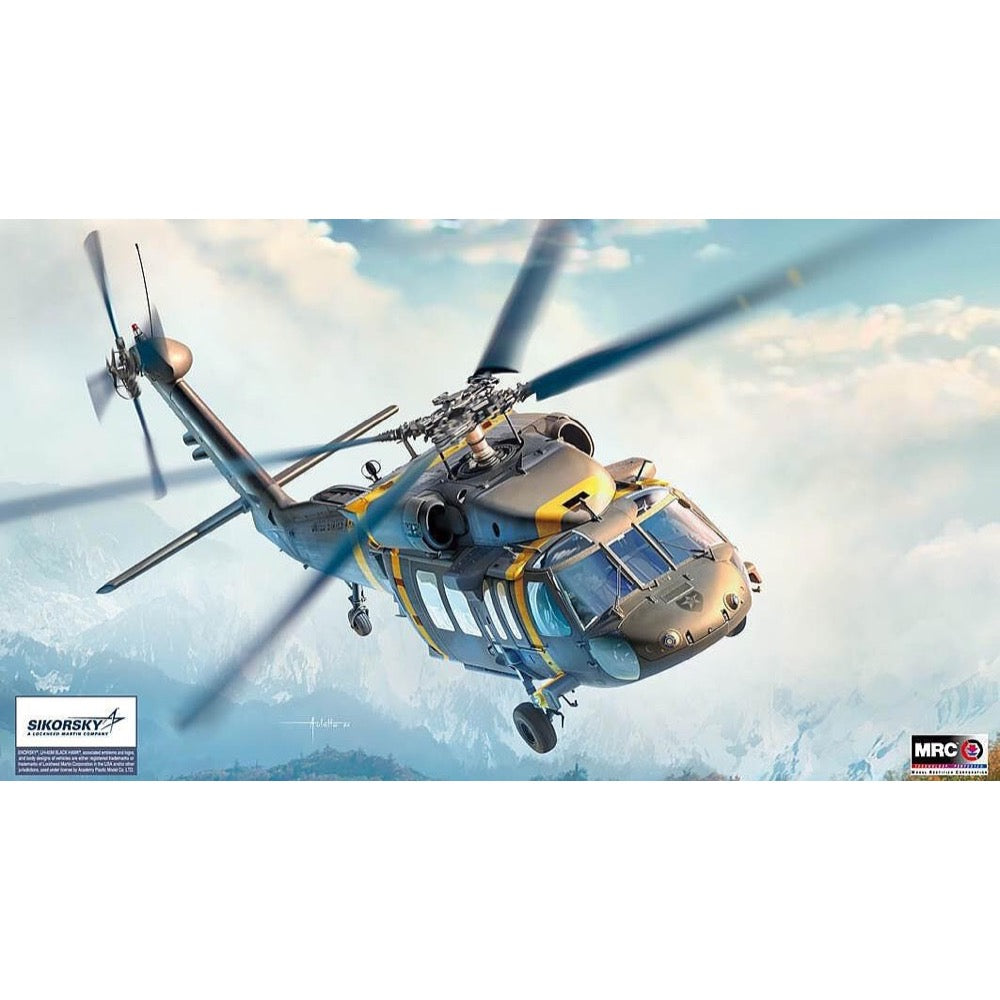
Academy 12135 1/35 Sikorsky...
$84.95
Upgraded variant of the Sikorsky UH-60 Black Hawk utility helicopter used primarily by the U.S. Army and allied forces. Features include more powerful T700-GE-701D engines for improved performance, new rotor blades for increased lift and efficiency, enhanced avionics including a glass cockpit with digital flight control system, improved durability and survivability features. The UH-60M is designed for a variety of missions including troop transport, medevac, combat support, and disaster relief.Updated MRC tooling including new main rotor blade, Radar Warning Receiver (RWR), chaff and flares, M-type engine nozzle device, new cockpit instrument panel.
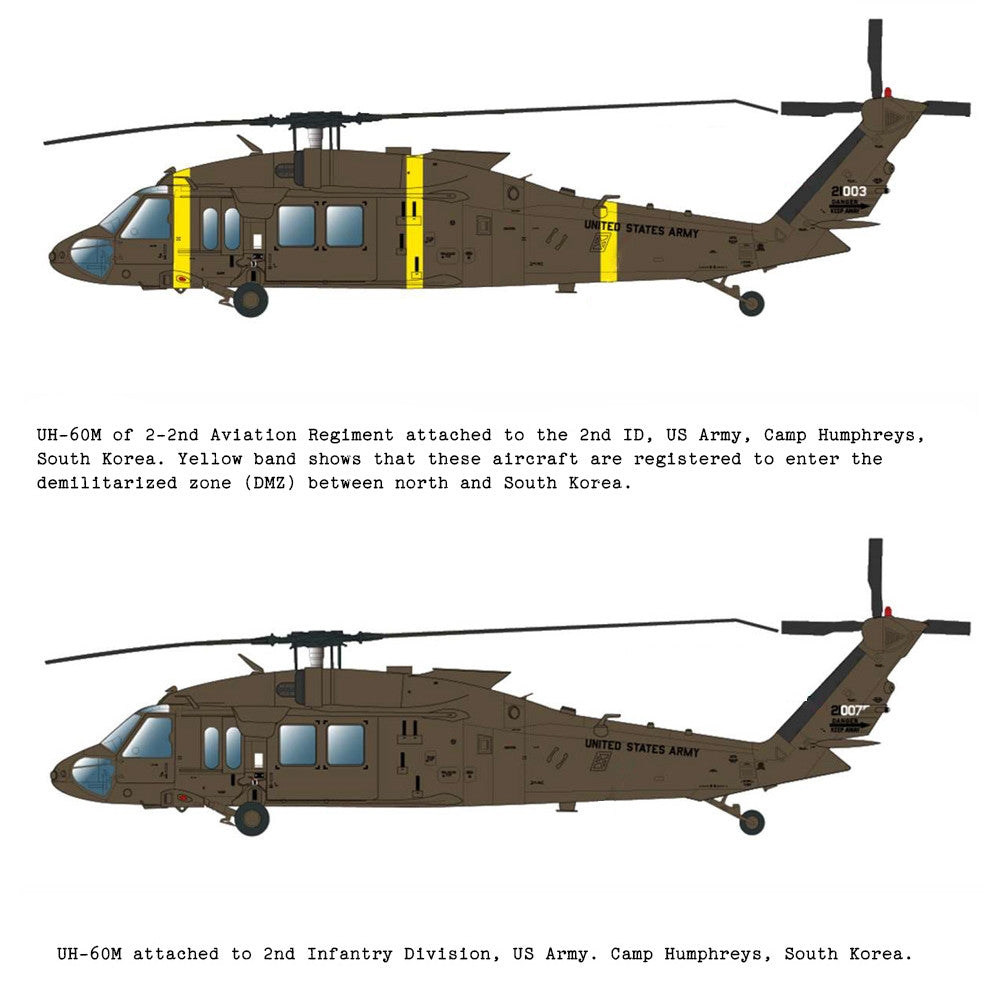
Markings for 5 aircraft: (1) US Army UH-60M of 2–2nd AVN, 2nd ID, Camp Humphreys, South Korea. Yellow band shows aircraft is registered to enter Demilitarized Zone (DMZ) between North and South Korea, with armaments removed; (2) US Army UH-60M of 2–2nd AVN, 2nd ID, Camp Humphreys, South Korea; (3) US Army UH-60M of B Company "Jokers", 3–227th AHB, 1st Cavalry Division, Fort Cavazos, Texas; (4) US Army UH-60M of 3–1 AHB, 1st UD; (5) Australian Army UH-60M, one of 40 aircraft (A60–001–040) arriving since 2023.
ACADEMY
Academy 12133 1/32 USAF F-4...
$147.95
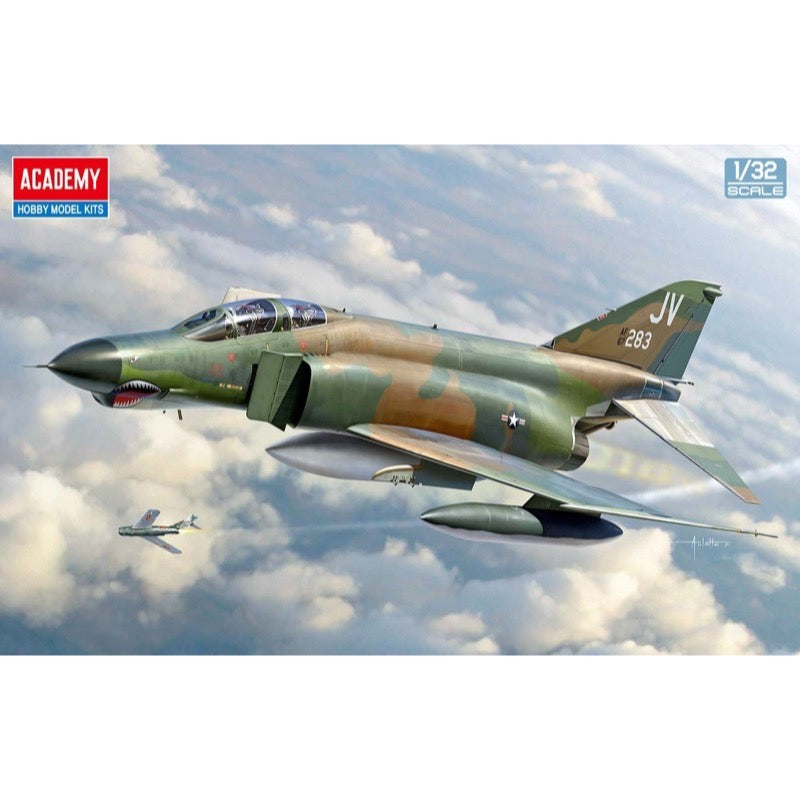
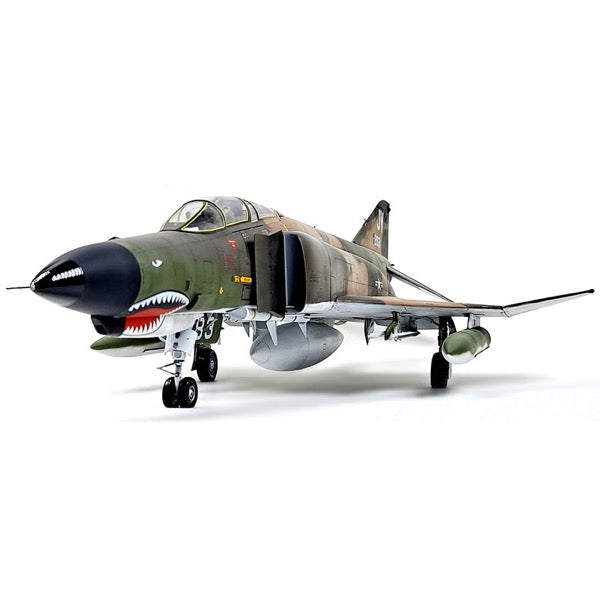
4E Phantom II is here at last! This precisely molded kit expresses each panel line and rivet, with a highly detailed cockpit and landing gear as well. Decals for seven different versions are included, too.
Features
Accurately detailed cockpit and landing gear
Various air-to-air weapons
Some metal parts
Contains seven marking options including USAF, ROKAF, and JASDF
Highly detailed TISEO and various antennas
Includes
7 markings options:
USAF The 388th TFW 469th TFS F-4E "Iceman 03' 67-0283 1972
USAF The 388th TFW 469th TFS F-4E 67-0283 1970's
ROKAF F-4E 67-0283 1970's
USAF The 52nd TFW 480th TFS F-4E 74-1645 1986
USAF The 51st CW(T) F-4E 68-0453 DAEGU AB 1980's
JASDF The 6th Air Wing 303rd SQ F-4EJ 47-8335, mid 1980's
JASDF The 6th Air Wing 303rd SQ F-4EJ 37-8313, mid 1980's


ACADEMY
Academy 12129 1/35 AH-64A A...
$60.95
$69.99
The McDonnell-Douglas (Boeing) AH-64 helicopter was selected as the winner in the competition with Bell's YAH-63 in December 1976. The name Apache stuck to the helicopter in 1981. This highly efficient machine has four-blade rotors driven by two General Electric T700-701 turbine engines with a capacity of 1696HP. The vestigial wings are fitted with conventional trailing edge flaps, and a plate tail improves longitudinal steering. The two-man crew takes seats one after the other in the armored cabin. The pilot's seat is in the rear, and the weapon operator / gunner is in the front. The key to the universal use of the helicopter are the TADS systems on the gunner's stand and the PNVS systems used by the pilot. The TADS is a target-tracking laser marker and rangefinder set and a forward-facing infrared sensor that is duplicated by the normal optics. The PNVS system is a developed FLIR system that allows you to pilot a helicopter just above the ground in order to prevent or delay detection by the enemy's anti-aircraft defense. Apache helicopters took part in the operation in Panama in 1989, during the Desert Storm in 1991, or the last conflict in Iraq (2003). At the end of 1990, the construction of a new version of the helicopter began, equipped with a Martin / Westinghouse Longbow millimeter radar installed above the head to control the weapons. It is used to control the Rockwell AGM-114 Hellfire anti-tank missiles. Technical data: Top speed: 300 km / h; climb speed 12.7 m / s, maximum range (without external tanks): 689 km, armament: 30mm Hughes M230A1 Chain Gun fixed-1 cannon, and outboard armaments - most often Hellfire missiles.
The AH-64A Apache is an attack helicopter that has been deployed by the U.S. Army since 1984. This model kit precisely reproduces the M261 rocket pod, the AGM-114 anti-tank missile, the rugged form equipped with a 30mm chain gun, and the front and rear tandem cockpit. Two kinds of decals are included -- the 59th Air Command 1st Battalion, and the 151st Air Regiment, belonging to South Carolina ANG (State Army( dispatched to Iraq.
Features
Highly detailed cockpit with pilot & co-pilot seats
Fully engraved panel lines and embossed rivets
M261 rocket pods, AGM-114 ATGMs and 30mm chain gun included
ACADEMY
Academy 12120 1/35 MH-60S H...
$99.95
$119.99
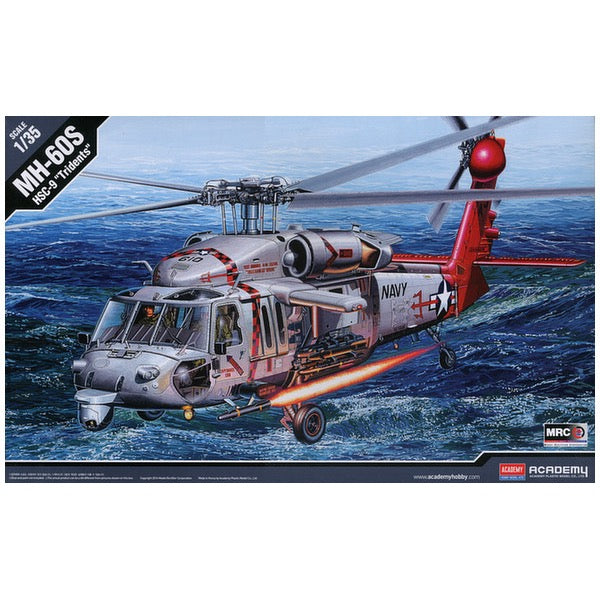
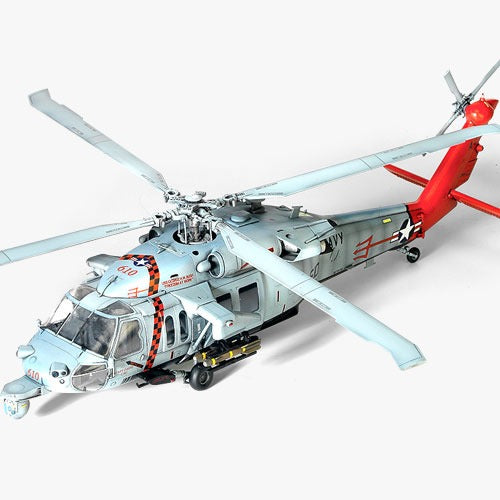
From Academy, this is a highly detailed model kit of the MH-60S HSC-9 "Tridents" in 1/35 scale. The completed model measures about 482mm long. It features extensive cockpit detailing, as well as a detailed jet engine and rotor assembly. The kit includes parts for a M261 19-tube Rocket Launcher and AGM-114 Hellfire. Also included are clear parts and decals. Parts come molded in gray.
This is an injection-plastic aircraft model kit.
ACADEMY
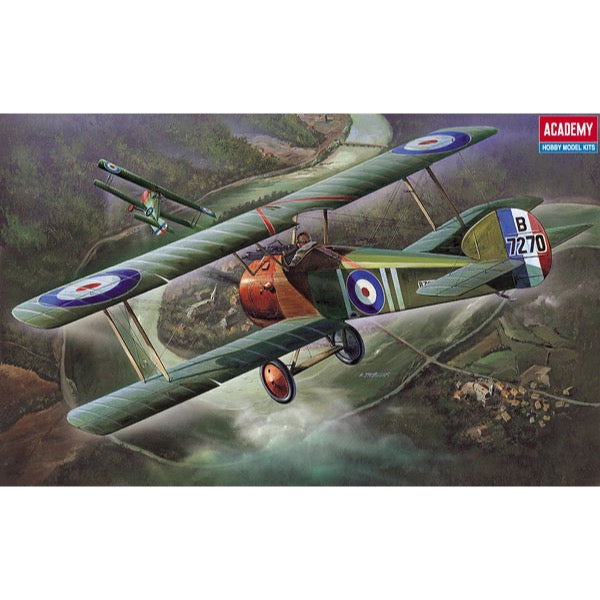
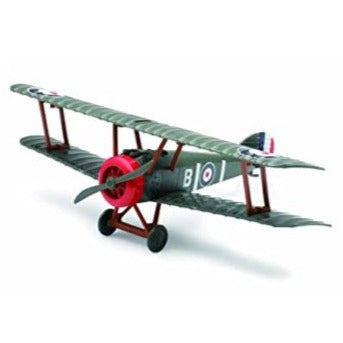
Academy 12109 1/32 Sopwith ...
$28.95
The Sopwith Camel was a British First World War single-seat biplane fighter aircraft that was introduced on the Western Front in 1917. It was developed by the Sopwith Aviation Company as a successor to the Sopwith Pup and became one of the best known fighter aircraft of the Great War.
Features
Medium grey plastic pieces moulded to sprue trees.
Single seat cockpit.
Recessed panel lines give authentic look.
Detailed cockpit and landing gear.
Detailed engine compartment. Detailed pictorial instructions.
Marking Options
One decal sheet with markings for two aircraft: 1: Sopwith Camel F.1, Capt. A.R. Brown, No. 209 Squadron, RAF, May 1918. 2: Sopwith Camel F.1, No. 43 Squadron, RAF, mid-1918