
Reset


ACADEMY
Academy 12484 1/72 Spitfire...
$15.95
Supermarine Spitfire is probably the most famous British fighter from the Second World War. It was an all-metal machine with a low wing configuration, characteristic elliptical wings, a classic tail and a retractable landing gear. The prototype flight took place on March 5, 1936. The Spitfire proved to be the RAF's staple of the war, which continued to do well after the war, remaining in production for 10 years. Technical data (Mk.XIV version): length: 9.14m, wingspan: 11.23m, height: 3.05m, maximum speed: 717km / h, rate of climb: 18.5m / s, practical ceiling: 13,200m, range maximum: 1815 km, armament: fixed - 4 7.7mm machine guns and 2 20mm Hispano Mk II cannons, suspended - up to 225 kg of bombs.
This is an injection-plastic jet aircraft model kit.

ACADEMY
Academy 12485 1/72 P-51D Mu...
$15.95
The North American P-51 Mustang is an American, single-engine, long-range fighter and attack aircraft with a classic tail and all-metal construction. The flight of the prototype took place on October 26, 1940. The P-51 Mustang has earned a reputation as one of the best, if not the best, WWII fighter. Replacing the Allison V-1710-39 engine from the first project with a Rolls-Royce Merlin motor (P-51 Mustang Mk.Ia version) made the Mustang, like never before, reached perfection. Technical data (P-51D version): length: 9.83m, wingspan: 11.28m, height: 4.08m, maximum speed: 703km / h, rate of climb: 16.3m / s, maximum range: 2755km, ceiling practical: 12800m, armament: fixed - 6 12.7mm M2 machine guns, suspended - up to 908 kg of bombs or 10 127mm HVAR rocket launchers.
This is an injection-plastic jet aircraft model kit.


ACADEMY
Academy 12487 1/72 PBY-5A C...
$38.95
In October 1933, the US Navy placed an order with Consolidated and Douglas for prototypes of new machines. The prototype constructed by Consolidated, designated XP3Y-1, became a flying boat built in the largest number of copies. Technical data (PBY-5A version): length: 19.46m, wingspan: 31.7m, height: 6.15m, maximum speed: 314km / h, rate of climb: 5.1m / s, practical ceiling: 4000m, range maximum: 4050 km, armament: fixed - 3 machine guns caliber 7.62 mm and 2 machine guns caliber 12.7 mm, suspended - up to 1814 kg of bombs.
This is an injection-plastic jet aircraft model kit.


ACADEMY
Academy 12488 1/72 AH-64A A...
$15.95
The McDonnell-Douglas (Boeing) AH-64 helicopter was selected as the winner in the competition with Bell's YAH-63 in December 1976. The name Apache stuck to the helicopter in 1981. This highly efficient machine has four-blade rotors driven by two General Electric T700-701 turbine engines with a capacity of 1696HP. The vestigial wings are fitted with conventional trailing edge flaps, and a plate tail improves longitudinal steering. The two-man crew takes seats one after the other in the armored cabin. The pilot's seat is in the rear, and the weapon operator / gunner is in the front. The key to the universal use of the helicopter are the TADS systems on the gunner's stand and the PNVS systems used by the pilot. The TADS is a target-tracking laser marker and rangefinder set and a forward-facing infrared sensor that is duplicated by the normal optics. The PNVS system is a developed FLIR system that allows you to pilot a helicopter just above the ground in order to prevent or delay detection by the enemy's anti-aircraft defense. Apache helicopters took part in the operation in Panama in 1989, during the Desert Storm in 1991, or the last conflict in Iraq (2003). At the end of 1990, the construction of a new version of the helicopter began, equipped with a Martin / Westinghouse Longbow millimeter radar installed above the head to control the weapons. It is used to control the Rockwell AGM-114 Hellfire anti-tank missiles. Technical data: Top speed: 300 km / h; climb speed 12.7 m / s, maximum range (without external tanks): 689 km, armament: 30mm Hughes M230A1 Chain Gun fixed-1 cannon, and outboard armaments - most often Hellfire missiles.
This is an injection-plastic aircraft model kit.


ACADEMY
Academy 12491 1/72 P-47D "B...
$18.95
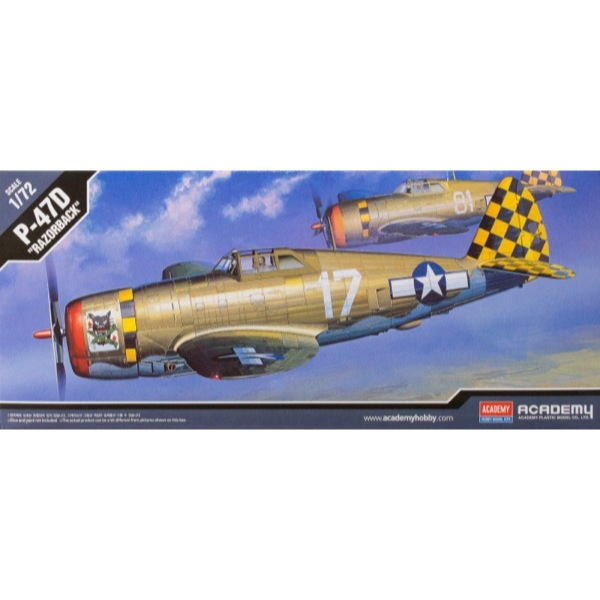
The Republic P-47 Thunderbolt is an American, single-engine fighter and fighter-attack aircraft, built in a low wing configuration with a classic tail. Considered one of the best American fighters of World War II. The flight of the prototype took place in 1941, and serial production continued in the years 1942-1945. The P-47 can be described as the workhorse of the US Air Force in both Europe and the Pacific. Although the 2000HP R-2800 Double Wasp engine, turbine and exhaust system made the plane very large and heavy, it was not a barrier to achieving great performance. The usefulness of the machine was so great that it was used both for bomber escorts and for bombing missions with the P-47 in the lead role. The P-47 class is evidenced by the sheer number of aircraft produced. There were 15660 of them, and as many as 12602 in the D specification, which is an absolute record when it comes to the number of fighters produced in one version. Another common version was the P-47N, with changed wings, larger fuel tanks, and a more powerful engine. It was used both as a fighter and an assault machine. Even after World War II, the Thunderbolt was one of the most popular American fighters until the early 1950s. Technical data (P-47D version): length: 11m, wingspan: 12.42m, height: 4.47m, maximum speed: 697km / h, rate of climb: 15.9m / s, maximum range: 2900km, practical ceiling: 13,100m, armament: fixed - 8 12.7mm M2 machine guns, suspended - up to 1100 kg of bombs or unguided missiles.
This is an injection-plastic jet aircraft model kit.
ACADEMY
Academy 12492 1/72 P-47D "R...
$20.95
The Republic P-47 Thunderbolt is an American, single-engine fighter and fighter-attack aircraft, built in a low wing configuration with a classic tail. Considered one of the best American fighters of World War II. The flight of the prototype took place in 1941, and serial production continued in the years 1942-1945. Technical data (P-47D version): length: 11m, wingspan: 12.42m, height: 4.47m, maximum speed: 697km / h, rate of climb: 15.9m / s, maximum range: 2900km, practical ceiling: 13,100m, armament: fixed - 8 12.7mm M2 machine guns, suspended - up to 1100 kg of bombs or unguided missiles.
This is an injection-plastic jet aircraft model kit.


ACADEMY
Academy 12493 1/72 Zero Fig...
$18.95
The Mitsubishi A6M Reisen (also known as Zero or Zeke) is a Japanese single-engine, full-metal low-wing fighter aircraft from the Second World War. The flight of the prototype took place on April 1, 1939, and it was put into service in the summer of 1940. Technical data (A6M2 model 21 version): length: 9.06m, wingspan: 12m, height: 3.05m, maximum speed: 533km / h, rate of climb: 15.7m / s, maximum range: 3105km, maximum ceiling 10000m , armament: fixed - 2 20mm Type 99-1 cannons and 2 7.7mm Type 97 machine guns, suspended - up to 250 kg of bombs.
This is an injection-plastic jet aircraft model kit.


ACADEMY
Academy 12495 1/72 B-17F "M...
$47.95
In May 1934, the US Army published the conditions with which it should meet the modern multi-engine bomber it needed. It was required that it could take up to 907 kg of bombs on a route from 1640 to 3540 km, while maintaining a speed of 322 to 402 km / h. While, according to the US Army, the term multi-engine meant that there should be more than one engines, Boeing invited to present its concept adopted the use of four engines for the Boeing 299 (later designated B-17). Work on the machine began in mid-June 1934. On July 28, 1935, the Boeing 299 took off for its first flight. Technical data (for the B-17G): Maximum speed: 510 km / h, practical ceiling: 10,670 m, operating radius: 1,760 km, armament: fixed - 13 machine guns cal. 12.7 mm, suspended - up to 5800 kg, normally - 2742 kg bombs.
This is an injection-plastic jet aircraft model kit.
ACADEMY
Academy 12506 1/72 F-15C Eagle
$43.99
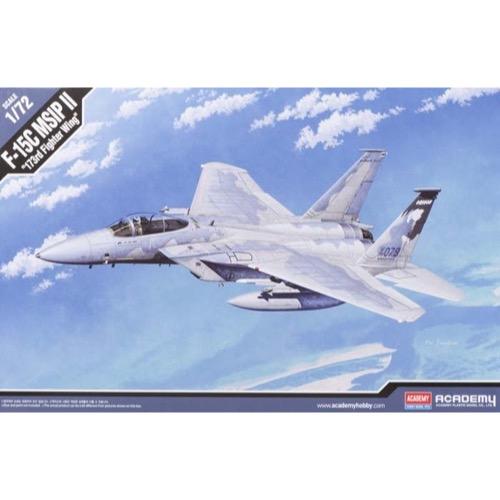
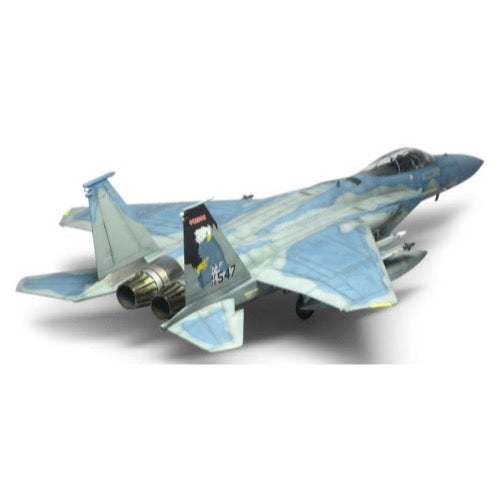
The McDonnell Douglas F-15 Eagle is an American twin-engine fighter and attack aircraft, the first flight of which took place on July 27, 1972. The F-15 aircraft is the result of the experience gained from air combat over Vietnam, and is also the USAAF's response to the Soviet Mig-23 and Mig-25 fighters. It was created as part of the FX (Fighter Experimental) project, in which the winner was McDonnell-Douglas in 1969. Technical data (version E): Maximum speed: 2660 km / h, climb speed: 255 m / s, practical ceiling 19500 m, maximum range: 5580 km, armament: fixed - 1 six-barrel M61A-1 20mm cannon, suspended - up to 10660kg load.
Molded in gray, it includes fully detailed exhaust cones, "Turkey Feathers", additional new parts such as the AIM-9X, AIM-120C, several antennas, and fuel tank, as well others parts and three marking options.
This is an injection-plastic jet aircraft model kit.


ACADEMY
Academy 12507 1/72 F-35A Li...
$39.95
The Lockheed Martin F-35 Lightning II is a single-seat, single-engine multirole fighter built by Lockheed Martin as a fifth-generation aircraft to meet the needs of the USAAF, US Navy, US Army and US Marine Corps. The aircraft was originally designated X-35 JSF, but in 2006 it was changed to F-35 Lightning II. Despite the fact that the main recipient will be the US government, the project is also co-financed by other countries, especially Great Britain, Italy and the Netherlands. The main contractors are the following companies: Lockheed Martin, Northrop Grumman and BAE Systems. The overriding goal of the JSF idea is to create a universal aircraft, manufactured for all types of armed forces, which will allow for far-reaching standardization of spare parts and a significant reduction in costs. Ultimately, three versions of the F-35 (A, B and C) are to be created, which will have more than three quarters of identical components. The main task of the F-35 of all versions is to attack land targets, fulfill the tasks of a combat aircraft, air combat and electronic warfare. It should be noted that the F-35 is created with low-intensity conflicts in mind, unlike its larger "relative" F-22. Which does not change the fact that thanks to the power unit used (Pratt-Whitney F135 engines), avionics and stealth properties, it is one of the most modern multi-role aircraft in the world. The first serial F-35 was created in February 2006. To date (2013), 63 aircraft of this type have been created. Technical data (version F-35A): Maximum speed: 1930 km/h, maximum ceiling 18288 m, maximum range: 2220 km, armament: fixed - one four-barrel General Dynamics GAU-22/A 25mm cannon, underslung - up to 8100 kg of payload.


ACADEMY
Academy 12514 1/72 AH-64D B...
$42.95
$49.99
The McDonnell-Douglas (Boeing) AH-64 helicopter was selected as the winner in the competition with Bell's YAH-63 in December 1976. The name Apache stuck to the helicopter in 1981. This highly efficient machine has four-blade rotors driven by two General Electric T700-701 turbine engines with a capacity of 1696HP. The vestigial wings are fitted with conventional trailing edge flaps, and a plate tail improves longitudinal steering. The two-man crew takes seats one after the other in the armored cabin. The pilot's seat is in the rear, and the weapon operator / gunner is in the front. The key to the universal use of the helicopter are the TADS systems on the gunner's stand and the PNVS systems used by the pilot. The TADS is a target-tracking laser marker and rangefinder set and a forward-facing infrared sensor that is duplicated by the normal optics. The PNVS system is a developed FLIR system that allows you to pilot a helicopter just above the ground in order to prevent or delay detection by the enemy's anti-aircraft defense. Apache helicopters took part in the operation in Panama in 1989, during the Desert Storm in 1991, or the last conflict in Iraq (2003). At the end of 1990, the construction of a new version of the helicopter began, equipped with a Martin / Westinghouse Longbow millimeter radar installed above the head to control the weapons. It is used to control the Rockwell AGM-114 Hellfire anti-tank missiles. Technical data: Top speed: 300 km / h; climb speed 12.7 m / s, maximum range (without external tanks): 689 km, armament: 30mm Hughes M230A1 Chain Gun fixed-1 cannon, and outboard armaments - most often Hellfire missiles.
This is an injection-plastic aircraft model kit.
ACADEMY
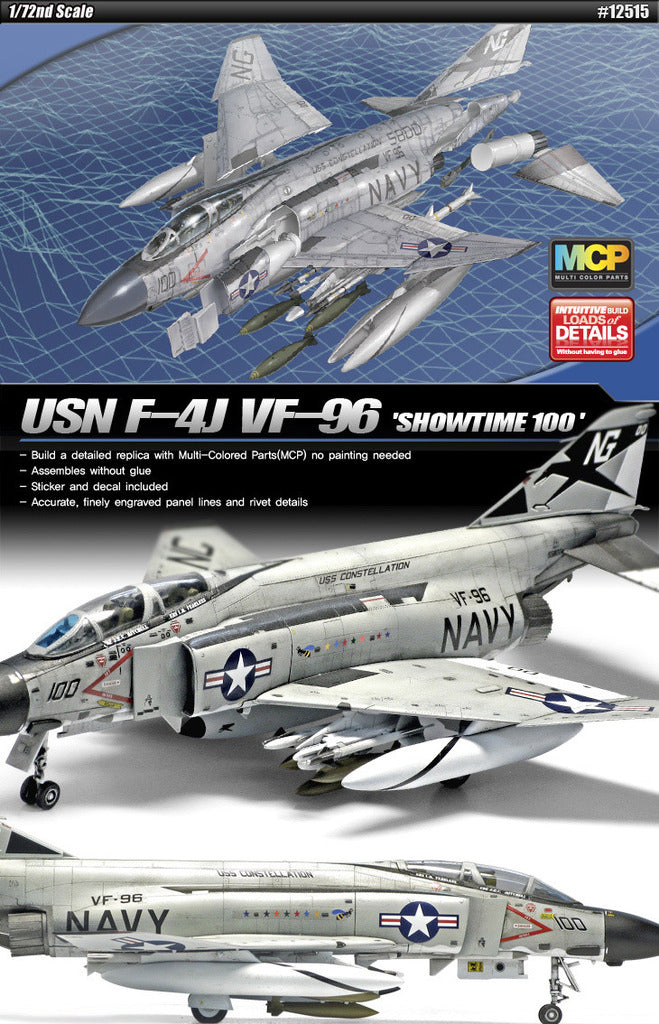
Academy 12515 1/72 F-4J Pha...
$59.99
$64.99
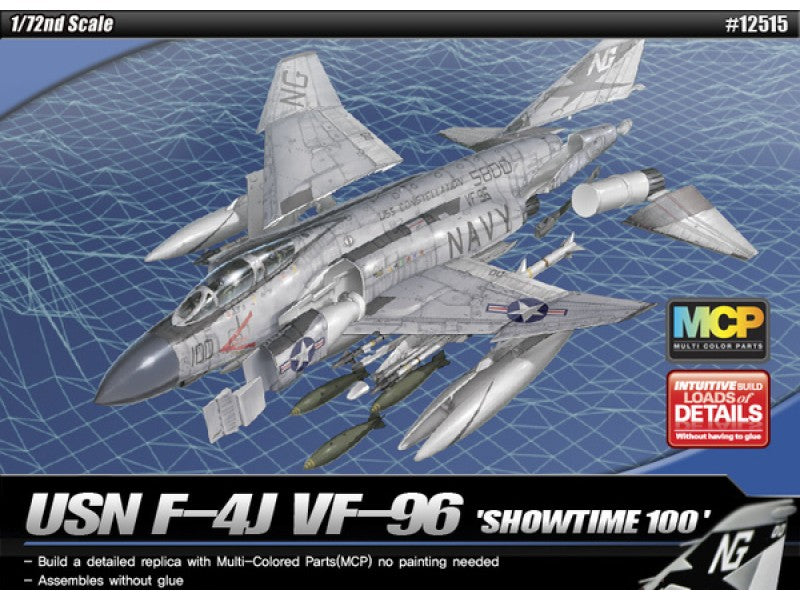
The McDonnell Douglas F-4 Phantom II is a tandem two-seat, twin-engine, all-weather, long-range supersonic jet interceptor and fighter-bomber originally developed by McDonnell Aircraft for the United States Navy. Proving highly adaptable, it first entered service with the Navy in 1961 before it was adopted by the United States Marine Corps and the United States Air Force. By the mid-1960s, it had become a significant part of their air arms. Phantom production ran from 1958 to 1981 with 5,195 aircraft built, making it the most produced American supersonic military aircraft in history and cementing its position as an iconic combat aircraft of the Cold War.
This is an injection-plastic jet aircraft model kit.


ACADEMY
Academy 12517 1/72 USAAF B-...
$82.95
$99.99
The outbreak of World War II made USAAF strategists realize that they should focus on long-range bomber projects identified as VHB (Very Heavy Bomber). When it turned out that such a plane could also be used over the Pacific, the designation VLR (Very Long Range) seemed more appropriate. Such a project was launched in early 1940 by General Henry Arnold. Study projects were presented by: Boeing, Consolidated, Douglas and Lockheed. Technical data: Maximum speed: 575 km / h, practical ceiling 9144 m, operational range: 5230 km, armament: fixed - most often 11 Browning 12.7mm machine guns. suspended - up to 9072 kg of bombs.
This is an injection-plastic jet aircraft model kit.

ACADEMY
Academy 12519 1/72 ROKAF T-...
$20.95
$25.59
The KAI T-50 Golden Eagle is a modern South Korean training and combat aircraft. The prototype flight took place in 2002. Three years later, the machine entered the line in the South Korean Air Force (ROKAF) and remains in it today. In total, about 130-140 copies of this aircraft were built. The drive is provided by a single motor General Electric F404 turbojet . The aircraft has a maximum speed of 1.5 Ma and a maximum range of 1,850 kilometers. The deck armament is a single 20mm General Dynamics A-50 cannon.
The T-50 advanced trainer aircraft, developed by Korea with technical assistance from Lockheed Martin, is now available. The product is a snap kit with a small number of parts and can be assembled without using adhesives. It is composed of multiple molding colors (MCP/multi-color parts), so it can be completed as an image model without painting. Includes a stand ideal for displaying the model in flight.
This is an injection-plastic jet aircraft model kit.

ACADEMY
Academy 12520 1/72 USMC F/A...
$40.95
McDonnell-Douglas / Northrop F / A-18 Hornet is an on-board fighter and attack aircraft capable of operating in all weather conditions. The roots of the F / A-18 go back to 1974 and the F-17 prototype, which was of interest to the US Navy command this year. The contract for the serial construction of the aircraft was concluded in 1976. In order to accelerate the work, the Northrop concern entered into cooperation with the McDonnell-Douglas concern. As a result, on November 18, 1978, the test flight of the prototype took place, and a year later, successful landings on the aircraft carrier. Since 1982, the aircraft has been delivered to linear units with General Electric F404-GE-402 engines as the propulsion unit. The plane is produced in several versions. The first were the F-18A (fighter) and F-18B (training). Foreign orders from Spain, Canada and Australia appeared quickly. In 1987, a version of the F-18C was created, adapted to the use of AMRAAM missiles. A year later, the F / A-18D, a two-seat version of the F-18, entered service in all weather conditions, and could be used as an attack aircraft. On its basis, the reconnaissance version of the R / F-18D was created. The newest versions (the so-called Super Hornet) -F / A-18E and F / A-18F are very modified versions of the F / A-18D. They are characterized by an increased length of the fuselage, wingspan and their surface. They also have new General Electric F414 engines and a decidedly expanded and modernized avionics. They were presented for the first time in 1995. The EA-18G Growler electronic warfare plane was also created on the basis of the F-18. All versions of the F / A-18 met with favor of pilots, they are characterized by low failure rate, ease of use and very good flight parameters. Hornets took part in the operation against Libya in 1986 and in the Operation Desert Storm in 1991. Technical data (version F / A-18 C): Maximum speed: 1915 km / h, speed of climb: 254 m / s, practical ceiling 15 240 m, maximum range: 3340 km, operating radius: 280-740 km, armament: fixed- Single 20mm M61A-1 six-barrel cannon, underslung - up to 7700 kg of cargo.
This is an injection-plastic jet aircraft model kit.


ACADEMY
Academy 12521 1/72 USN F-8E...
$41.95
The Vought F-8 Crusader was an American in-flight fighter and attacker from the post-war period. The drive, in the F-8E version, was provided by a single engine Pratt and Whitney J57-P-20A with 47.6 kN thrust without afterburner. The first flight of this machine took place in 1955. Its serial production started shortly after. In total, over 1,200 machines of this type were built. The length of the aircraft was 16.53 meters with a wingspan of 10.87 meters. In the F-8E version, the on-board armament consisted of four 20mm Colt Mk.12 cannons. The machine could also take a load of bombs, unguided and guided missiles.
The Vought F-8 Crusader was developed for the US Navy as a successor to the completely unsuccessful Vought F-7U-1 Cutlass. It was characterized by a much more conservative design, but it was also much easier to pilot, operate and operate. Equally important, it also turned out to be significantly less failure-prone than its predecessor. It also had a much better maximum speed (the first serial supersonic deck fighter!), Maneuverability and good take-off and landing characteristics from the deck of an aircraft carrier. In general, a very successful plane was created, which remained in service with the US Navy as a fighter until 1976, and in the French naval aviation - until 1999! In the course of serial production, many versions of this aircraft were created, including: F-8U-1 (first production version), F-8U-2N (night fighter) and F-8E (FN)[wersja dla marynarki francuskiej] . Vought F-8 Crusader aircraft took an active part in several armed conflicts, but were used particularly intensively during the Vietnam War of 1964 / 1965-1975.
Academy brings us their 1/72 USN F-8E VF-162 The Hunters scale model aircraft kit. It features accurately detailed panel lines, rivet details, and cockpit and landing gear detailing. One can assemble the finished piece with the air brakes open or closed. Various weapons are also included, as well as some 'cartograf' premium quality decals.
This is an injection-plastic jet aircraft model kit.
ACADEMY
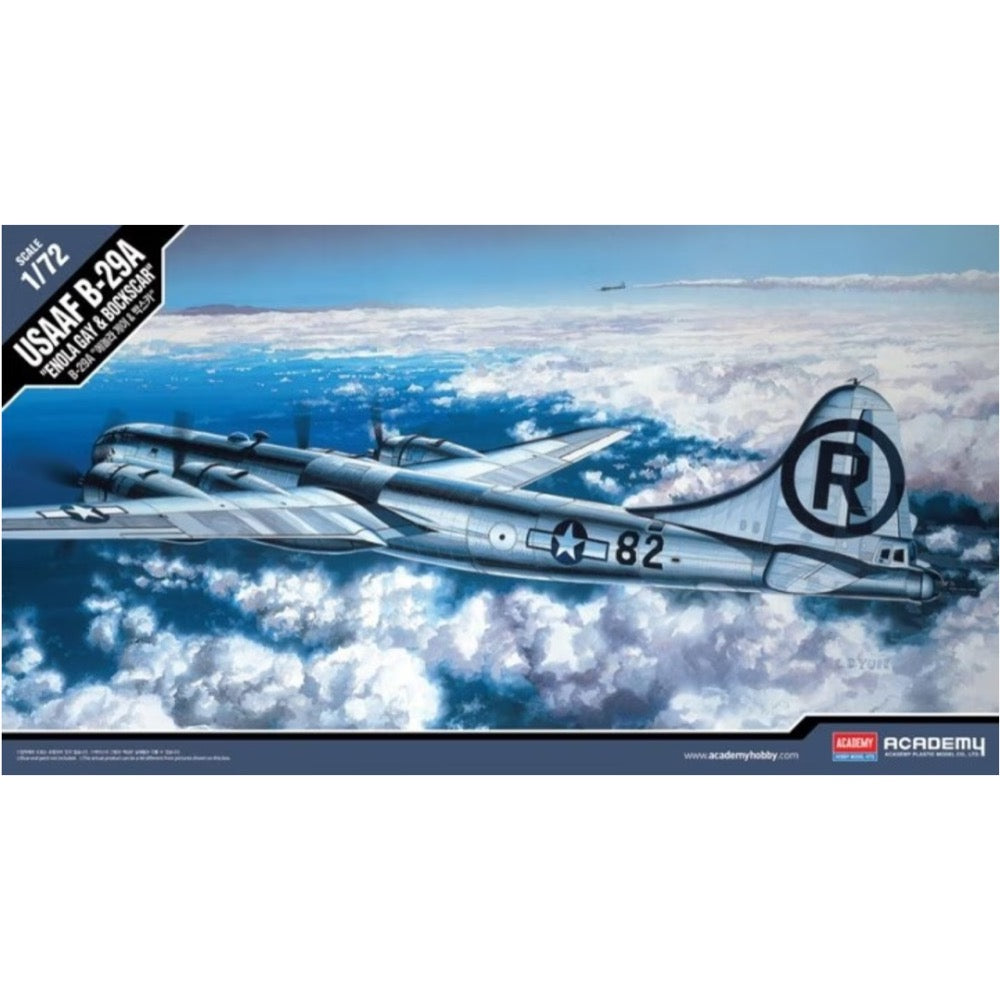
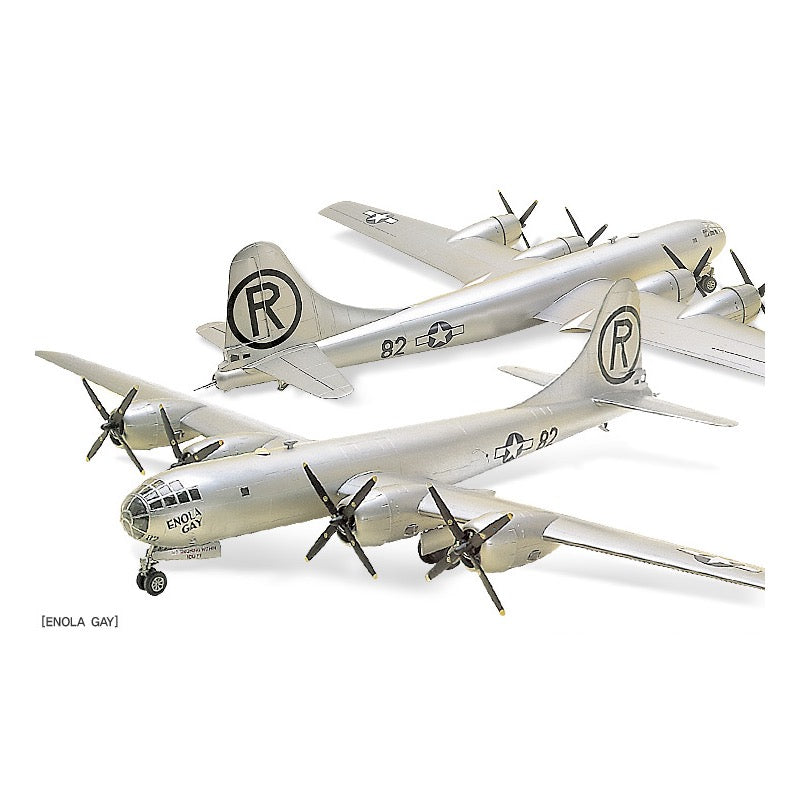
Academy 12528 1/72 B-29A "E...
$64.95
$74.99
The outbreak of World War II made USAAF strategists realize that they should focus on long-range bomber projects identified as VHB (Very Heavy Bomber). When it turned out that such an aircraft could also be used over the Pacific, the designation VLR (Very Long Range) seemed more appropriate. Such a project was launched in early 1940 by General Henry Arnold. Technical data: Maximum speed: 575 km/h, practical ceiling 9144 m, operational range: 5230 km, armament: fixed - most often 11 Browning machine guns caliber 12.7 mm. underslung - up to 9072 kg of bombs.
This is an injection-plastic jet aircraft model kit.


ACADEMY
Academy 12529 1/72 USN F-4J...
$59.99
$64.99
The McDonnell-Douglas F-4 Phantom is a long-range, twin-engine, two-seater multi-role fighter designed for operations in difficult weather conditions. The flight of the prototype took place on May 27, 1958, and serial production began in 1961. Originally, the F-4 was intended only as a stormtrooper, but from 1955 on, the design work went towards meeting the US Navy's need for a new on-board fighter. The F-4 Phantom turned out to be a very successful machine, produced in several versions, exported to many countries and produced under license. The first versions are models from A to D intended for fighter-bombers. The next version is the F-4E, produced since 1967 as a long-range fighter. Reconnaissance versions were also created: RF-4B, RF-4C and RF-4E. The latest versions are the F-4F and F-4G Wild Weassel - these are electronic warfare planes and designed to fight the enemy radars. The F-4 took part in the Vietnam War, the conflicts in the Middle East (1967, 1973) and the Iran-Iraq War (1980-1988). In total, 5,057 F-4 Phantom aircraft were built. Technical data (version F-4E): Maximum speed: 2370 km / h, speed of climb: 210 m / s, maximum ceiling 18300 m, maximum range: 2600 km, armament: fixed - 1 20mm M61A-1 cannon, Suspended - up to 7255 kg of bombs and rockets.
Strike Fighter Squadron 103 (abbreviation VFA-103) is an American in-flight air unit created in May 1952. Currently, the most characteristic hallmark of the VFA-103 aircraft is the pirate flag, in English called Jolly Rogers, on the horizontal stabilizers. It was also the source of the squadron's unofficial name. The first aircraft on which the VFA-103 pilots flew were the FG-1D Corsair. In 1957, the unit was rearmed with the F-8 Crusader, as one of the first in the US Navy. At the turn of 1964/1965, the VFA-103 began to be armed with the new F-4 Phantom machines. In 1983, however, it was rearmed with the new Grumman F-14A Tomcat fighters, armed with AIM-54 Phoenix missiles. Currently, the basic aircraft of the unit is the F / A-18F Super Hornet. Strike Fighter Squadron 103 pilots took an active part in the Vietnam War (1964 / 195-1975) and in both Persian Gulf Wars (1990-1991 and 2003).
This is an injection-plastic jet aircraft model kit.


ACADEMY
Academy 12530 1/72 P-47D & ...
$43.95
The Republic P-47 Thunderbolt is an American, single-engine fighter and fighter-attack aircraft, built in a low wing configuration with a classic tail. Considered one of the best American fighters of World War II. The flight of the prototype took place in 1941, and serial production continued in the years 1942-1945. The P-47 can be described as the workhorse of the US Air Force in both Europe and the Pacific. Although the 2000HP R-2800 Double Wasp engine, turbine and exhaust system made the plane very large and heavy, it was not a barrier to achieving great performance. The F-86 was the first mass-produced fighter capable of exceeding the speed of sound. The North American F-86 Saber was the U.S. primary fighter during the Korean War that was able to compete and successfully fight the Mig-15. It is estimated that the ratio of combat losses of both these machines is 2: 1 in favor of the American machine. Technical data (F-86F version): Maximum speed: 1,106 km / h, climb speed: 45.7 m / s, maximum altitude 15,100 m, maximum range: 2,454 km, armament: fixed - 6 M2 Browning 12 machine guns 7mm sling - up to 2400 kg of bombs and rockets.
This is an injection-plastic jet aircraft model kit.

ACADEMY
Academy 12531 1/72 F-15C MS...
$29.95
The McDonnell Douglas F-15 Eagle is an American twin-engine fighter and attack aircraft, the first flight of which took place on July 27, 1972. The F-15 aircraft is the result of the experience gained from air combat over Vietnam, and is also the USAAF's response to the Soviet Mig-23 and Mig-25 fighters. It was created as part of the FX (Fighter Experimental) project, in which the winner was McDonnell-Douglas in 1969. When designing the F-15, particular emphasis was placed on the maximum reduction of service time. Mainly, on the one hand, it was based on the installation of elements that were as easy to use as possible, and on the other hand, the use of automatic systems, which kind of relieve people. As a result, the successor of the F-4 Phantom, surpassing it in all respects, can be served in half the time. Another strength of the F-15 is the pair of Pratt-Whitney F100 afterburner engines, which produce 4,500 kg more thrust than the machine itself weighs, allowing it to make tight turns without sacrificing great speed. In addition, it makes it possible to suspend a huge amount of additional weapons on 8 knots under the wings and fuselage. From the moment the F-15 entered service, several variants were created. The C and D versions are the second generation of single and double seater aircraft, respectively, replacing the A and B versions in 1979. Externally, they do not differ much from them, but the avionics underwent a comprehensive modification, which made the Eagle even more lethal weapon. In the 1980s, the F-15D also experimented with ASAT anti-satellite missiles. A version of the F15-E Strike Eagle was being developed at the same time. Contrary to the previous models, the E version is not only a hunting machine used for air superiority, but also an assault machine with a wide range of possibilities for attacks on ground targets. The E version entered service in 1988 and is expected to remain in the line until 2035. Another variant is the F-15J, exported and produced under license in Japan. F-15 aircraft were exported to several countries, including Japan, Israel, Saudi Arabia and South Korea. The F-15 turned out to be a very valuable machine, achieving air victories, among others. during Operation Desert Storm and the 2003 invasion of Iraq. Technical data (version E): Maximum speed: 2660 km / h, climb speed: 255 m / s, practical ceiling 19500 m, maximum range: 5580 km, armament: fixed - 1 six-barrel M61A-1 20mm cannon, suspended - up to 10660kg load.
This is an injection-plastic jet aircraft model kit.


ACADEMY
Academy 12533 1/72 USAAF B-...
$64.99
$69.99
In May 1934, the US Army published the conditions with which it should meet the modern multi-engine bomber it needed. It was required that it could take up to 907 kg of bombs on a route from 1640 to 3540 km, while maintaining a speed of 322 to 402 km / h. While, according to the US Army, the term multi-engine meant that there should be more than one engines, Boeing invited to present its concept adopted the use of four engines for the Boeing 299 (later designated B-17). Work on the machine began in mid-June 1934. On July 28, 1935, the Boeing 299 took off for its first flight. It took place on a 3,380 km route with an average speed of 406 km / h. Technical data (for the B-17G): Maximum speed: 510 km / h, practical ceiling: 10,670 m, operating radius: 1,760 km, armament: fixed - 13 machine guns cal. 12.7 mm, suspended - up to 5800 kg, normally - 2742 kg bombs.Technical data (for the B-17G): Maximum speed: 510 km / h, practical ceiling: 10,670 m, operating radius: 1,760 km, armament: fixed - 13 machine guns cal. 12.7 mm, suspended - up to 5800 kg, normally - 2742 kg bombs.
From Academy comes a 1/72 scale kit of the USAAF B-17E "Pacific Theater". It features a precisely engraved cockpit and landing gear, as well as accurately detailed panel lines and rivets. Decals are included.
This is an injection-plastic jet aircraft model kit.

ACADEMY
Academy 12534 1/72 F/A-18C ...
$41.95
The McDonnell-Douglas / Northrop F / A-18 Hornet is a carrier-based combat and attack aircraft capable of operating in all weather conditions. The roots of the F / A-18 go back to 1974 and the prototype of the F-17, which was of interest to the US Navy command that year. The contract for the serial construction of the aircraft was concluded in 1976. In order to speed up the work, Northrop entered into cooperation with McDonnell-Douglas. As a result, on November 18, 1978, the test flight of the prototype took place, and a year later - successful landings on the aircraft carrier. Since 1982, the aircraft has been delivered to linear units with General Electric F404-GE-402 engines as the propulsion unit. The aircraft is produced in several versions. The first were the F-18A (fighter) and F-18B (trainer). Foreign orders from Spain, Canada and Australia appeared quickly. In 1987, a version of the F-18C was created, adapted to the use of AMRAAM missiles. A year later, the two-seater F/A-18D version of the F-18 entered service, adapted for operation in all weather conditions, which could serve as an attack aircraft. On its basis, the reconnaissance version of the R/F-18D was created. The newest versions (the so-called Super Hornet) -F/A-18E and F/A-18F are highly modified versions of the F/A-18D. They are characterized by an increased length of the fuselage, wingspan and their area. They also have new General Electric F414 engines and significantly expanded and modernized avionics. They were first presented in 1995. The EA-18G Growler electronic warfare aircraft was also created on the basis of the F-18. All versions of the F/A-18 met with the favor of pilots, are characterized by a low failure rate, ease of operation and very good flight parameters. Hornets took part in the operation against Libya in 1986 and Operation Desert Storm in 1991. Technical data (version F/A-18 C): Maximum speed: 1915 km/h, rate of climb: 254 m/s, practical ceiling 15 240 m, maximum range: 3340 km, operational radius: 280-740 km, armament: fixed- single six-barreled 20 mm M61A-1 cannon, underslung - up to 7700 kg load.
This is an injection-plastic jet aircraft model kit.

ACADEMY
Academy 12535 1/72 USN F/A-...
$48.95
McDonnell-Douglas / Northrop F / A-18 Hornet is an on-board fighter and attack aircraft capable of operating in all weather conditions. The roots of the F / A-18 go back to 1974 and the F-17 prototype, which was of interest to the US Navy command this year. The contract for the serial construction of the aircraft was concluded in 1976. In order to accelerate the work, the Northrop concern entered into cooperation with the McDonnell-Douglas concern. As a result, on November 18, 1978, the test flight of the prototype took place, and a year later, successful landings on the aircraft carrier. Since 1982, the aircraft has been delivered to linear units with General Electric F404-GE-402 engines as the propulsion unit. Technical data (version F / A-18 C): Maximum speed: 1915 km / h, speed of climb: 254 m / s, practical ceiling 15 240 m, maximum range: 3340 km, operating radius: 280-740 km, armament: fixed- Single 20mm M61A-1 six-barrel cannon, underslung - up to 7700 kg of cargo.
Strike Fighter Squadron 103 (abbreviation VFA-103) is an American in-flight air unit created in May 1952. Currently, the most characteristic hallmark of the VFA-103 aircraft is the pirate flag, in English called Jolly Rogers, on the horizontal stabilizers. It was also the source of the squadron's unofficial name. The first aircraft on which the VFA-103 pilots flew were the FG-1D Corsair. In 1957, the unit was rearmed with the F-8 Crusader, as one of the first in the US Navy. At the turn of 1964/1965, the VFA-103 began to be armed with the new F-4 Phantom machines. In 1983, however, it was rearmed with the new Grumman F-14A Tomcat fighters, armed with AIM-54 Phoenix missiles. Currently, the basic aircraft of the unit is the F / A-18F Super Hornet. Strike Fighter Squadron 103 pilots took an active part in the Vietnam War (1964 / 195-1975) and in both Persian Gulf Wars (1990-1991 and 2003).
This is an injection-plastic jet aircraft model kit.


ACADEMY
Academy 12537 1/72 British ...
$47.95
The Boeing AH-64 Apacheis an American twin-turboshaft attack helicopter with a tailwheel-type landing gear and a tandem cockpit for a crew of two. Nose-mounted sensors help acquire targets and provide night vision. It carries a 30 mm (1.18 in) M230 chain gun under its forward fuselage and four hardpoints on stub-wing pylons for armament and stores, typically AGM-114 Hellfire missiles and Hydra 70 rocket pods. Redundant systems help it survive combat damage.
The Apache began as the Model 77 developed by Hughes Helicopters for the United States Army's Advanced Attack Helicopter program to replace the AH-1 Cobra. The prototype YAH-64 first flew on 30 September 1975. The U.S. Army selected the YAH-64 over the Bell YAH-63 in 1976, and later approved full production in 1982. After acquiring Hughes Helicopters in 1984, McDonnell Douglas continued AH-64 production and development. The helicopter was introduced to U.S. Army service in April 1986. The advanced AH-64D Apache Longbow was delivered to the Army in March 1997. Production has been continued by Boeing Defense, Space & Security. As of March 2024, over 5,000 Apaches have been delivered to the U.S. Army and 18 international partners and allies.
This is an injection-plastic jet aircraft model kit.