
Reset

ACADEMY
Academy 12538 1/72 IL-2M & ...
$59.99
The Ilyushin Il-2 is a Soviet, single-engine low-wing and mixed structure attack aircraft with a classic tail, designed by Sergei Ilyushin from the Second World War. The flight of the prototype took place on October 2, 1939, and serial production started in 1940 and lasted until 1945. In total, as many as 36,183 copies of this great plane were created. The power unit was a 12-cylinder Mikulin AM-38 piston engine with a power of up to 1600 HP. The concept of the Il-2 aircraft was based on the desire to create a heavily armed and heavily armored attack aircraft designed to destroy the enemy's land targets and his armored vehicles. The airplanes produced in series had armor from 4 to 6mm around the engine and cockpit. The Il-2 was therefore resistant to small arms fire as well as to single hits with 20mm cannons. After improving the quality of crew training and applying new tactics, the Il-2 became an aircraft capable of wreaking havoc among the German Panzewaffe. It is no coincidence that the Germans gave him the nickname "flying death", and the designer nicknamed him "flying tank". During the war, a dozen or so versions of Ił-2 were created, the most important of which is Ił2m3. Its crew consisted of two people - a pilot and a rear gunner, the Mikulin AM-38F (1700 KM) unit was used as the engine and a self-sealing fuel tank was introduced. The aerodynamic properties were also improved. In total, 7377 machines of this version were built by 1944. Il-2 took part in all major battles on the Eastern Front - from Moscow (1941) through Stalingrad and Kursk (1942/1943), until the Berlin Operation in 1945. Technical data (version Ił-2 mod.1942): length: 11.65m, wingspan: 14.6m, maximum speed: 426km / h, practical range: 740km, practical ceiling 6200m, armament: permanent - 2 WJ cannons cal. 23mm, 2 x 7.62mm SzKAS machine guns, underslung-8 RS-82 / RS-132 unguided missiles, up to 400 kg of bombs.The Pz.Kpfw V (SD.Kfz 171) Panther is a German medium tank, considered to be one of the best tanks of the Second World War. This vehicle was a response to the Soviet T-34. The first production versions appeared as early as 1942, but the Panthers appeared for the first time on the front lines in the summer of 1943, in the Battle of Kursk. Due to the very high failure rate and numerous "childhood" problems of the vehicle, 150 out of 204 used vehicles were lost. Interestingly, however, only a few of these 150 cars were lost as a result of the Soviet shelling. After eliminating these shortcomings, the Panther became famous as an extremely effective tank. It owed it to the well-shaped frontal armor and the excellent anti-tank gun. KwK 42 / L70 cal 75mm. The basic version of the T34 / 76 did not stand a chance with the Panther. Only the advent of the T34 / 85 and IS-2 tanks changed this state of affairs. On the other hand, the Allied Sherman tanks could compete with the Panther only after being armed with a 17-pound gun (Sherman Firefly). Nevertheless, it should not be forgotten that the Achilles' heel of this successful design was the weak side armor and the high technical complexity of the entire structure, and thus the high production time. Throughout the war, around 6,000 Panther vehicles of all versions (Ausf. D, A, G) were produced. The first mass-produced version was the "D" version, with 80mm thick frontal armor and a Maybach 230 P30 engine with 700HP. From the second half of 1943, tanks of this version had armored aprons. The Panther Ausf entered production in September 1943. A. It had a spherical mount for the MG-34 rifle in the fuselage. It was produced until March 1944. The "G" version was the most produced version. Over 3,700 tanks of this model were built. It was produced from March 1944 to January 1945. It mainly increased the angle of the frontal armor and made it thicker. The gun mantlet has also been modified. The Jagdpanther tank destroyer (Sd.Kfz 179) was also built on the Panther's chassis. When assessing the Pz.Kpfw V, you should remember not only about the great frontal armor or the gun, but also pay attention to the disadvantages of the weapon - large overall dimensions, delicate suspension, armor of increasingly poor quality caused by a lack of molybdenum or weak side armor. Technical data: length (with a barrel): 8.66m, width: 3.42m, height: 2.99m, engine power: 700KM, range (on the road): 200km, maximum speed (on the road): 46km / h, weapons : 1 cannon. 75mm KwK 42 / L70, 2 7.92mm MG-34 machine guns.
This is an injection-plastic military vehicle model kit.

ACADEMY
Academy 12541 1/72 USAF F-1...
$36.99
The General-Dynamics F16 Falcon is an American single-engine, multi-role light fighter and stormtrooper. Work on the F-16 project began in 1971 at the General Dynamics concern (which in 1993 was part of the Lockheed Martin giant), entering the competition for a light multi-purpose fighter (LWF) for the US Air Force. The YF-16 prototype first flew on February 2, 1974. A breakthrough in technical terms was the use of a computerized electric fly-by-wire control system, which made it possible to reduce the area of the wings and tail, and thus reduce the weight of the entire aircraft. The F-16 was the first fighter in the world to use such a system. The first versions were to a large extent made of aluminum alloys (about 83% of the total structure), but with time they gave way to composites. The different versions of the F-16 are powered by three versions of the engines: Pratt-Whitney F-100-PW-200, General Electric F110-GE100 and Pratt-Whitney F-100-PW-2020. The "brain" of the guidance system was the APG-66 radar, later replaced by the APG-68 (V) radar. It is worth noting that the YF-16 design turned out to be so successful that it won not only the LWF competition in the USA (in competition with the Northrop YF-17 aircraft), but also won the centenary contract for a multi-role fighter for European NATO countries. His rivals were the Dassault Mirage F.1 and SAAB J-37 Viggen machines. Serial production of the F-16 began in 1975. It was also attended by European NATO countries for which it was an injection of new aviation technologies. Final assembly was performed in the USA, Belgium and the Netherlands. The first serial F-16A Fighting Falcon was flown on August 7, 1978. It is an assault version of the F-16, intended primarily to counter ground targets. The F-16 also proved itself in combat, with a series of air victories in the war in Lebanon (1982) and during the Operation Desert Storm (1991). By the end of the 20th century, more than 4,000 of this successful aircraft had been produced. There were six basic versions of the F-16, marked as A, C, E (single-seater) and B, D, F (two-seater). On the basis of these six models, numerous upgrades are created, most often associated with the replacement of avionics, marked as "Block". Since 2006, the F-16 also serves in the Polish aviation. The Polish Ministry of Defense decided that the F-16 would be the backbone of the modernized air force, rejecting offers from Dessault and SAAB, although in this case they were Mirrage F2000 and JAS-39 Grippen fighters. Undoubtedly, the highest sum proposed by the American company as part of the so-called offset transaction. Technical data: Maximum speed: 2,170 km / h, rate of climb: 254 m / s, maximum ceiling 15240m, maximum range: 3890km, armament: fixed - one 20mm six-barrel M61A-1 cannon, suspended - up to 9275 kg of cargo.
This is an injection-plastic jet aircraft model kit.


ACADEMY
Academy 12542 1/72 ME262A-1...
$36.95
The Messerschmitt Me-262A Schwalbe (German: swallow) is a German twin-engine fighter-bomber with a metal structure in a low wing configuration. The Me-262 was the first combat jet in the history of aviation. The first flight with piston engines took place in 1941, and with turbojet engines on July 18, 1942. The first design of the airframe, designated P.1065, was presented in 1939 and, surprisingly, differed significantly from the final version. It was quickly decided to use oblique wings and test the airframe in flight with piston engines (Jumo210), which was successfully completed in 1941. As a result of problems with the target power unit (BMW003 engine), the first jet flight on the Me-262 took place with Junkers Jumo004 engines. Interestingly, the Me-262 was structurally ready for serial production at the end of 1942. However, his entry into the line was significantly delayed. Firstly, due to material deficiencies (especially tungsten and chrome deficiencies), which forced technological changes, secondly, because of the failure of the BMW003 engines, and third, because of Hitler's resistance to the Me-262 being a fast bomber, not a fighter. As a result of all factors, the plane entered the line only in 1944! Given the already overwhelming advantage of the Allies in the air, the shortage of fuel and trained crews of the Me-262 could not have had a major impact on the course of the war. Undoubtedly, it was technologically superior to enemy aircraft, and the loss ratio was 1: 9 in favor of the Me-262. A total of about 1,400 machines were built, but only about 300 entered service. Several development versions of this revolutionary aircraft were created: a bomber (A-2a), reconnaissance (A-1a / U3 and A-4a), day fighter (A-1a) and night fighter (B-1a / U1). Technical data (version Me-262A-1a): length: 10.6m, wingspan: 12.6m, height: 3.5m, maximum speed: 900km / h, speed of climb: 20m / s, maximum range: 1050km, ceiling maximum 11450m, armament: fixed - 4 30mm MK108 cannons, underslung - 24 R4M rockets, 55mm caliber, up to 1000 kg of bombs.
This is an injection-plastic jet aircraft model kit.


ACADEMY
Academy 12545 1/72 U.S.Navy...
$52.95
The Curtiss SB2C Helldiver was an American low-wing dive bomber from the Second World War. The flight of the prototype took place in 1940, and serial production was carried out in the period 1943-1945. The drive - in the SB2C-4 version - was provided by a single 1900 HP Wright R-2600-20 engine. The length of the aircraft was 11.18 meters with a wingspan of 15.17 meters. The maximum speed was up to 475 km / h. The deck armament consisted of two 20mm AN / M2 cannons and two 7.62mm Browning machine guns. The machine could also carry a bomb load of up to 1,400 kilograms or a Mark 13-2 torpedo.
The Curtiss SB2C Helldiver was developed and put on the line as the successor to the successful Douglas SBD Dauntless aircraft. The machine, compared to its predecessor, was clearly larger, heavier, but also had a shorter range and was much more demanding than the pilot. However, it was compensated by a very high - for this class of machines - maximum speed and climb. Over time, the Curtiss SB2C Helldiver gained a very good reputation among the crews flying it. Several versions of this aircraft were developed in the course of production, including: SB2C-1 (first production version armed with 4 12.7 mm MGs and one 7.62 mm MG), SB2C-3 (version with new engine and propeller), SB2C-4 (version with higher capacity) or SB2C-5 (version with increased capacity of fuel tanks). Machines of this type were used very intensively during the Pacific War of 1943-1945. They took part, for example, during the Battle of the Philippine Sea (1944) or during the Battle of Leyte Bay (1944), but also during the struggles on Iwo-Jima and Okinawa (1945). After the end of World War II, many aircraft of this type were handed over to, for example, Greece, France or Italy.
This is an injection-plastic jet aircraft model kit.


ACADEMY
Academy 12546 1/72 F-86F "K...
$30.95
The North American F-86 Saber is an American single-seat turbojet fighter aircraft that was considered a worthy opponent of the Mig 15 during the Korean War. The flight of the F-86 prototype, which was powered by the Chevrolet J35-C-3 engine, took place in October 1947. The plane entered the line in 1949. The F-86 was the first mass-produced fighter capable of exceeding the speed of sound. The North American F-86 Saber was the U.S. primary fighter during the Korean War that was able to compete and successfully fight the Mig-15. It is estimated that the ratio of combat losses of both these machines is 2: 1 in favor of the American machine. The F-86 also took part in other conflicts: in the Indo-Pakistani war in 1965 and in the Bangladeshi War of Independence in 1971. A dozen or so versions of the F-86 were created, which differed from each other in the built-up engine, weapons and tasks performed. Three versions are the most popular. F-86A, the first serial version, fulfilling the role of a fighter, 554 copies were produced. Another is the F-86D, with a new General Electric J47-GE-17 engine, a characteristically elongated bow part and a new horizontal tail. In total, 2504 units of this version were created. Finally, the F-86F version, with the new General Electric J47-GE-27 engine and reinforced wings. 2239 units of this version were produced. The F-86 was also produced under the license of min. in Australia and Canada. In total, 9,812 pieces of this successful aircraft were built. Technical data (F-86F version): Maximum speed: 1,106 km / h, climb speed: 45.7 m / s, maximum altitude 15,100 m, maximum range: 2,454 km, armament: fixed - 6 M2 Browning 12 machine guns 7mm sling - up to 2400 kg of bombs and rockets.
This is an injection-plastic jet aircraft model kit.


ACADEMY
Academy 12547 1/72 USN F/A-...
$59.99
McDonnell-Douglas / Northrop F / A-18 Hornet is an on-board fighter and attack aircraft capable of operating in all weather conditions. The roots of the F / A-18 go back to 1974 and the F-17 prototype, which was of interest to the US Navy command this year. The contract for the serial construction of the aircraft was concluded in 1976. In order to accelerate the work, the Northrop concern entered into cooperation with the McDonnell-Douglas concern. As a result, on November 18, 1978, the test flight of the prototype took place, and a year later, successful landings on the aircraft carrier. Since 1982, the aircraft has been delivered to linear units with General Electric F404-GE-402 engines as the propulsion unit. The plane is produced in several versions. The first were the F-18A (fighter) and F-18B (training). Foreign orders from Spain, Canada and Australia appeared quickly. In 1987, a version of the F-18C was created, adapted to the use of AMRAAM missiles. A year later, the F / A-18D, a two-seat version of the F-18, entered service in all weather conditions, and could be used as an attack aircraft. On its basis, the reconnaissance version of the R / F-18D was created. The newest versions (the so-called Super Hornet) -F / A-18E and F / A-18F are very modified versions of the F / A-18D. They are characterized by an increased length of the fuselage, wingspan and their surface. They also have new General Electric F414 engines and a decidedly expanded and modernized avionics. They were presented for the first time in 1995. The EA-18G Growler electronic warfare plane was also created on the basis of the F-18. All versions of the F / A-18 met with favor of pilots, they are characterized by low failure rate, ease of use and very good flight parameters. Hornets took part in the operation against Libya in 1986 and in the Operation Desert Storm in 1991. Technical data (version F / A-18 C): Maximum speed: 1915 km / h, speed of climb: 254 m / s, practical ceiling 15 240 m, maximum range: 3340 km, operating radius: 280-740 km, armament: fixed- Single 20mm M61A-1 six-barrel cannon, underslung - up to 7700 kg of cargo.
This is an injection-plastic jet aircraft model kit.


ACADEMY
Academy 12548 1/72 USN F2H-...
$33.95
The McDonnell-Douglas F2H Banshee is an American, twin-engine, on-board fighter-bomber and reconnaissance aircraft. The flight of the prototype took place on January 11, 1947, and the machine entered service from 1948. It was powered by two Westinghouse J34-WE-34 jet engines with a thrust of 14.5kN each. The F2H Banshee served in the US Navy from 1948 to 1959 and, together with the F9F Panther, was the US Navy's primary deck fighter during the Korean War. A total of nine versions of this aircraft were created, of which only two (F2H-2P and F2H-3P - both versions are photographic reconnaissance aircraft) performed different tasks than fighter or bombing. The planes served in the US Navy and in the Marine Corps. Canada turned out to be one foreign recipient. In total, 895 F2Hs were built. Technical data: Maximum speed: 933 km / h, rate of climb: 30 m / s, maximum ceiling 14205 m, maximum range: 2760 km, armament: fixed - 4 Colt Mk.16 20mm cannons, suspended - up to 1580 kg of bombs and rockets.
This is an injection-plastic jet aircraft model kit.

ACADEMY
Academy 12550 1/72 USAF F-1...
$59.99
The McDonnell Douglas F-15 Eagle is an American twin-engine fighter and attack aircraft, the first flight of which took place on July 27, 1972. The F-15 aircraft is the result of the experience gained from air combat over Vietnam, and is also the USAAF's response to the Soviet Mig-23 and Mig-25 fighters. It was created as part of the FX (Fighter Experimental) project, in which the winner was McDonnell-Douglas in 1969. When designing the F-15, particular emphasis was placed on the maximum reduction of service time. Mainly, on the one hand, it was based on the installation of elements that were as easy to use as possible, and on the other hand, the use of automatic systems, which kind of relieve people. As a result, the successor of the F-4 Phantom, surpassing it in all respects, can be served in half the time. Another strength of the F-15 is the pair of Pratt-Whitney F100 afterburner engines, which produce 4,500 kg more thrust than the machine itself weighs, allowing it to make tight turns without sacrificing great speed. In addition, it makes it possible to suspend a huge amount of additional weapons on 8 knots under the wings and fuselage. From the moment the F-15 entered service, several variants were created. The C and D versions are the second generation of single and double seater aircraft, respectively, replacing the A and B versions in 1979. Externally, they do not differ much from them, but the avionics underwent a comprehensive modification, which made the Eagle even more lethal weapon. In the 1980s, the F-15D also experimented with ASAT anti-satellite missiles. A version of the F15-E Strike Eagle was being developed at the same time. Contrary to the previous models, the E version is not only a hunting machine used for air superiority, but also an assault machine with a wide range of possibilities for attacks on ground targets. The E version entered service in 1988 and is expected to remain in the line until 2035. Another variant is the F-15J, exported and produced under license in Japan. F-15 aircraft were exported to several countries, including Japan, Israel, Saudi Arabia and South Korea. The F-15 turned out to be a very valuable machine, achieving air victories, among others. during Operation Desert Storm and the 2003 invasion of Iraq. Technical data (version E): Maximum speed: 2660 km / h, climb speed: 255 m / s, practical ceiling 19500 m, maximum range: 5580 km, armament: fixed - 1 six-barrel M61A-1 20mm cannon, suspended - up to 10660kg load.
This is an injection-plastic jet aircraft model kit.


ACADEMY
Academy 12551 1/72 U.S. Arm...
$43.95
The McDonnell-Douglas (Boeing) AH-64 helicopter was selected as the winner in the competition with Bell's YAH-63 in December 1976. The name Apache stuck to the helicopter in 1981. This highly efficient machine has four-blade rotors driven by two General Electric T700-701 turbine engines with a capacity of 1696HP. The vestigial wings are fitted with conventional trailing edge flaps, and a plate tail improves longitudinal steering. The two-man crew takes seats one after the other in the armored cabin. The pilot's seat is in the rear, and the weapon operator / gunner is in the front. The key to the universal use of the helicopter are the TADS systems on the gunner's stand and the PNVS systems used by the pilot. The TADS is a target-tracking laser marker and rangefinder set and a forward-facing infrared sensor that is duplicated by the normal optics. The PNVS system is a developed FLIR system that allows you to pilot a helicopter just above the ground in order to prevent or delay detection by the enemy's anti-aircraft defense. Apache helicopters took part in the operation in Panama in 1989, during the Desert Storm in 1991, or the last conflict in Iraq (2003). At the end of 1990, the construction of a new version of the helicopter began, equipped with a Martin / Westinghouse Longbow millimeter radar installed above the head to control the weapons. It is used to control the Rockwell AGM-114 Hellfire anti-tank missiles. Technical data: Top speed: 300 km / h; climb speed 12.7 m / s, maximum range (without external tanks): 689 km, armament: 30mm Hughes M230A1 Chain Gun fixed-1 cannon, and outboard armaments - most often Hellfire missiles.
The AH-64D Apache Block 2 late type helicopter, which has been deployed by the U.S. Army since 2002, is the subject of this kit from Academy! The main rotor is molded in one piece, and the main hull features delicate rivets and panel lines. Decals for four versions are included, including a machine used by the First Cavalry Division of the U.S. Army.
This is an injection-plastic aircraft model kit.
Includes
Decals for 4 versions
Size
Approximately 24.6cm long, 6.8cm high when completed


ACADEMY
Academy 12554 1/72 ROKAF F-...
$62.95
The McDonnell Douglas F-15 Eagle is an American twin-engine fighter and attack aircraft, the first flight of which took place on July 27, 1972. The F-15 aircraft is the result of the experience gained from air combat over Vietnam, and is also the USAAF's response to the Soviet Mig-23 and Mig-25 fighters. It was created as part of the FX (Fighter Experimental) project, in which the winner was McDonnell-Douglas in 1969. When designing the F-15, particular emphasis was placed on the maximum reduction of service time. Mainly, on the one hand, it was based on the installation of elements that were as easy to use as possible, and on the other hand, the use of automatic systems, which kind of relieve people. As a result, the successor of the F-4 Phantom, surpassing it in all respects, can be served in half the time. Another strength of the F-15 is the pair of Pratt-Whitney F100 afterburner engines, which produce 4,500 kg more thrust than the machine itself weighs, allowing it to make tight turns without sacrificing great speed. In addition, it makes it possible to suspend a huge amount of additional weapons on 8 knots under the wings and fuselage. From the moment the F-15 entered service, several variants were created. The C and D versions are the second generation of single and double seater aircraft, respectively, replacing the A and B versions in 1979. Externally, they do not differ much from them, but the avionics underwent a comprehensive modification, which made the Eagle even more lethal weapon. In the 1980s, the F-15D also experimented with ASAT anti-satellite missiles. A version of the F15-E Strike Eagle was being developed at the same time. Contrary to the previous models, the E version is not only a hunting machine used for air superiority, but also an assault machine with a wide range of possibilities for attacks on ground targets. The E version entered service in 1988 and is expected to remain in the line until 2035. Another variant is the F-15J, exported and produced under license in Japan. F-15 aircraft were exported to several countries, including Japan, Israel, Saudi Arabia and South Korea. The F-15 turned out to be a very valuable machine, achieving air victories, among others. during Operation Desert Storm and the 2003 invasion of Iraq. Technical data (version E): Maximum speed: 2660 km / h, climb speed: 255 m / s, practical ceiling 19500 m, maximum range: 5580 km, armament: fixed - 1 six-barrel M61A-1 20mm cannon, suspended - up to 10660kg load.
This kit of the Korean Air Force fighter bomber, the F-15K Slam Eagle, features a moderately reduced number of parts, with precise modeling for accurate details and decals from Cartograf for five versions.
This is an injection-plastic jet aircraft model kit.
ACADEMY
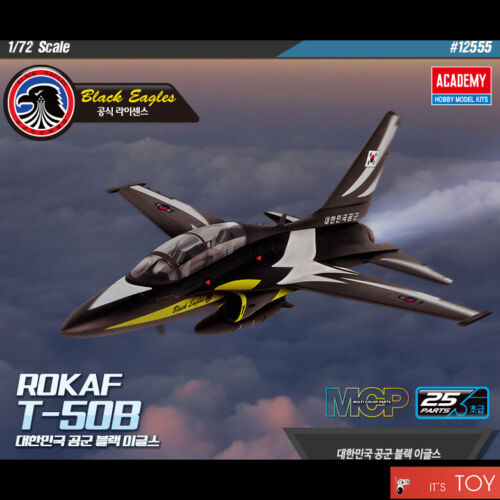
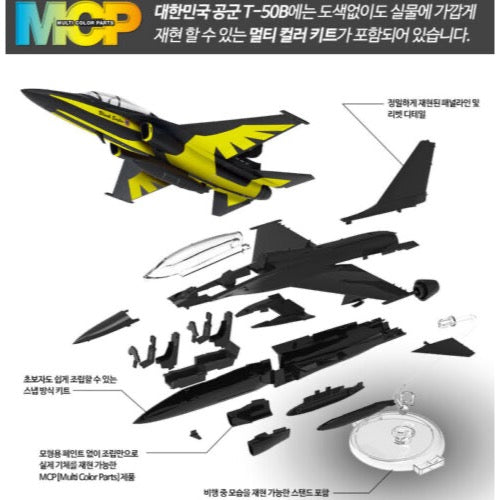
Academy 12555 1/72 ROKAF T-...
$ PRICE IN PROGRESS!
1/72 ROKAF T-50B Black Eagles MCP Snap Fit
This is an injection-plastic aircraft model kit.

ACADEMY
Academy 12556 1/72 USMC F-4...
$56.95
$64.99
The McDonnell-Douglas F-4 Phantom is a long-range, twin-engine, two-seater multi-role fighter designed for operations in difficult weather conditions. The flight of the prototype took place on May 27, 1958, and serial production began in 1961. Originally, the F-4 was intended only as a stormtrooper, but from 1955 on, the design work went towards meeting the US Navy's need for a new on-board fighter. The F-4 Phantom turned out to be a very successful machine, produced in several versions, exported to many countries and produced under license. The first versions are models from A to D intended for fighter-bombers. The next version is the F-4E, produced since 1967 as a long-range fighter. Reconnaissance versions were also created: RF-4B, RF-4C and RF-4E. The latest versions are the F-4F and F-4G Wild Weassel - these are electronic warfare planes and designed to fight the enemy radars. The F-4 took part in the Vietnam War, the conflicts in the Middle East (1967, 1973) and the Iran-Iraq War (1980-1988). In total, 5,057 F-4 Phantom aircraft were built. Technical data (version F-4E): Maximum speed: 2370 km / h, speed of climb: 210 m / s, maximum ceiling 18300 m, maximum range: 2600 km, armament: fixed - 1 20mm M61A-1 cannon, Suspended - up to 7255 kg of bombs and rockets.
This is an injection-plastic jet aircraft model kit.
ACADEMY
Academy 12560 1/72 Grumman ...
$56.95
$64.99
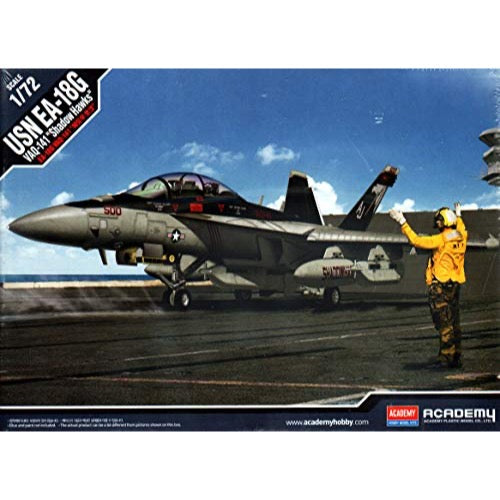
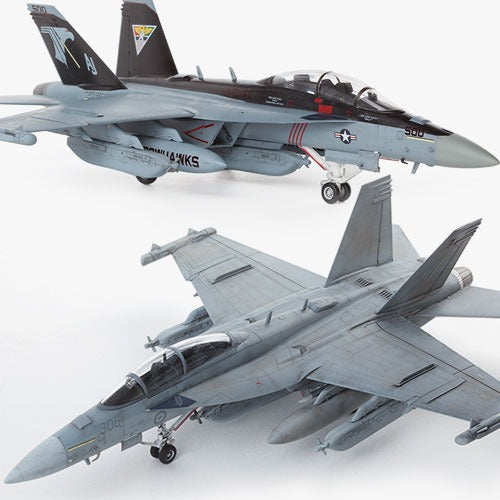
The Boeing EA-18G Growler is a modern American electronic combat aircraft. The prototype flight took place in 2006. Three years later, the machine entered the line in the US Navy and is still in it. In total, about 100 examples of this aircraft were built. The drive is provided by two motors turbofan General Electric F414-GE-400 . The aircraft has a maximum speed of 1.8 Ma and a maximum range of 3,300 kilometers. The unit price of the aircraft is $ 68.2 million (USD).
The Boeing EA-18G Growler was created to replace the EA-6B Prowler in the US Navy. It was developed on the basis of the F / A-18 F Super Hornet machine and shares 90% of its components with it. However, it was created for completely different purposes and tasks - namely to disrupt and destroy all means of detection (mainly radars) of the enemy and thus increase the chances of success of US Navy combat missions. The main weapons of the Boeing EA-18G Growler are modern ALQ-99 jamming containers, but also anti-radar missiles (AGM-88) and a self-defense missile (AIM-120). Currently, the main user of the EA-18G is the US Navy. The only foreign recipient so far turned out to be Australia.
The electronic fighter EA-18G Growler as adopted by the U.S. Navy gets a new model kit from Academy, complete with decals by Cartograf for three different aircraft from the VAQ-141 Shadow Hawks squadron, as well as decals for the Australian Air Force 6th Squadron.
This is an injection-plastic jet aircraft model kit.
ACADEMY
Academy 12561 1/72 Lockheed...
$53.95
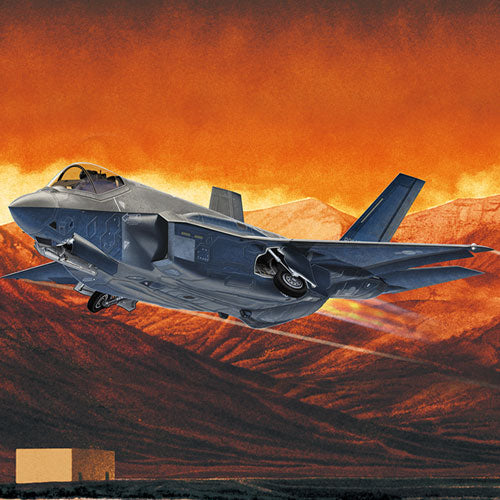
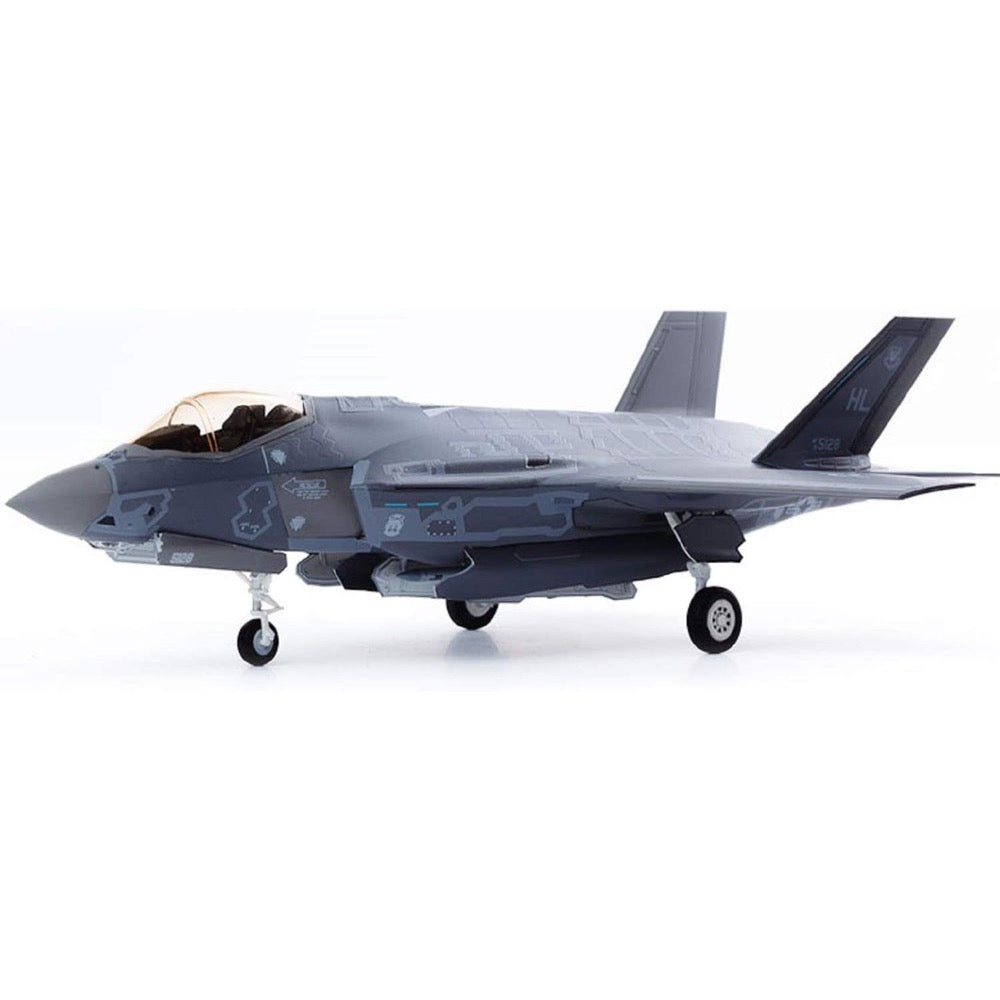
Lockheed Martin F-35 Lightning II (lightning) is a single-seat, single-engine multi-role fighter built by Lockheed Martin as a fifth generation machine, which is to meet the needs of the USAAF, US Navy, US Army and US Marine Corps. Originally the machine was called the X-35 JSF, but in 2006 it was changed to the F-35 Lightning II. Despite the fact that the main recipient will be the US government, the project is also co-financed by other countries, especially Great Britain, Italy and the Netherlands. The main contractors are: Lockheed Martin, Northrop Grumman and BAE Systems. The overriding goal of the JSF idea is to create a universal machine, produced for all types of armed forces, which will allow for far-reaching standardization of spare parts and a significant reduction in costs. Finally, three versions of the F-35 (A, B and C) are to be built, which will have more than three-quarters of the same elements. The main task of the F-35 of all versions is to attack land targets, perform the tasks of a battlefield plane, air combat and electronic combat. It should be noted that the F-35 is designed for conflicts of a low intensity, in contrast to its larger "relative" F-22. Which does not change the fact that thanks to the propulsion unit used (Pratt-Whitney F135 engines), avionics and Stealth properties, it is one of the most modern multi-role aircraft in the world. The first serial F-35 was made in February 2006. Until now (2013), 63 aircraft of this type have been built. Technical data (version F-35A): Maximum speed: 1930 km / h, maximum ceiling 18288 m, maximum range: 2220 km, armament: fixed - one four-barrel General Dynamics GAU-22 / A 25mm cannon, suspended - up to 8100 kg load.
This is an injection-plastic jet aircraft model kit.


ACADEMY
Academy 12563 1/72 Grumman ...
$57.95
$69.99
Designed as the U.S. Navy's primary fighter, the F-14 Tomcat could perform air superiority, escort, and strike missions and was undoubtedly one of the most sophisticated and technologically advanced aircraft ever to serve an aircraft carrier. The prototype machine was flown on December 21, 1970, and the first planes were delivered to the US Navy four years later. The last Tomcat planes were decommissioned only in 2006, which perfectly illustrates the high quality and great performance of this machine. The most innovative and characteristic solution for the F-14 are the wings with variable geometry. Controlled by computer or manually by the pilot, they can change their angle of attack from 20 degrees at minimum speed to 60 degrees at supersonic speeds. The changing geometry of the wings also allows for optimal positioning of the wings when maneuvering tightly, thanks to which this powerful aircraft exhibits amazing maneuverability. The heart of the Tomcat weapon system is the Hughes ANG-9 radar, usually cooperating with the AIM-54A Phoenix air-to-air missiles with a range of up to 180 km. Being able to track and attack more than one target is especially important. No less important element of the armament, as shown by the combat experience in the Vietnam War, is the cannon - in the F-14 mounted inside the M-61 Vulcan hull, firing up to 6,000 rounds per minute! Of course, you can also attach other types of weapons to the Tomcat, such as Sparrow, Sidewinder rockets or various bombs. The F-14 also owes a lot of its success to the excellent power unit in the form of a pair of Pratt-Whitney TF30 engines with a thrust of 9300 daN with afterburning. Technical data: Maximum speed: 2480 km / h, climb speed: 153 m / s, practical ceiling 17100 m, maximum range: 3200 km, armament: fixed - single, six-barrel 20mm M61-A1 cannon, suspended - up to 6580 kg cargo.
This is an injection-plastic jet aircraft model kit.


ACADEMY
Academy 12564 1/72 USN F/A-...
$40.95
McDonnell-Douglas / Northrop F / A-18 Hornet is an on-board fighter and attack aircraft capable of operating in all weather conditions. The roots of the F / A-18 go back to 1974 and the F-17 prototype, which was of interest to the US Navy command this year. The contract for the serial construction of the aircraft was concluded in 1976. In order to accelerate the work, the Northrop concern entered into cooperation with the McDonnell-Douglas concern. As a result, on November 18, 1978, the test flight of the prototype took place, and a year later, successful landings on the aircraft carrier. Since 1982, the aircraft has been delivered to linear units with General Electric F404-GE-402 engines as the propulsion unit. The plane is produced in several versions. The first were the F-18A (fighter) and F-18B (training). Foreign orders from Spain, Canada and Australia appeared quickly. In 1987, a version of the F-18C was created, adapted to the use of AMRAAM missiles. A year later, the F / A-18D, a two-seat version of the F-18, entered service in all weather conditions, and could be used as an attack aircraft. On its basis, the reconnaissance version of the R / F-18D was created. The newest versions (the so-called Super Hornet) -F / A-18E and F / A-18F are very modified versions of the F / A-18D. They are characterized by an increased length of the fuselage, wingspan and their surface. They also have new General Electric F414 engines and a decidedly expanded and modernized avionics. They were presented for the first time in 1995. The EA-18G Growler electronic warfare plane was also created on the basis of the F-18. All versions of the F / A-18 met with favor of pilots, they are characterized by low failure rate, ease of use and very good flight parameters. Hornets took part in the operation against Libya in 1986 and in the Operation Desert Storm in 1991. Technical data (version F / A-18 C): Maximum speed: 1915 km / h, speed of climb: 254 m / s, practical ceiling 15 240 m, maximum range: 3340 km, operating radius: 280-740 km, armament: fixed- Single 20mm M61A-1 six-barrel cannon, underslung - up to 7700 kg of cargo.
This F/A-18C belonged to the VFA-192 (192nd Battle Attack Squadron) Golden Dragons stationed at the U.S. Navy's base at Atsugi, and includes precise modeling for accurate details as well as decals from Cartograf for 3 versions.
This is an injection-plastic jet aircraft model kit.


ACADEMY
Academy 12565 1/72 USN F/A-...
$49.95
McDonnell-Douglas / Northrop F / A-18 Hornet is an on-board fighter and attack aircraft capable of operating in all weather conditions. The roots of the F / A-18 go back to 1974 and the F-17 prototype, which was of interest to the US Navy command this year. The contract for the serial construction of the aircraft was concluded in 1976. In order to accelerate the work, the Northrop concern entered into cooperation with the McDonnell-Douglas concern. As a result, on November 18, 1978, the test flight of the prototype took place, and a year later, successful landings on the aircraft carrier. Since 1982, the aircraft has been delivered to linear units with General Electric F404-GE-402 engines as the propulsion unit. The plane is produced in several versions. The first were the F-18A (fighter) and F-18B (training). Foreign orders from Spain, Canada and Australia appeared quickly. In 1987, a version of the F-18C was created, adapted to the use of AMRAAM missiles. A year later, the F / A-18D, a two-seat version of the F-18, entered service in all weather conditions, and could be used as an attack aircraft. On its basis, the reconnaissance version of the R / F-18D was created. The newest versions (the so-called Super Hornet) -F / A-18E and F / A-18F are very modified versions of the F / A-18D. They are characterized by an increased length of the fuselage, wingspan and their surface. They also have new General Electric F414 engines and a decidedly expanded and modernized avionics. They were presented for the first time in 1995. The EA-18G Growler electronic warfare plane was also created on the basis of the F-18. All versions of the F / A-18 met with favor of pilots, they are characterized by low failure rate, ease of use and very good flight parameters. Hornets took part in the operation against Libya in 1986 and in the Operation Desert Storm in 1991. Technical data (version F / A-18 C): Maximum speed: 1915 km / h, speed of climb: 254 m / s, practical ceiling 15 240 m, maximum range: 3340 km, operating radius: 280-740 km, armament: fixed- Single 20mm M61A-1 six-barrel cannon, underslung - up to 7700 kg of cargo.
Academy brings us their 1/72 F/A-18E Super Hornet kit. The F/A-18E, an aircraft belonging to the VFA-195 (195th Battle Attack Squadron), is deployed at the U.S. Navy's Iwakuni Air Base. With precise modeling for a high level of detail and a moderate number of parts for easy assembly, this kit includes decals by Cartograf.
This is an injection-plastic jet aircraft model kit.


ACADEMY
Academy 12567 1/72 USN F/A-...
$59.95
McDonnell-Douglas / Northrop F / A-18 Hornet is an on-board fighter and attack aircraft capable of operating in all weather conditions. The roots of the F / A-18 go back to 1974 and the F-17 prototype, which was of interest to the US Navy command this year. The contract for the serial construction of the aircraft was concluded in 1976. In order to accelerate the work, the Northrop concern entered into cooperation with the McDonnell-Douglas concern. As a result, on November 18, 1978, the test flight of the prototype took place, and a year later, successful landings on the aircraft carrier. Since 1982, the aircraft has been delivered to linear units with General Electric F404-GE-402 engines as the propulsion unit. The plane is produced in several versions. The first were the F-18A (fighter) and F-18B (training). Foreign orders from Spain, Canada and Australia appeared quickly. In 1987, a version of the F-18C was created, adapted to the use of AMRAAM missiles. A year later, the F / A-18D, a two-seat version of the F-18, entered service in all weather conditions, and could be used as an attack aircraft. On its basis, the reconnaissance version of the R / F-18D was created. The newest versions (the so-called Super Hornet) -F / A-18E and F / A-18F are very modified versions of the F / A-18D. They are characterized by an increased length of the fuselage, wingspan and their surface. They also have new General Electric F414 engines and a decidedly expanded and modernized avionics. They were presented for the first time in 1995. The EA-18G Growler electronic warfare plane was also created on the basis of the F-18. All versions of the F / A-18 met with favor of pilots, they are characterized by low failure rate, ease of use and very good flight parameters. Hornets took part in the operation against Libya in 1986 and in the Operation Desert Storm in 1991. Technical data (version F / A-18 C): Maximum speed: 1915 km / h, speed of climb: 254 m / s, practical ceiling 15 240 m, maximum range: 3340 km, operating radius: 280-740 km, armament: fixed- Single 20mm M61A-1 six-barrel cannon, underslung - up to 7700 kg of cargo.
This is an injection-plastic jet aircraft model kit.


ACADEMY
Academy 12568 1/72 USAF F-1...
$64.99
$69.99
The McDonnell Douglas F-15 Eagle is an American twin-engine fighter and attack aircraft, the first flight of which took place on July 27, 1972. The F-15 aircraft is the result of the experience gained from air combat over Vietnam, and is also the USAAF's response to the Soviet Mig-23 and Mig-25 fighters. It was created as part of the FX (Fighter Experimental) project, in which the winner was McDonnell-Douglas in 1969. When designing the F-15, particular emphasis was placed on the maximum reduction of service time. Mainly, on the one hand, it was based on the installation of elements that were as easy to use as possible, and on the other hand, the use of automatic systems, which kind of relieve people. As a result, the successor of the F-4 Phantom, surpassing it in all respects, can be served in half the time. Another strength of the F-15 is the pair of Pratt-Whitney F100 afterburner engines, which produce 4,500 kg more thrust than the machine itself weighs, allowing it to make tight turns without sacrificing great speed. In addition, it makes it possible to suspend a huge amount of additional weapons on 8 knots under the wings and fuselage. From the moment the F-15 entered service, several variants were created. The C and D versions are the second generation of single and double seater aircraft, respectively, replacing the A and B versions in 1979. Externally, they do not differ much from them, but the avionics underwent a comprehensive modification, which made the Eagle even more lethal weapon. In the 1980s, the F-15D also experimented with ASAT anti-satellite missiles. A version of the F15-E Strike Eagle was being developed at the same time. Contrary to the previous models, the E version is not only a hunting machine used for air superiority, but also an assault machine with a wide range of possibilities for attacks on ground targets. The E version entered service in 1988 and is expected to remain in the line until 2035. Another variant is the F-15J, exported and produced under license in Japan. F-15 aircraft were exported to several countries, including Japan, Israel, Saudi Arabia and South Korea. The F-15 turned out to be a very valuable machine, achieving air victories, among others. during Operation Desert Storm and the 2003 invasion of Iraq. Technical data (version E): Maximum speed: 2660 km / h, climb speed: 255 m / s, practical ceiling 19500 m, maximum range: 5580 km, armament: fixed - 1 six-barrel M61A-1 20mm cannon, suspended - up to 10660kg load.
In this model kit from Academy, the U.S. Air Force's battle bomber, the F-15E Strike Eagle, wears commemorative paint observing the 76th anniversary of D-Day. Its paint reproduces that worn by the P-47 Thunderbolt belonging to the 48th Fighter Wing which supported the ground attack on that fateful day. The kit has a moderate number of parts for ease of assembly, and all are precisely molded. Decals by Cartograf for two different commemorative versions are included.
This is an injection-plastic jet aircraft model kit.


ACADEMY
Academy 12569 1/72 USMC F-3...
$59.99
$64.99
Lockheed Martin F-35 Lightning II (lightning) is a single-seat, single-engine multi-role fighter built by Lockheed Martin as a fifth generation machine, which is to meet the needs of the USAAF, US Navy, US Army and US Marine Corps. Originally the machine was called the X-35 JSF, but in 2006 it was changed to the F-35 Lightning II. Despite the fact that the main recipient will be the US government, the project is also co-financed by other countries, especially Great Britain, Italy and the Netherlands. The main contractors are: Lockheed Martin, Northrop Grumman and BAE Systems. The overriding goal of the JSF idea is to create a universal machine, produced for all types of armed forces, which will allow for far-reaching standardization of spare parts and a significant reduction in costs. Finally, three versions of the F-35 (A, B and C) are to be built, which will have more than three-quarters of the same elements. The main task of the F-35 of all versions is to attack land targets, perform the tasks of a battlefield plane, air combat and electronic combat. It should be noted that the F-35 is designed for conflicts of a low intensity, in contrast to its larger "relative" F-22. Which does not change the fact that thanks to the propulsion unit used (Pratt-Whitney F135 engines), avionics and Stealth properties, it is one of the most modern multi-role aircraft in the world. The first serial F-35 was made in February 2006. Until now (2013), 63 aircraft of this type have been built. Technical data (version F-35A): Maximum speed: 1930 km / h, maximum ceiling 18288 m, maximum range: 2220 km, armament: fixed - one four-barrel General Dynamics GAU-22 / A 25mm cannon, suspended - up to 8100 kg load.
The F-35B, the 5th generation stealth fighter developed by Lockheed Martin, is now available as a 1/72 kit from Academy!
This finely detailed model kit is a completely new mold. You can choose to assemble it in its characteristic vertical take-off and landing mode or in normal take-off and landing mode. Various armaments (air-to-air missiles / air-to-ground bombs) stored in the weapon bay, panel lines of the fuselage, and other parts are precisely recreated.
The kit comes with three types of decals, including the "VMFA-121 Green Knights" deployed to the Iwakuni Air Base since 2017.
This is an injection-plastic jet aircraft model kit.


ACADEMY
Academy 12573 1/72 USN PBY-...
$47.95
In October 1933, the US Navy placed an order with Consolidated and Douglas for prototypes of new machines. The prototype constructed by Consolidated, designated XP3Y-1, became a flying boat built in the largest number of copies. The internal designation assigned to the structure by the company is Consolidated 28. The aircraft, just like its predecessor - P2Y - had a high wing system. The new design, however, uses a system of internal stiffening curvatures, which made the wing look like a free-bearing structure. The only exception was the two small, profiled supports on both sides of the plane, between the fuselage and the center wing. As a result, version 28 was devoid of sources of additional aerodynamic drag, generated in earlier designs by struts and stiffening straps, which were the cause of lower flight parameters. Another aerodynamic innovation limiting drag was the use of stabilizing floats, which were folded up during flight to form a profiled wing tip. The hull with two redans was very similar to that of the P2Y, but in the 28 version it had a streamlined, cross-shaped self-supporting tail. The prototype was powered by two 836HP Pratt-Whitney R-1830-54 Twin Wasp engines, installed on the leading edge of the wing. The armament consisted of four 7.62 mm machine guns and a bomb load of up to 907 kg. The first flight took place on March 28, 1935, after which the XP3Y-1 was promptly handed over to the US Navy for operational evaluation. The tests proved the significant advantage of the P3Y-1 over the patrol flying boats used so far. The long range and improved properties when taking off from land-based airfields meant that the US Navy expressed interest in the further development of the structure so that it could be used as a patrol-bomber. Therefore, in October 1935, the prototype returned to the parent plant to continue construction work on it. They included i.a. development of new R-1830-64 engines with a capacity of 912HP. A redesigned vertical tail was also introduced and a new prototype, designated XPBY-1, was flew on May 19, 1936, and soon the serial PBY-1 began to be delivered to the US Navy. After minor changes, the planes ordered in July 1936 received the designation PBY-2, and the following PBY-3 and PBY-4 were fitted with the R-1830-66 (1014KM) and R-1830-72 (1065KM) engines, respectively. In April 1939, the last of the PBY-4 machines was returned to the production plants for the installation of a wheeled chassis. Such equipment made the plane amphibious, extending the possibilities of its use. This specimen, leaving the production plant in November 1939 after the modification was completed, received the designation XPBY-5A. Test flights confirmed the advantage of this version over the previous one. Therefore, the planes ordered by the US Navy as PBY-5 were equipped as amphibians in accordance with the PBY-5A standard. Intensive use led to the thought that the plane could have significantly improved characteristics by redesigning the fuselage. The necessary tests and design works were carried out by Naval Aircraft Factory and the next, last production version of Catalina was already called PBY-6A. Technical data (PBY-5A version): length: 19.46m, wingspan: 31.7m, height: 6.15m, maximum speed: 314km / h, rate of climb: 5.1m / s, practical ceiling: 4000m, range maximum: 4050 km, armament: fixed - 3 machine guns caliber 7.62 mm and 2 machine guns caliber 12.7 mm, suspended - up to 1814 kg of bombs.
Academy brings us a model kit of the PBY-5A Catalina, a flying boat that was active in the U.S. Navy Air Corps for anti-submarine patrol, coast guard duties, and salvage. Each panel line is realistically expressed thanks to precision molding; a canopy masking sticker is included, as are decals for two U.S. Army and Navy Air Corps versions.
This is an injection-plastic jet aircraft model kit.


ACADEMY
Academy 12575 1/72 USMC CH-...
$39.95
The Sikorsky CH-53 Sea Stallion is a heavy, American-made transport helicopter with a metal structure in a classic layout with a main rotor and a tail rotor on the beam. The drive is provided by two General Electric T-64-GE-413 engines with a capacity of 3925 KM each. The flight of the first prototype took place in 1964, and serial production continued in 1966-1978. It is estimated that about 510 copies of this helicopter were built.
The Sikorsky CH-53 Sea Stallion was created in response to a tender for a new transport helicopter launched by the Marine Corps in 1959. The new machine was to be able to launch freely, have a loading ramp at the rear of the hull and carry about 50-60 soldiers. All these criteria were met by the machine of the Sikorsky concern. Many development versions of this very solid helicopter were created in the course of serial production. One of them was the CH-53D version with a stronger hull structure, better performance and higher lifting capacity. Another was the search and rescue version, designated CH-53GE. There were also versions dedicated to foreign recipients with changed avionics or engines (e.g. CH-53G created for the needs of German aviation of land forces). The CH-53 helicopter took an active part in the Vietnam War (1964 / 1965-1975). It has also been exported to several countries, including Austria, Germany, Israel and Mexico.
Features
Tail boom can be built straight or folded
Rear ramp can be built open or closed
Two pilot figures included
Highly detailed cockpit and landing gear
Fully engraved panel lines


ACADEMY
Academy 12576 1/72 Lockheed...
$43.99
The Lockheed F-104 Starfighter is an American supersonic interceptor and fighter-bomber. The F-104 is the fruit of the American experience of the Korean War, where most air victories were achieved in one surprising blow. This, in turn, meant that the new USAAF fighter should, above all, be fast and have a high rate of climb. It is also a reflection of the concept of "plane-missile with a man on board", which also functioned in the Soviet and British aviation in the second half of the 1950s and early 1960s. The flight of the prototype, created by Clarence "Kelly" Johnson, took place on February 7 1954, and entry into line units began in 1958. The serial plane was powered by a General Electric J79 turbojet engine with thin, trapezoidal wings and R21G / H radar. The F-104 was produced in several versions. The basic one is the F-104A, acting as a fighter plane, and the F-104C, i.e. a fighter-bomber. Subsequent versions were primarily produced for export. F-104G, with a more powerful J79-GE-11 engine and improved avionics went to Germany, the CF-104 is a license version of the F-104G, but with the J79-OEL-7 engine, produced in Canada, the F-104S is an aircraft produced in Italy licensed with the J79-GE-19 engine. Finally, the F-104J was produced for the Japanese Air Force with the J79-IHI-11A engine at Mitsubishi plants. The plane designed to train test pilots was the NF-104 Rocket Starfighter. The F-104 was an airplane that was incredibly difficult to pilot and "unforgiving" mistakes. It has suffered many crashes - in the german aviation alone, 110 of the 238 F-104 planes were crashed! Technical data (version F-104G): Maximum speed: 2137 km / h, speed of climb: max. 254 m / s, maximum altitude 27,400 m, maximum range: 2,920 km, armament: fixed - one 20mm six-barrel M61A-1 cannon, suspended - up to 1,814 kg of cargo.
The F-104C Starfighter has been adopted by the U.S. Air Force and other countries around the world. This model kit from Academy precisely reproduces its cockpit, panel lines and main gear; decals for four versions are included, featuring the Japan Air Self-Defense Force 207th Squadron.
This is an injection-plastic jet aircraft model kit.


ACADEMY
Academy 12577 1/72 Boeing F...
$52.95
McDonnell-Douglas / Northrop F / A-18 Hornet is an on-board fighter and attack aircraft capable of operating in all weather conditions. The roots of the F / A-18 go back to 1974 and the F-17 prototype, which was of interest to the US Navy command this year. The contract for the serial construction of the aircraft was concluded in 1976. In order to accelerate the work, the Northrop concern entered into cooperation with the McDonnell-Douglas concern. As a result, on November 18, 1978, the test flight of the prototype took place, and a year later, successful landings on the aircraft carrier. Since 1982, the aircraft has been delivered to linear units with General Electric F404-GE-402 engines as the propulsion unit. The plane is produced in several versions. The first were the F-18A (fighter) and F-18B (training). Foreign orders from Spain, Canada and Australia appeared quickly. In 1987, a version of the F-18C was created, adapted to the use of AMRAAM missiles. A year later, the F / A-18D, a two-seat version of the F-18, entered service in all weather conditions, and could be used as an attack aircraft. On its basis, the reconnaissance version of the R / F-18D was created. The newest versions (the so-called Super Hornet) -F / A-18E and F / A-18F are very modified versions of the F / A-18D. They are characterized by an increased length of the fuselage, wingspan and their surface. They also have new General Electric F414 engines and a decidedly expanded and modernized avionics. They were presented for the first time in 1995. The EA-18G Growler electronic warfare plane was also created on the basis of the F-18. All versions of the F / A-18 met with favor of pilots, they are characterized by low failure rate, ease of use and very good flight parameters. Hornets took part in the operation against Libya in 1986 and in the Operation Desert Storm in 1991. Technical data (version F / A-18 C): Maximum speed: 1915 km / h, speed of climb: 254 m / s, practical ceiling 15 240 m, maximum range: 3340 km, operating radius: 280-740 km, armament: fixed- Single 20mm M61A-1 six-barrel cannon, underslung - up to 7700 kg of cargo.
Academy brings a model kit of the F/A-18F Super Hornet belonging to the U.S. Navy's Fighter Attack Squadron VFA-154 Black Knights! The weapons and aircraft are precisely molded for accuracy, and a moderately limited number of parts makes assembly a breeze. Decals for two versions by Cartograf (including the air wing commander [CAG]) are included, as is a canopy masking sticker.
This is an injection-plastic jet aircraft model kit.