
Reset

ACADEMY
Academy 1/48 Mi-17 HIP Mode...
$ PRICE IN PROGRESS!
Plastic model kit utilizing original AMK (Aura Model Kit) tooling, featuring a length of roughly 368 mm to 390 mm and Cartograf decals.
Features
Thick photo-etched detail fret, Cartograf decals, armament options including UB-32 rocket pods, and three pilot figures (two seated, one standing).
Includes decals for Czech Air Force and North Macedonian Air Force liveries.


ACADEMY
Academy 1/48 R.O.K. Army UH...
$ PRICE IN PROGRESS!
The Bell UH-1 Iroquois (nicknamed "Huey") is a utility military helicopter designed and produced by the American aerospace company Bell Helicopter. It is the first member of the prolific Huey family, as well as the first turbine-powered helicopter in service with the United States military.
Features
The product precisely depicts the cockpit, the interior of the aircraft, each panel line, and various weapons systems.
This kit includes newly designed decals, resin parts, and photo-etched parts for the South Korean Army Air Force.


ACADEMY
Academy 1/48 ROKAF T-50 Mod...
$ PRICE IN PROGRESS!
The KAI T-50 Golden Eagle is a modern South Korean training and combat aircraft. The prototype flight took place in 2002. Three years later, the machine entered the line in the South Korean Air Force (ROKAF) and remains in it today. In total, about 130-140 copies of this aircraft were built. The drive is provided by a single motor General Electric F404 turbojet . The aircraft has a maximum speed of 1.5 Ma and a maximum range of 1,850 kilometers. The deck armament is a single 20mm General Dynamics A-50 cannon.
The T-50 Golden Eagle was created to replace the T-38 and A-37 training aircraft in ROKAF, as well as to enable advanced training for future F-15K and KF-16 fighter pilots. The new machine was developed at the Korean Aerospace Industries (KAI) plants with the great help of Lockheed Martin. The T-50 Golden Eagle is characterized by very high performance for a machine of this class, high maneuverability and very good piloting qualities. It also has rich and modern electronic equipment. It is probably one of the most modern training and combat aircraft in the world at the moment. Until now, several variants of this machine have been created, first of all: T-50 (basic, training version), T-50B (aerobatic version), FA-50 (light attack aircraft) and F-50 (light fighter). Currently, the KAI T-50 is used by the air forces of South Korea, Indonesia, Iraq, the Philippines and Thailand.

ACADEMY
Academy 1/48 USAAF P-51B 70...
$ PRICE IN PROGRESS!
The North American P-51 Mustang is an American, single-engine, long-range fighter and attack aircraft with a classic tail and all-metal construction. The flight of the prototype took place on October 26, 1940. The P-51 Mustang has earned a reputation as one of the best, if not the best, WWII fighter.
Replacing the Allison V-1710-39 engine from the first project with a Rolls-Royce Merlin motor (P-51 Mustang Mk.Ia version) made the Mustang, like never before, reached perfection. The single-seat fighter impressed with its maximum speed, range, maneuverability, and powerful weapons. The combination of all the most important parameters for the assessment of the aircraft made the Mustang prove itself in virtually every role entrusted to it: it gained air superiority, escorted, carried out reconnaissance missions, attacked ground targets. The class of design is evidenced by the fact that the Mustang remained in active service until the 70's! One of the most important versions was the P-51D, based on the P-51B. It received a drip cab fairing, ensuring excellent visibility, and a new engine - Packard V-1650-7, which significantly improved performance.


ACADEMY
Academy 1/48 USAF F-22A Air...
$84.95
An all-new kit from Academy, the first in this scale to accurately represent the US Air Force's newest fighter.
Features
Detailed cockpit, weapons bays and landing gear
Full intake trunking, optional position exhaust petals, full weapons load of six AIM-120C, two JDAMs, two AIM-9M, two AIM-9X
Underwing pylons with drop tanks and optional position canopy
Landing gear, weapons bay doors, and arrestor hook.
Naturally, such an outstanding kit would need outstanding markings, and Academy delivers in spades! The massive Cartograf-printed decal sheet provides decals for no less than 18 aircraft of 17 Squadrons from six bases.


ACADEMY
Academy 1/48 USAF U-2 5th R...
$71.95
1/48 scale plastic model kit of the USAF Lockheed U-2S "Dragon Lady" featuring markings for the 5th Reconnaissance Squadron based at Osan Air Base.
Features
Detailed large-span wings and specialized high-altitude body shape.
Cockpit interior details and pilot figure options.
Marking options specifically tailored for the 5th RS "Black Cats" stationed at Osan AB.


ACADEMY
Academy 1/72 Assault Galien...
$ PRICE IN PROGRESS!
The Academy and Wave KG-022 Assault Galient kit is a recent collaboration that revisits the classic mecha from Panzer World Galient, specifically the heavy armored version that appears in Episode 10 of the anime. This 1/72 scale kit, standing about 19 cm tall when assembled, offers a faithful representation of the “Heavy Armor Kai” variant, including its reinforced flight cannon, heavy armored cannon, and shield. Is entirely snap-fit, requiring no glue, and includes parts for both Flight Armor and Self-Propelled modes.
This kit reflects Wave’s attention to fine surface detail and proportions, clean multicolor molding, making for a visually impressive build even unpainted. The dual-mode display options give it a strong presence on the shelf and echo the transformation seen on screen. Assembly is straightforward, with no complex mechanics involved, yet the finished model retains the angular, heavy-metal styling typical of the 1980s anime aesthetic.


ACADEMY
Academy 1/72 F-15C Eagle Mo...
$ PRICE IN PROGRESS!
The McDonnell Douglas F-15 Eagle is an American twin-engine fighter and attack aircraft, the first flight of which took place on July 27, 1972. The F-15 aircraft is the result of the experience gained from air combat over Vietnam, and is also the USAAF's response to the Soviet Mig-23 and Mig-25 fighters. It was created as part of the FX (Fighter Experimental) project, in which the winner was McDonnell-Douglas in 1969. When designing the F-15, particular emphasis was placed on the maximum reduction of service time. Mainly, on the one hand, it was based on the installation of elements that were as easy to use as possible, and on the other hand, the use of automatic systems, which kind of relieve people. As a result, the successor of the F-4 Phantom, surpassing it in all respects, can be served in half the time.
Another strength of the F-15 is the pair of Pratt-Whitney F100 afterburner engines, which produce 4,500 kg more thrust than the machine itself weighs, allowing it to make tight turns without sacrificing great speed. In addition, it makes it possible to suspend a huge amount of additional weapons on 8 knots under the wings and fuselage. From the moment the F-15 entered service, several variants were created. The C and D versions are the second generation of single and double seater aircraft, respectively, replacing the A and B versions in 1979. Externally, they do not differ much from them, but the avionics underwent a comprehensive modification, which made the Eagle even more lethal weapon.
In the 1980s, the F-15D also experimented with ASAT anti-satellite missiles. A version of the F15-E Strike Eagle was being developed at the same time. Contrary to the previous models, the E version is not only a hunting machine used for air superiority, but also an assault machine with a wide range of possibilities for attacks on ground targets. The E version entered service in 1988 and is expected to remain in the line until 2035. Another variant is the F-15J, exported and produced under license in Japan. F-15 aircraft were exported to several countries, including Japan, Israel, Saudi Arabia and South Korea. The F-15 turned out to be a very valuable machine, achieving air victories, among others. during Operation Desert Storm and the 2003 invasion of Iraq.
This kit is an ideal addition for jet enthusiasts, showcasing the speed and dominance of a fighter that achieved an unrivalled combat record. Paint and cement are required and sold separately.
Features
1/72 scale plastic model kit of the F-15C Eagle
Detailed cockpit with ejection seat and instrument panel
Authentic USAF decals and squadron markings
Optional external tanks, missiles, and bombs included
Finely recessed panel lines and realistic surface detail


ACADEMY
Academy 1/72 German Army Le...
$21.95
A highly detailed 1/72 scale model of the Leopard 1A5 main battle tank, as operated by the West German Bundeswehr and other Western nations. The kit captures the tank's rugged silhouette and fine hull equipment with delicate detail, making it ideal for hobbyists and collectors.
Features
Scale: 1/72
Subject: Leopard 1A5 main battle tank used by West Germany and other NATO countries
Material: Injection molded plastic for precise parts and crisp detail
Includes decals for three nation variants: Italian Army, German Army, Canadian Army
Designed for assembly, painting, and customization
Ideal for display, dioramas, and model collections
Mold: produced from earlier Ace tooling


ACADEMY
Academy 1/72 KF-16C Fightin...
$46.95
1/72 KF-16C Fighting Falcon Korean Air Force
Features
Well-detailed cockpit and landing gear straight from the box
Optional parts for a smooth nose or either of two styles of IFF "bird slicers,"
Optional ASPJ antennas, optional braking parachute housing for under the rudder, small-mouth intake with decently deep trunking
Underwing and centerline drop tanks, two each AMRAAM, AIM-9M, AIM-9X, AGM-88
Towed Decoy System and GBU-31 JDAM, plus one each AN/ALQ-184 ECM pod, AN/AAQ-14 and AN/AAQ-13 targeting and navigation pods and AN/ASQ-213 HTS pod.
The kit is single-seat specific, although gate marks on the sprues suggest that Academy has at least planned for a two-seat version.
The canopy is molded correctly as a "double bubble," and is in tinted clear plastic.
Decals are given to enable you to build any single-seat Korean Fighting Falcon.


ACADEMY
Academy 1/72 MH-53E HM-14 V...
$ PRICE IN PROGRESS!
Helicopter Mine Countermeasures Squadron 14 (HM-14) was a United States Navy helicopter squadron established in 1978 based at Naval Station Norfolk, Virginia. Nicknamed the Vanguard and flying the MH-53E Sea Dragon, it comprised both active duty and reserve personnel. It was the sister squadron to HM-15, the Blackhawks, based at NS Norfolk.
HM-14 flew its last mission on 8 December 2022 and was deactivated on 30 March 2023. The squadron was officially disestablished in July 2023. Squadron responsibilities were transferred to HM-15 beginning in January 2023.
Features
The product precisely depicts the cockpit, the interior of the aircraft, each panel line, and various weapons systems.
This kit includes newly designed decals for the U.S. Navy's 14th Helicopter Mine Countermeasures Squadron and the Japan Maritime Self-Defense Force's 111th Air Squadron (Air Mine Countermeasures Unit).


ACADEMY
Academy 1/72 Panzer World P...
$ PRICE IN PROGRESS!
Second release in cooperation between Wave and Academy based on the Panzer World Galient anime TV series. Academy holds the rights to produce these kits while Wave is doing the new tools.
Panzer World Galient (Kikōkai Galient) is a mecha anime series created by Ryōsuke Takahashi and produced by Sunrise in 1984-1985. Unlike traditional sci-fi mecha shows, Galient blends medieval fantasy with futuristic technology, featuring knightly mechas (Panzer Frames) in a world of swords, magic, and war. The story follows Jordy Volder, the rightful heir of the kingdom of Arst, as he leads a rebellion against the tyrannical dictator Mardoul using the legendary Panzer Frame Galient.
Promaxis is a key character in the series, initially appearing as a powerful and enigmatic enemy knight serving Mardoul. Clad in distinctive armor and piloting an imposing Panzer Frame, he is a skilled and ruthless warrior, often clashing with Jordy. However, as the story unfolds, his true identity and motivations become more complex, revealing layers of intrigue within Mardoul’s forces. His presence adds depth to the show’s themes of loyalty, destiny, and redemption.
Panzer World Galient remains a cult classic, known for its unique blend of fantasy and mecha, as well as its detailed mechanical designs by Kunio Okawara (Gundam).
Features
Kit is snap fit type, no glue required, and turns into a poseable model once built.


ACADEMY
Academy 1/72 Sea Harrier FR...
$38.95
Unassembled plastic model kit released by Academy in 2014 as a rebox depicting the British Royal Navy vertical takeoff fighter famous for its role in the Falklands War
Features
Represents the initial FRS.1 production variant operated by the Fleet Air Arm.
Includes markings and decals for Royal Navy versions tied to historical operations.


ACADEMY
Academy 1/72 US Cargotruck ...
$22.95
Term 2 , 5 -ton, 6x6 truck (colloquially: deuce and a half) refers to the entire family of medium trucks used by the US armed forces during World War II, but also on a large scale during the Cold War. This family of trucks was designed and produced in the early 1940s for the US Army as a basic 5,000 lb. (2.5 'short' or 2.3 metric) heavy duty truck. terrain and in all weather conditions. From the very beginning it was assumed that these types of cars would be simple in design and that their production would be mass production. During World War II, a total of over 700,000 trucks of this type were created, especially by GMC (CCKW model) and Studebaker. Many of these vehicles found their way to the USSR under the Lend-and-Lease program. The families of these trucks played a gigantic role in the logistics and transport of Allied and Soviet troops during World War II. After 1945, the M35 series trucks were introduced into service, which is also often included in the family 2 , 5 -ton, 6x6 truck.
This is an injection-plastic military vehicle model kit.


ACADEMY
Academy 1/72 USN A-6E VA-95...
$58.95
Attack Squadron 95 (VA-95), known as the "Green Lizards," was a United States Navy attack squadron established in 1972 and based at Naval Air Station Whidbey Island, Washington.
Flying the A-6 Intruder, the squadron participated in significant operations, including combat missions during Operation Desert Storm in 1991, where it delivered precision strikes against Iraqi targets. The Green Lizards also deployed aboard various aircraft carriers in the Pacific and Indian Oceans, supporting U.S. interests around the globe. VA-95 was decommissioned in 1995 as part of post-Cold War reductions in the Navy’s attack aircraft fleet.


ACADEMY
Academy 12107 1/32 F/A-18 V...
$198.95
McDonnell-Douglas / Northrop F / A-18 Hornet is an on-board fighter and attack aircraft capable of operating in all weather conditions. The roots of the F / A-18 go back to 1974 and the F-17 prototype, which was of interest to the US Navy command this year. The contract for the serial construction of the aircraft was concluded in 1976. In order to accelerate the work, the Northrop concern entered into cooperation with the McDonnell-Douglas concern. As a result, on November 18, 1978, the test flight of the prototype took place, and a year later, successful landings on the aircraft carrier. Since 1982, the aircraft has been delivered to linear units with General Electric F404-GE-402 engines as the propulsion unit. The plane is produced in several versions. The first were the F-18A (fighter) and F-18B (training). Foreign orders from Spain, Canada and Australia appeared quickly. In 1987, a version of the F-18C was created, adapted to the use of AMRAAM missiles. A year later, the F / A-18D, a two-seat version of the F-18, entered service in all weather conditions, and could be used as an attack aircraft. On its basis, the reconnaissance version of the R / F-18D was created. The newest versions (the so-called Super Hornet) -F / A-18E and F / A-18F are very modified versions of the F / A-18D. They are characterized by an increased length of the fuselage, wingspan and their surface. They also have new General Electric F414 engines and a decidedly expanded and modernized avionics. They were presented for the first time in 1995. The EA-18G Growler electronic warfare plane was also created on the basis of the F-18. All versions of the F / A-18 met with favor of pilots, they are characterized by low failure rate, ease of use and very good flight parameters. Hornets took part in the operation against Libya in 1986 and in the Operation Desert Storm in 1991. Technical data (version F / A-18 C): Maximum speed: 1915 km / h, speed of climb: 254 m / s, practical ceiling 15 240 m, maximum range: 3340 km, operating radius: 280-740 km, armament: fixed- Single 20mm M61A-1 six-barrel cannon, underslung - up to 7700 kg of cargo.
This is an injection-plastic aircraft model kit.
Includes
Markings of U.S. Marines & Canadian Air Force
Size/Weight: 55.5 x 37 x 12.5 cm / 2400g
Weight: 2.4 kg
Features
Fully engraved panel lines and rivet details
Highly detailed cockpit and landing gear
Various weapons included
Die-cast metal landing gear struts
Solid synthetic-rubber tires
Includes four figures: two pilots and two ground crew
Cartograf premium quality decals included for two versions:
USMC F/A-18A Plus
Royal Canadian Air Force CF-188
ACADEMY
Academy 12109 1/32 Sopwith ...
$30.95
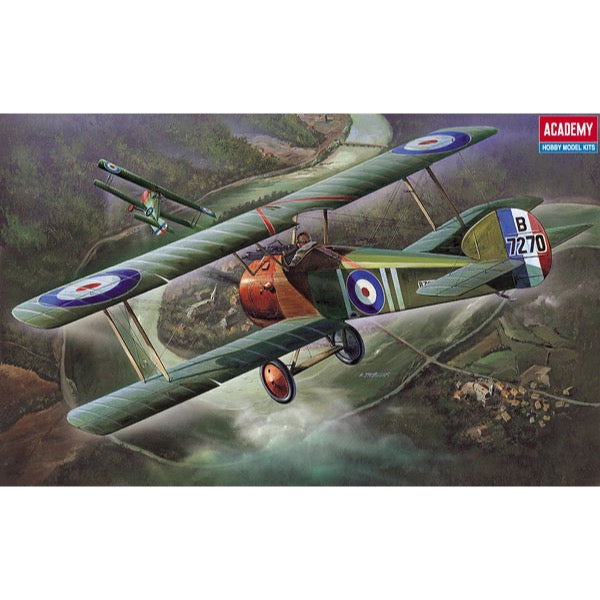
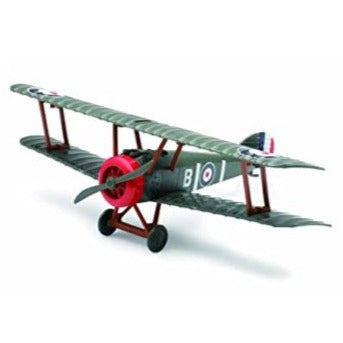
The Sopwith Camel was a British First World War single-seat biplane fighter aircraft that was introduced on the Western Front in 1917. It was developed by the Sopwith Aviation Company as a successor to the Sopwith Pup and became one of the best known fighter aircraft of the Great War.
Features
Medium grey plastic pieces moulded to sprue trees.
Single seat cockpit.
Recessed panel lines give authentic look.
Detailed cockpit and landing gear.
Detailed engine compartment. Detailed pictorial instructions.
Marking Options
One decal sheet with markings for two aircraft: 1: Sopwith Camel F.1, Capt. A.R. Brown, No. 209 Squadron, RAF, May 1918. 2: Sopwith Camel F.1, No. 43 Squadron, RAF, mid-1918


ACADEMY
Academy 12111 1/35 UH-60L B...
$84.99
$89.99
The Sikorsky UH-60 Black Hawk is a medium multi-role and infantry support helicopter of American production with a metal structure in a classic layout with a main rotor and a tail rotor on the beam. The drive of the UH-60 D version is provided by two General Electric T-700-700 engines with a capacity of 1560 HP each. The flight of the first prototype took place in 1974, and serial production, which started in 1974, is still ongoing. It is estimated that over 4,000 copies of this helicopter were built by 2017.
The Sikorsky UH-60 was created in response to a tender launched in 1972 by the US Army for a new transport helicopter to replace the UH-1 Huey machines. The new machine was supposed to have better performance, be cheaper to operate and be characterized by high survivability on the battlefield. All these criteria were met by the machine of the Sikorsky concern, with particular emphasis on the last of the above-mentioned elements. Many development versions of this very solid and successful helicopter were created in the course of serial production. The basic version was designated as UH-60A, which was used primarily for transport purposes. Later, the UH-60L version with more powerful engines was introduced, which increased the lifting capacity of the machine. A version of the S-70 International was also created, widely offered - often successfully - to foreign customers. It is worth adding that at present (2017) this version is produced in the plants in Mielec. Numerous specialized versions have also been created, such as the MH-60A, which is dedicated to American special forces. On the basis of the UH-60, the marine version, the SH-60 Seahawk, was also significantly changed. MH-60 helicopters actively participated in the intervention in Granada (1983), the operation in Mogadishu (1993), both wars in Iraq (1990-1991 and 2003), as well as in the operation in Afghanistan from 2001. They have also been exported to many countries, including Austria, Brazil, Chile, Egypt, Israel, Japan and Turkey.
This is an injection-plastic aircraft model kit.
ACADEMY
Academy 12112 1/35 UH-1C HU...
$64.99
$69.99
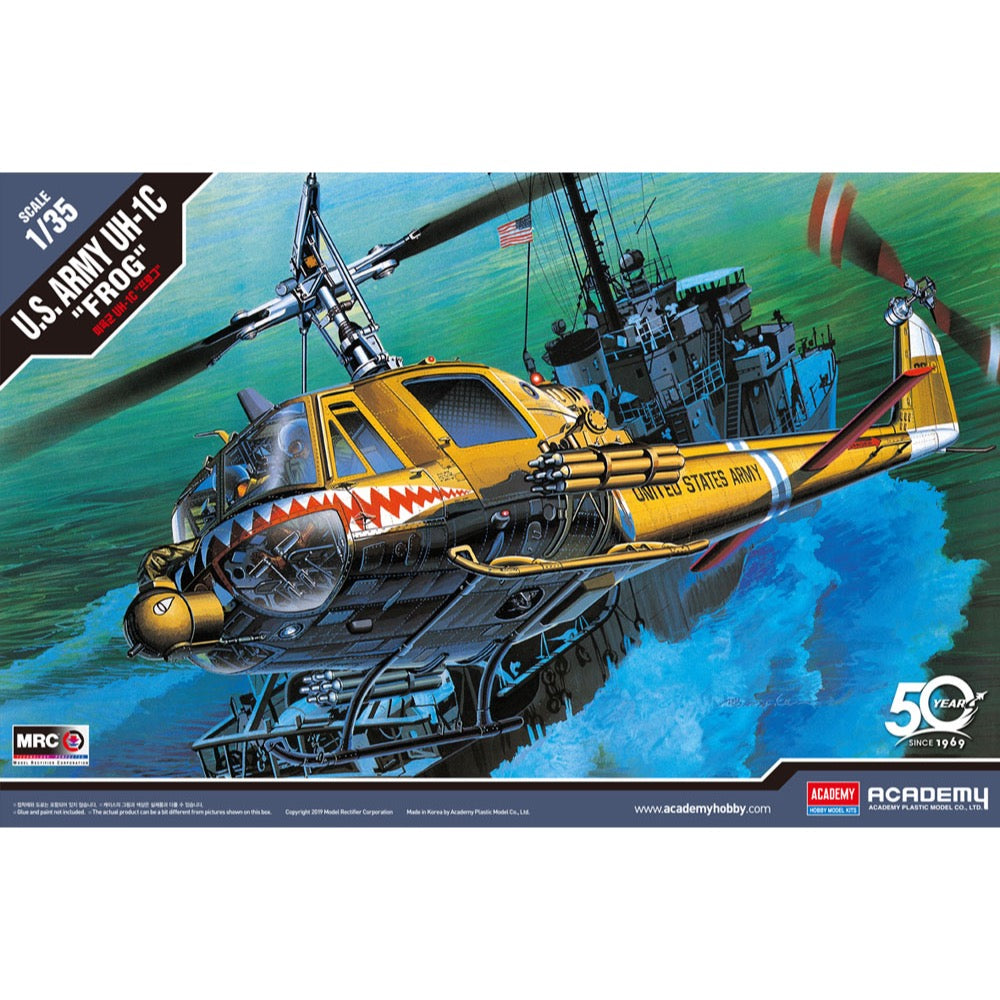
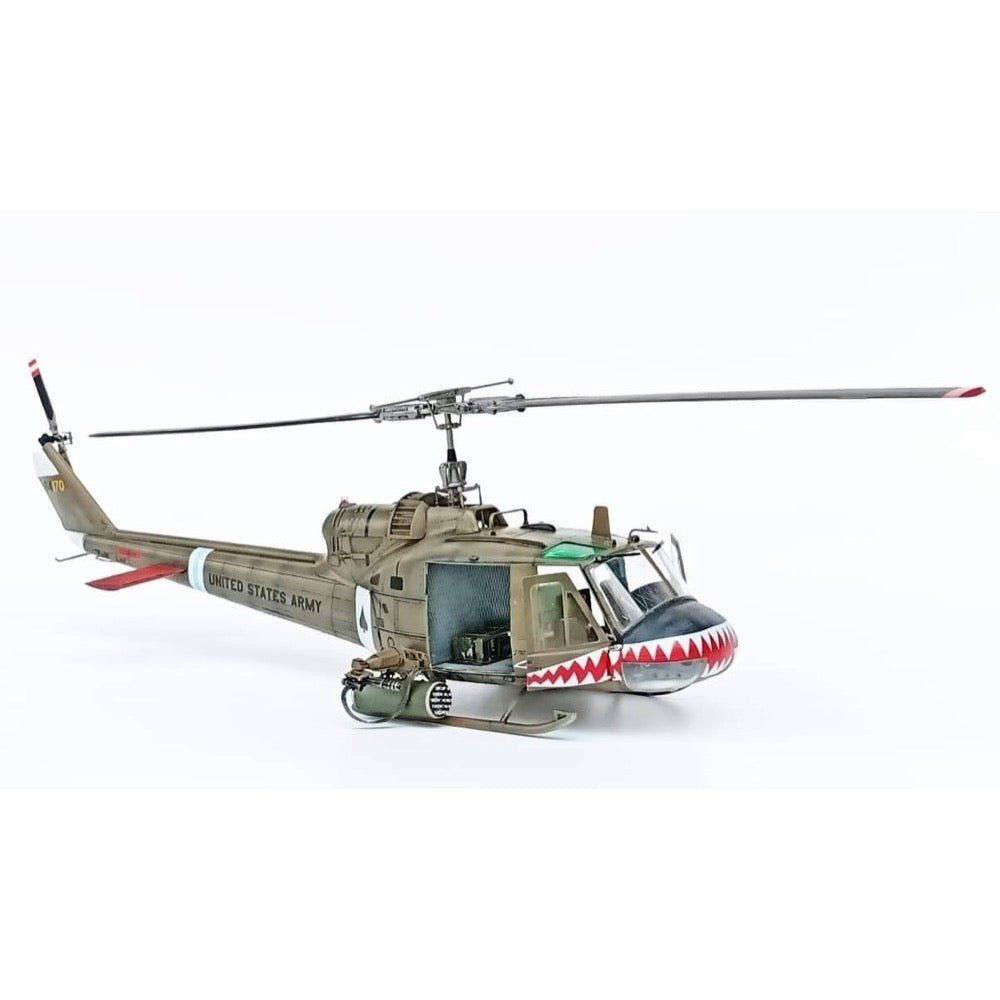
Bell UH-1 Iroquois (commonly known as Huey) is a multirole helicopter of American production from the Cold War and modern times. The flight of the prototype took place in 1956, and the machine entered service in 1959. The helicopter - in the UH-1D version - has a total length of 17.4 m, and the diameter of its main rotor is 14.6 meters. The drive is provided by a single 1100 HP Lycoming T-53-L-11 engine. Its maximum speed in horizontal flight reaches 220 km / h. The helicopter has a classic layout with a single main rotor and a propeller on the tail boom.
This is an injection-plastic aircraft model kit.


ACADEMY
Academy 12115 1/35 AH-60L D...
$99.99
$109.99
The Direct Action Penetrator (DAP) is one of the most awesome airborne weapon platforms the US Army Special Operation Forces operate. As the ground troops carry out their missions, they feel relieved knowing that the DAP is in the sky, providing armed escort and precision guided fire support. If you're looking for an exciting kit to build with lots of armament and highly detailed parts, look no further than Academy's AH-60 DAP.
Used primarily as an attack helicopter, the AH-60 DAP is a highly modified version of the standard UH-60L Black Hawk. The DAP is equipped with an advanced avionics package including a Forward Looking Infrared (FLIR) surveillance system, making it accurate and effective both day and night. The communications package is extensive, and the Fast Rope Insertion and Extraction System (FRIES) can support a remarkable 1,500 lbs per side. To provide for extended range, the DAP is equipped with inboard auxiliary fuel tanks, and many have a refueling probe for in-flight refueling capability.
Academy's AH-60 DAP is a bona fide replica, meticulously capturing every detail. Made up of over 270 parts, this awesome 1/35 scale measures nearly 2 feet in length. Academy's engineers loaded this model with an impressive arsenal, including 6-barrel Gatling door guns with 1 kilometer range, M261 19 tube rocket launcher, and inescapable AGM-114 Hellfire semi-active laser guided missiles. The kit comes with inboard auxiliary fuel tanks, just like the real thing. It even includes an accurate cockpit and instrument panel with FLIR scope monitors.
The DAP is operated by the 160th Special Operations Aviation Regiment (SOAR). SOAR seeks out only the best aviators and soldiers to be members of their team. Are you ready to SOAR?
This is an injection-plastic aircraft model kit.
Features
Fully engraved panel line and rivet details
M261 19-tube Rocket Launcher and AGM-114 Hellfire included
Detailed jet engine and rotor assembly
Extensive cockpit detailing


ACADEMY
Academy 12116 1/35 USMC AH-...
$64.99
$69.99
Reissue of the MRC 1/35-scale AH-1W kit by Academy with slightly retooled nose and forward canopy profile to represent the current Super Cobras with NTS upgrade.
Other parts are the same as previous AH-1W releases. Decals are provided to mark the kit as any of three aircraft: TV/28 of HML/A-167 "Warriors" (shown), the shark-mouthed TV/39, also of HML/A-167, and EM/30 attached to HMM-261 "Raging Bulls" during "Operation Bright Star 2000."
The AH-1 Cobra helicopter (Bell 209) is an attack helicopter in the classic layout, using many components of its "big brother" UH-1 Huey. The first flight of the AH-1 prototype took place on September 7, 1965 and the helicopter entered mass production in the same year. During the Vietnam War, 1,126 machines of the G model were produced, of which 279 were lost in combat. Due to the very high reliability of the structure, small side profile and good performance, the helicopter remains in service to this day in the US Marine Corps. The AH-1 allowed the US Army to fully implement the theoretical assumption of airmobile infantry ("air cavalry") through the fire support of landing infantry units. Today, the AH-1 Cobra is primarily used against an armored celon. From 1965, several versions of this successful helicopter were created, including: AH-1G (basic version), AH-1J (two-engine version), AH-1Q (version armed with TOW missiles). Technical data: Top speed: 333 km / h; maximum range (depending on version): 507-574km, armament: fixed-1 20mm M197 three-barrel cannon, slung rockets, guided missiles, unguided missiles and cannon pods.


ACADEMY
Academy 12117 1/35 U.S. Arm...
$39.99
Build your own plastic model U.S. Army RQ-7B UAV Shadow with this quality scale kit!
RQ-7 Shadow is a modern American-Israeli unmanned aerial vehicle (drone). The drive is provided by a single combustion engine UEL AR-741 with a power of 38 HP. The maximum ceiling is 4300 meters, and the maximum speed is around 200 km / h. The maximum take-off weight of the drone is 149 kg. Serial production started in 2002.
Includes 2 operator figures and a stand.
ACADEMY
Academy 12119 1/32 Lockheed...
$ PRICE IN PROGRESS!
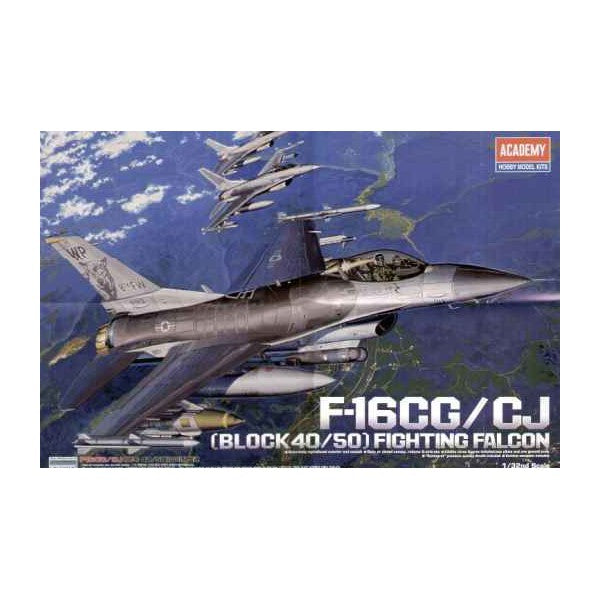
The General Dynamics F-16 Fighting Falcon is an American single-engine supersonic multirole fighter aircraft originally developed by General Dynamics for the United States Air Force (USAF). Designed as an air superiority day fighter, it evolved into a successful all-weather multirole aircraft with over 4,600 built since 1976. Although no longer purchased by the U.S. Air Force, improved versions are being built for export. In 1993, General Dynamics sold its aircraft manufacturing business to the Lockheed Corporation, which became part of Lockheed Martin after a 1995 merger with Martin Marietta.
This is an injection-plastic aircraft model kit.
ACADEMY
Academy 12120 1/35 MH-60S H...
$99.95
$119.99
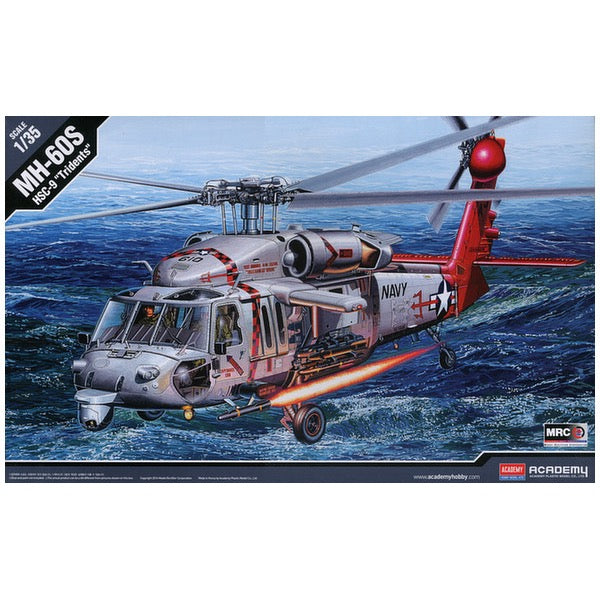
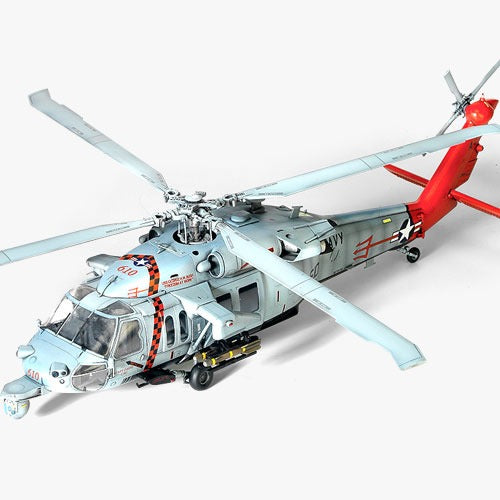
From Academy, this is a highly detailed model kit of the MH-60S HSC-9 "Tridents" in 1/35 scale. The completed model measures about 482mm long. It features extensive cockpit detailing, as well as a detailed jet engine and rotor assembly. The kit includes parts for a M261 19-tube Rocket Launcher and AGM-114 Hellfire. Also included are clear parts and decals. Parts come molded in gray.
This is an injection-plastic aircraft model kit.