
Reset


ACADEMY
Academy 1/144 Rafale M Mode...
$17.95
The Dassault Rafale (French squall) is a French twin-engine multi-role fighter plane with delta wings. Construction of the Rafale was initiated in 1980 by Dassault as an experimental combat aircraft - the ACX. It was to replace the tactical battlefield aircraft of the French air force Jaguar and the French navy Vouhgt F-8E and Dassault Super Etendard. Rafale A, powered by two General Electric F104 turbofan engines, left the assembly line on December 14, 1985, and exceeded the speed of sound in its first flight on July 4, 1986. In April 1987, the plane made several approaches to aircraft carrier Clemenceau to mark an operation from the deck. In April 1989, the new SNECMA M88-2 engine was introduced, which became the basic power unit. The flight of the aircraft in this configuration took place on February 27, 1990. The plane was purchased by India in 2012, so far (2013) other countries apart from India and France have not acquired the plane.
Features
Accurately detailed cockpit and landing gear
Precisely engraved panel lines
ACADEMY
Academy 1/144 Russian Airfo...
$27.99
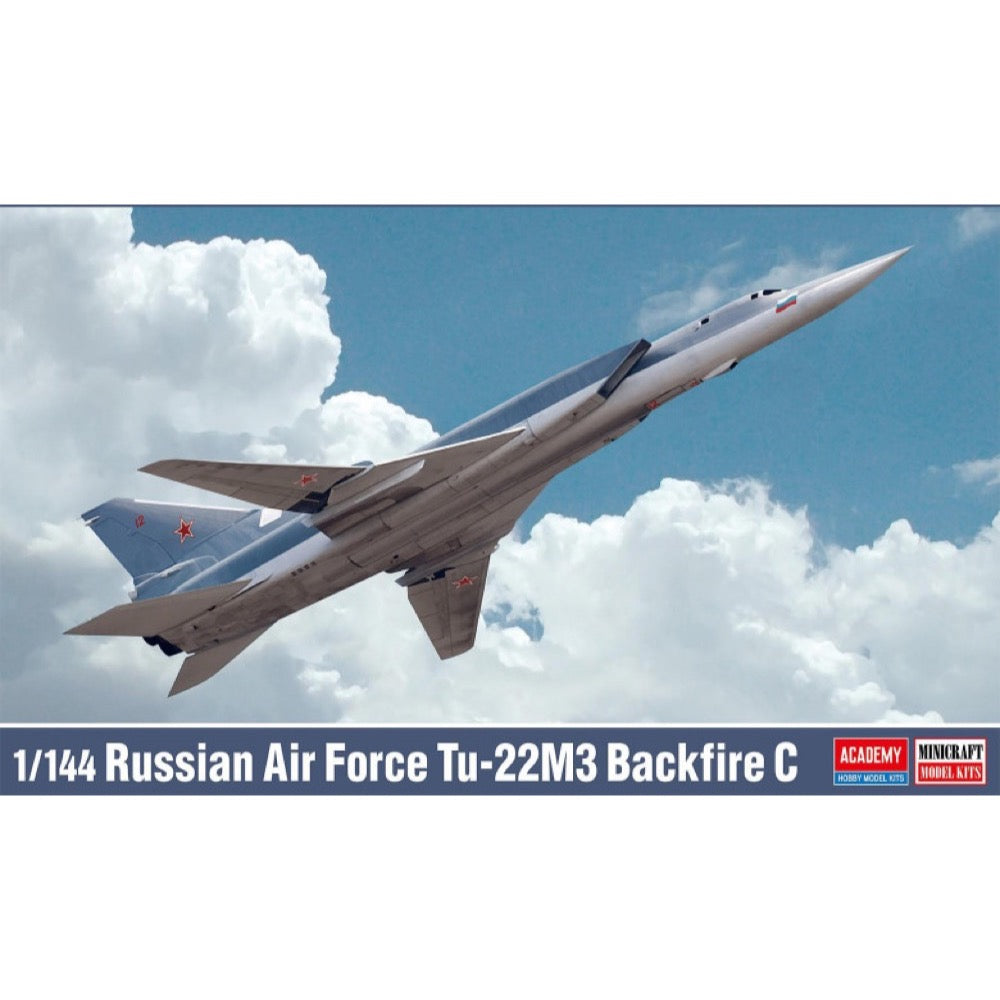
Academy 12636 presents an impressive model of the Soviet bomber Tu-22M3 Backfire C in 1/144 scale , which takes aviation history enthusiasts into the fascinating world of military with extraordinary precision and attention to detail. This powerful symbol of strategic air power has been carefully reproduced, ensuring the highest level of realism and authenticity.
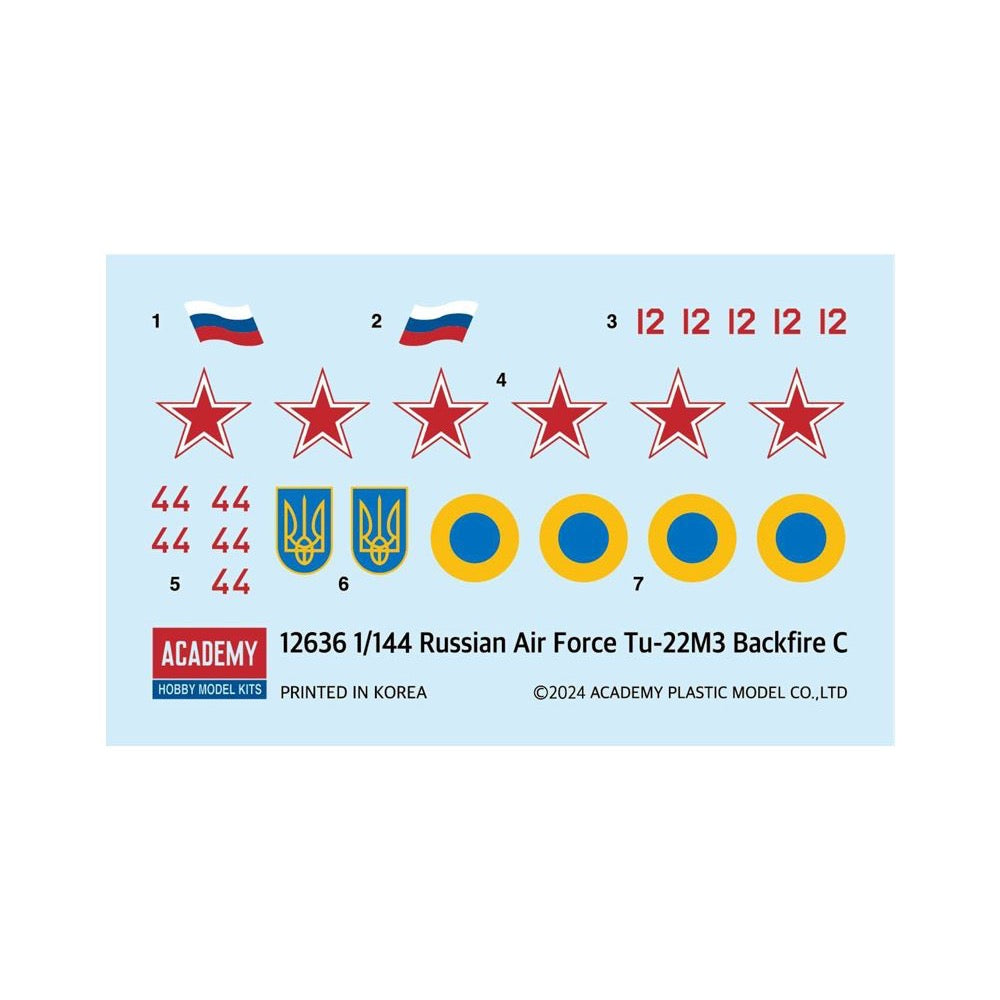
The kit includes a complete set of parts and assembly instructions, allowing you to assemble an impressive replica of the Tu-22M3 Backfire C. Decals with different paint schemes and markings allow you to choose your favorite look of the aircraft, adding even more attractiveness to this model.
Add this unique Tu-22M3 Backfire C miniature to your military collection and discover the fascinating world of strategic aviation, exploring the unrivaled power and versatility of this legendary Soviet bomber.


ACADEMY
Academy 1/144 Sea Harrier F...
$16.95
Accurately recreates the real-life British Cold War era jump jet used during the Flakland War. This plastic model kit requires paint and glue to complete.
The BAe Harrier is a British single-seat V / STOL fighter, attack and reconnaissance aircraft with a duralumin, half-shell structure. The origins of Harrier's construction can be found in 1957, when Lord Sydney Camm of Hawker Aircraft and Dr. Stanley Hooker of Bristol Siddeley Engines started the construction of a tactical aircraft using the latest turbo-fan engine from Bristol plants, then known as BS.53. It was specially adapted to the vertical thrust vector ensuring the vertical take-off of a fixed-wing aircraft. Engine exhaust gases were directed to four staggered nozzles placed in pairs at the front and rear of the fuselage. The range of rotation of the nozzles exceeded 90 degrees, which allowed the exhaust gases to be directed directly rearward in normal flight, vertically downward for take-off and landing, or to any angle during the transition phase. Around the engine, Camm constructed a compact, conventional, high-wing metal airframe. In the forward part of the fuselage there was a one-person cabin, next to which there were two fixed, stationary air inlets for engines with a semicircular cross-section. The two-wheeled main and one-wheeled undercarriages are built in tandem in the central axis of the fuselage. The first of the six prototypes took off for the first time on October 21, 1960. After less than a year, a complete transition was made from vertical climb to horizontal flight and hover again. In February 1965, the UK government ordered six test aircraft. These were the first examples to be given the name Harrier. Apart from Great Britain, the only user of the standard Harrier aircraft is the Spanish Navy, where the aircraft are known as the Matador. To date, a dozen or so versions of the Harrier aircraft have been produced. Chronologically, the first was the Harrier GR.1 (an attack aircraft that entered service in 1969). Version T.3 was created quickly, i.e. a two-person school version of Harrier GR.1. The next version is the Harrier GR.3, which is the most modern assault version of this aircraft equipped with Pegasus 11 Mk 103 engines. Since 1978, the version marked as Sea Harrier has also been produced, the FRS.MK.1 model of which distinguished itself during the Falklands war. in 1982 as a fighter attack aircraft. As a result of the experience gained from this war, the FA.2 version was created, which has better avionics, including a great Blue Vixen radar, greater payload and can use a wider range of weapons.
Choice of 2 markings
Sea Harrier FRS.1 XZ451, 801 NAS, HMS Invincible, Falklands Conflict 1982
Sea Harrier FRS.1 XZ457, 800 NAS, HMS Hermes, Falklands Conflict 1982.


ACADEMY
Academy 1/144 USAF C-54 Sky...
$28.95
The Douglas C-54 Skymaster was a four-engine transport aircraft developed from the civilian DC-4, designed to provide long-range heavy transport for the U.S. Army Air Forces during World War Two. Used extensively in the Pacific, European, and China-Burma-India theatres, transporting troops, equipment, and fuel, often over hostile territory.
After the war the C-54 flew sustained high-frequency supply missions in the Berlin Airlift, along with Douglas Dakota, Avro York and Short Sunderland types, and formed the basis for later long-range transport designs.
Choice of markings for 6 aircraft
C-54 of the ATC (Air Transport Command), USAF, 1943.
C-54 of the ATC (Air Transport Command), USAF, 1944-45.
VC-54C Sacred Cow, the first U.S. presidential aircraft, used for President Franklin D. Roosevelt’s flight to the Yalta Conference in Crimea in 1945.
C-54B EW-999 (43-14126), used for the flight of the Prime Minister of Great Britain, Sir Winston Churchill, to the Yalta Conference in 1945.
VC-54E 44-9027, "Bataan II", personal flight of 1st Supreme Commander for the Allied Powers, General Douglas McArthur, used for his arrival in Japan, 1945.
Air America, C-54G N2168, operated on regional missions between Korea, Japan, and Vietnam during the early 1960s.


ACADEMY
Academy 1/144 USAF EC-121 W...
$29.95
Academy 12637 is an impressive 1/144 scale replica of the USAF EC-121 Warning Star. This classic aircraft has been meticulously recreated to provide the highest level of realism and authenticity.
The kit includes a complete set of parts and assembly instructions, which allows you to assemble an impressive replica of the EC-121 Warning Star. Decals with different paint and marking options allow you to choose your favorite look of the plane, adding even more attractiveness to this model.
Add this unique EC-121 Warning Star miniature to your military collection and discover the fascinating world of reconnaissance aviation, exploring the role of this legendary aircraft in the history of the U.S. Air Force.


ACADEMY
Academy 1/24 Hyundai Santa ...
$58.95
Academy's kit of the 2018 fourth-generation Santa Fe SUV from Hyundai features a low number of parts, and snaps together for easy assembly! Since it's molded in color, painting is not required (although, as with just about any model kit, it'll look even more amazing with some paint). Decals and stickers are provided too.
Specifications
Approximately 19.8cm long, 7.8cm wide when completed
With Decals, stickers


ACADEMY
Academy 1/24 Samseongyo Aca...
$ PRICE IN PROGRESS!
In 1969, Academy Science Co., Ltd. started as Academy Science Teaching Material Company, a model teaching material store in Seoul.
Features
The product is a precise reproduction of the Academy Science Teaching Material Company store of the 1980s~1990s with a small number of parts.
The shelves where the finished products are displayed in the store are represented with clear parts, and the back of the store is reproduced with stickers.
Material: Plastic, etc.
Size when completed: Length 260mm / Height 160mm


ACADEMY
Academy 1/24 T600 3-Wheeled...
$63.95
Experience a piece of South Korean history with the 1/24 scale replica of the iconic T600 three-wheeled cargo vehicle, originally released in 1969 as a symbol of the country's delivery and transportation industry. With its unique mobility, the T600 was suitable for transporting goods through complex and narrow alleys, making it a popular choice for cargo transportation in South Korea. The T600 has been recognized for its technological value in the automotive industry and was designated as the 400th registered cultural heritage by the Cultural Heritage Administration of South Korea in 2008. This model features precision detailing of the T600's interior and exterior, as well as a faithful reproduction of the vehicle's underbody. The kit is designed to be easy to assemble, even for beginners, with carefully selected components. Add a touch of history to your collection with this Academy Science 1/24 scale T600 three-wheeled cargo vehicle model, and relive the glory days of South Korea's transportation industry.
Features
Precision detailing of exterior, interior, and underbody
Easy-to-assemble kit with carefully selected components


ACADEMY
Academy 1/32 F-16I Sufa Fig...
$172.95
$239.99
This 1 / 32nd scale MRC academy plastic model kit is an authentic replica of the Israeli F-16I "Sufa" fighter. The sufa (thunderstorm) is easily recognizable by the distinctive conformal 600 gallon fuel tanks that give the aircraft a range of up to 1,000 miles, enough to cover the entire Middle East region. Its radar, the Northrop Grumman APG-68, is also more advanced than any other in the IAF fleet. The F-16I has all-weather, day and night attack capabilities.
To accurately reproduce this special aircraft for the experienced modeler, academy made certain to concentrate on the weapon systems including the GBU-31 (V) 3 and AGM-130, GBU-38, AIM-120B, PYTHON-4, GBU-12 and the latest RADAR and countermeasures arrays. Academy "pulled out all the stops" with this big 1/32 model. This magnificent, museum quality kit also offers a choice of two canopies and open or closed canopy configurations, two pilot figures, radome & airbrakes.
Every last rivet, screw and panel line is engraved throughout and extensive detail abounds. The cockpit gauges and ejection seat detail is incredible along with the complexity and completeness of the landing gear and bays. Photo etched metal parts have been added throughout and even a turned brass pitot tube and AOA probe. Naturally, a kit of this size and quality is completed with two extensive cartograf decal sheets and detailed painting instructions. A large wall poster is included too. This will be the F-16 to hold "pride of place" in any modern aircraft collection. Every last rivet, screw and panel line is engraved throughout and extensive detail abounds. The cockpit gauges and ejection seat detail is incredible along with the complexity and completeness of the landing gear and bays.
Photo etched metal parts have been added throughout and even a turned brass pitot tube and AOA probe. Naturally, a kit of this size and quality is completed with two extensive cartograf decal sheets and detailed painting instructions. A large wall poster is included too. This will be the F-16 to hold "pride of place" in any modern aircraft collection. Every last rivet, screw and panel line is engraved throughout and extensive detail abounds. The cockpit gauges and ejection seat detail is incredible along with the complexity and completeness of the landing gear and bays.
Photo etched metal parts have been added throughout and even a turned brass pitot tube and AOA probe. Naturally, a kit of this size and quality is completed with two extensive cartograf decal sheets and detailed painting instructions. A large wall poster is included too. This will be the F-16 to hold "pride of place" in any modern aircraft collection. Photo etched metal parts have been added throughout and even a turned brass pitot tube and AOA probe.
Naturally, a kit of this size and quality is completed with two extensive cartograf decal sheets and detailed painting instructions. A large wall poster is included too. This will be the F-16 to hold "pride of place" in any modern aircraft collection. Photo etched metal parts have been added throughout and even a turned brass pitot tube and AOA probe. Naturally, a kit of this size and quality is completed with two extensive cartograf decal sheets and detailed painting instructions. A large wall poster is included too. This will be the F-16 to hold "pride of place" in any modern aircraft collection.


ACADEMY
Academy 1/35 German Army Le...
$75.95
Detailed plastic model kit ideal for hobbyists and collectors.
Features
120mm L/44 smoothbore gun and MG3 machine gun
Optional assembly of river-crossing device that can be mounted on the commander's hatch
Including soft track


ACADEMY
Academy 1/35 German Leopard...
$79.95
Features
Leopard 2A6 German main battle tank
Modern tank with powerful and robust appearance
Detailed and realistic design
Ideal for military vehicle collections
Impressive display model once completed


ACADEMY
Academy 1/35 German Panzer ...
$71.95
The Panzer III was one of the main German tanks in the early years of World War II. The Ausf. N variant was a later version equipped with a short-barreled 75 mm gun intended for infantry support and engaging fortified positions. These tanks were deployed by the Afrika Korps in North Africa, where they had to operate in harsh desert environments with high temperatures and dust.
The Academy 13567 kit features a detailed model of the German Panzer III Ausf. N, used by the Afrika Korps during the North African campaign of World War II. This variant was equipped with a short-barreled 7.5 cm KwK 37 gun, designed primarily for infantry support. These tanks operated in harsh desert conditions, where reliability and mobility were essential.
Features
Plastic model kit in 1:35 scale
German Panzer III Ausf. N tank
Afrika Korps desert camouflage
Detailed hull and turret components
Armament: 7.5 cm KwK 37 gun
Decals included


ACADEMY
Academy 1/35 M113 Fitter AR...
$54.95
American-built/Australian-modified armoured personnel carrier with HIAB hydraulic crane and Gearmatic winch, specifically for maintenance and repair operations in the field.
Movable crane system (working position or travelling position), various repair equipment, detailed interior and engine compartment. Optional one-piece flexible tracks or individual track links. Choice of markings for Israeli Ground Forces or Australian Army. Reissue of Academy kit 1388.


ACADEMY
Academy 1/35 R.O.K. Army K8...
$58.95
Academy 13569 ROK Army K808 1/35 is a plastic model kit of the K808 wheeled armored personnel carrier used by the South Korean armed forces. Developed by Academy in 1/35 scale, this kit allows for the construction of a detailed replica of this modern military vehicle.
The K808 is part of the South Korean K806/K808 family of armored vehicles developed by Hyundai Rotem for the Republic of Korea Army. The vehicle was designed as a modern wheeled transporter providing high mobility, crew protection, and the ability to transport troops in various terrain conditions. The design features an 8x8 drive, high speed, and the ability to operate both on roads and in difficult terrain.
This model represents modern military equipment used by the ROK Army and makes an interesting addition to any 21st-century armored vehicle collection. The 1/35 scale allows for the reproduction of numerous structural details and the creation of a realistic model for display or diorama.


ACADEMY
Academy 1/35 R.O.K. Army K9...
$ PRICE IN PROGRESS!
Academy's Korean Army K9 155mm Self-Propelled Howitzer features detailed flexible belt style tracks and three figures. Hatches can be posed open or closed. Markings provided or one Korean Army vehicle.


ACADEMY
Academy 1/35 R.O.K. Army K9...
$47.95
Academy 13561 ROK Army K9A1 155mm Self-Propelled Howitzer 1/35 is a plastic model kit of the 155mm K9A1 self-propelled howitzer used by the Republic of Korea Army in 1:35 scale.
This model is perfect for fans of modern military technology and collectors, offering a high level of detail and realistic representation of the vehicle. Thanks to its precise workmanship and large amount of detail, assembling this model will be a rewarding experience for both beginners and advanced modelers.
Features
Accurately reproduced elements of the howitzer's hull and turret.
Detailed running gear, including realistically reproduced tracks.
Movable parts of the gun allow the barrel to be set in different positions.
Turret interior with details such as crew stations and control systems.
Decals enabling the reproduction of authentic ROK Army painting and markings.
Additional equipment and exterior details such as tools and equipment boxes.


ACADEMY
Academy 1/35 ROK KIFV K-200...
$75.95
Academy 13292 K200A1 KIFV in 1:35 scale is a unique plastic model kit of the South Korean K200A1 KIFV (Korea Infantry Fighting Vehicle). This model is a faithfully reproduced miniature of the vehicle, which has remained the primary combat transporter of the Republic of Korea Army from the 1980s to the present day.
The original K200A1 entered service in 1985, intended to address the need for a modern armored personnel carrier and infantry fighting vehicle for the South Korean armed forces. Designed by Daewoo, the vehicle was primarily used in South Korea, but also found service with the Philippine Army. It participated in various exercises, peacekeeping operations, and internal operations in the East Asian region.
The Academy 13292 model is made of high-quality plastic, ensuring ease of processing and assembly. The kit includes detailed parts that allow for faithful reproduction of the vehicle's distinctive features: a turret armed with a machine gun, a detailed suspension, a drive system, and realistic armor textures. The model does not contain resin or photo-etched parts, but it offers very high-quality plastic detail. The components require the use of separately available glue and modeling paints.
This product falls into the "plastic model kit" category and is aimed at both intermediate and advanced modelers. It's an excellent choice for enthusiasts of modern military technology and those interested in conflicts and equipment from the Korean Peninsula region. The 1:35 scale ensures a high level of detail, and detailed assembly instructions support the construction process.
Features
Model scale: 1/35
Country of origin of the original: South Korea
Period of use: 1985–present (modern times, Cold War–present)
Material: high-quality plastic
The kit does not include glue and paints - they must be purchased separately.
Detailed, precise reproduction of the original
Category: plastic model kit
Assembly difficulty level: 3/5


ACADEMY
Academy 1/35 Sd.Kfz.234/2 P...
$58.95
The Sd.Kfz. 234/2 "Puma" was a German heavy armored reconnaissance car used during World War II, featuring an eight-wheel independent suspension system, a 50mm main gun, and a top speed of 90 km/h. Only 101 units were produced between December 1943 and June 1944.
This is a plastic model kit, which comes unassembled and unpainted. So glue, model paints and other basic modelling tools are additionally required.
Features four figures and assorted accessories


ACADEMY
Academy 1/35 U.S. Army M109...
$79.95
High quality 1/35 scale plastic model kit ideal for hobbyists and collectors. Perfect for painting, customization, and display in dioramas. Assembly required.
Contents
Plastic sprue, Photoetched fret, Decalsheet (waterslide), Vinyl


ACADEMY
Academy 1/35 U.S. Army M8 G...
$58.95
This is a plastic model kit, which comes unassembled and unpainted. So glue, model paints and other basic modelling tools are additionally required.
Contents
Plastic sprue, Decalsheet (waterslide)

ACADEMY
Academy 1/35 USMC M50A1 Ont...
$54.95
Having to make do with the ancient (but collectible!) Renwal kit, AFV modelers have been pining for a new-tool Ontos for years...but now that wait is over! Academy answers the call with this all-newly-tooled kit of the Ontos (Greek for "the thing"), and indeed it has been worth the wait. The kit accurately reproduces the odd Ontos with its six 106mm recoilless rifles, and includes photo-etched parts, two figures, some shells, detailed flexible one-piece belt-style tracks, and markings for the USMC.


ACADEMY
Academy 1/48 B-17F Flying F...
$ PRICE IN PROGRESS!
The 1/48 B-17F Flying Fortress "Memphis Belle" is now available. The product reproduces the cockpit interior, bomb bays, various anti-aircraft gun mounts, and the delicate panel lines of the aircraft.
Two types of decals (Memphis Belle of the 358th Bombardment Squadron, etc.), canopy masking stickers, and photo-etched sheets are included.


ACADEMY
Academy 1/48 F-15K Slam Eag...
$67.95
Reissue of the Academy 1/48-scale Strike Eagle kit with new-tool parts and decals to bring it up to date as an F-15K "Slam Eagle" of the Korean Air Force.
The McDonnell Douglas F-15 Eagle is an American twin-engine fighter and attack aircraft, the first flight of which took place on July 27, 1972. The F-15 aircraft is the result of the experience gained from air combat over Vietnam, and is also the USAAF's response to the Soviet Mig-23 and Mig-25 fighters. It was created as part of the FX (Fighter Experimental) project, in which the winner was McDonnell-Douglas in 1969. When designing the F-15, particular emphasis was placed on the maximum reduction of service time. Mainly, on the one hand, it was based on the installation of elements that were as easy to use as possible, and on the other hand, the use of automatic systems, which kind of relieve people. As a result, the successor of the F-4 Phantom, surpassing it in all respects, can be served in half the time. Another strength of the F-15 is the pair of Pratt-Whitney F100 afterburner engines, which produce 4,500 kg more thrust than the machine itself weighs, allowing it to make tight turns without sacrificing great speed. In addition, it makes it possible to suspend a huge amount of additional weapons on 8 knots under the wings and fuselage. From the moment the F-15 entered service, several variants were created. The C and D versions are the second generation of single and double seater aircraft, respectively, replacing the A and B versions in 1979. Externally, they do not differ much from them, but the avionics underwent a comprehensive modification, which made the Eagle even more lethal weapon. In the 1980s, the F-15D also experimented with ASAT anti-satellite missiles. A version of the F15-E Strike Eagle was being developed at the same time. Contrary to the previous models, the E version is not only a hunting machine used for air superiority, but also an assault machine with a wide range of possibilities for attacks on ground targets. The E version entered service in 1988 and is expected to remain in the line until 2035. Another variant is the F-15J, exported and produced under license in Japan. F-15 aircraft were exported to several countries, including Japan, Israel, Saudi Arabia and South Korea. The F-15 turned out to be a very valuable machine, achieving air victories, among others. during Operation Desert Storm and the 2003 invasion of Iraq.
Features
GE F110 engine nozzles, new sensor pods, AIM-9X, AIM-120C, SLAM-ER and JDAM weapons.
Decals will cover airframes 02-000 through 02-040.