

Reset


ACADEMY
Academy 1/35 M113 Fitter AR...
$54.95
American-built/Australian-modified armoured personnel carrier with HIAB hydraulic crane and Gearmatic winch, specifically for maintenance and repair operations in the field.
Movable crane system (working position or travelling position), various repair equipment, detailed interior and engine compartment. Optional one-piece flexible tracks or individual track links. Choice of markings for Israeli Ground Forces or Australian Army. Reissue of Academy kit 1388.


ACADEMY
Academy 13539 1/35 German S...
$69.95
The Jagdpanther was a German WWII tank destroyer. The first prototypes of the vehicle were created in 1943, and serial production continued in the period 1944-1945, ending with the production of 392 cars. The Jagdpanther was powered by a 700hp Maybach HL 230 P30 single engine. It was armed with 1 88mm PaK 43 L / 71 gun and 1 7.92mm MG34 machine gun.
The Jagdpanther was created in response to the demand announced in August 1942 by the German army for a new tank destroyer. In response to this demand, the cooperating plants Krupp and Daimler-Benz developed a preliminary technical specification based on the chassis of the PzKpfw V Panther tank and models that were approved by the German army. The new tank destroyer had powerful armament, capable of destroying any enemy vehicle in the period 1944-1945, as well as well-profiled armor - especially at the front of the vehicle. The disadvantages were the complicated production process and high unit costs of the vehicle, which effectively slowed down serial production. Jagdpanther made his debut on the battlefield in the summer of 1944 in Normandy, then fought against the Western Allies in France and in the Ardennes operation at the turn of 1944-1945. It appeared on the Eastern Front in the fall of 1944, successfully fighting both the T-34 and the heavy IS-2. After World War II, Jagdpanther served in the French army until the 1960s!
The Jagdpanther G1 was a heavy tank destroyer adopted by the German Army in the second half of World War II. This model kit from Academy reproduces the initial production type with its characteristic armor color. The kit has a moderately reduced number of parts for ease of assembly; its unique form with its inclined armor is precisely molded for accuracy. Two types of 88mm barrels can be selected -- a one-piece type and a two-piece type. The tracks are partially split; photo-etched parts for the net to prevent foreign matter from entering the engine room are included. Decals for four versions are included, centered on the 654th Heavy Tank Destroyer Battalion, a combatant on the Normandy Front.
This is an injection-plastic military vehicle model kit.
Includes
Photo-etched parts, decals for 4 versions
Size
28.2cm long, 9.3cm wide when completed


ACADEMY
Academy 13522 1/35 German S...
$70.95
1/35 scale plastic model kit of the StuG IV Sd.Kfz.167 WWII German Army assault gun.
This is an injection-plastic military vehicle model kit.
Features
75mm Stuk L/48 gun and MG34 machine gun
Build with hatches open or closed
Contains four marking options
Flexible rubber tracks
Size
Approximately 19.8cm long, 7cm high when completed


ACADEMY
Academy 13511 1/35 ROK Army...
$92.95
The K2 Black Panther is a modern 3rd generation South Korean main battle tank manufactured by Hyundai Rotem. The first prototypes of the vehicle were made in 2004, and serial production started in 2013 continues to this day. The exact number of tanks produced is unknown. Estimates are about 100 tanks of this type in the line. The K2 is powered by the 1500hp MTU MT 883 engine. The vehicle is armed with a single 120mm tank gun, 1 7.62mm machine gun and 1 12.7mm machine gun.
Despite the fact that the modern K1 tank was introduced to the line in the early 1990s, the command of the South Korean army decided to develop a new tank that would complement, and eventually probably a successor to, the K1 vehicle. It was also decided to rely on the domestic arms industry as much as possible and use the help of foreign companies only as a last resort. What's more - the most advanced technology was chosen. As a result, the K2 tank has a very modern SKO (fire control system), an effective 120mm gun, very high mobility and maneuverability, and powerful armor that is a rare combination of composite and reactive armor of the ERA and NERA type. Undoubtedly, the K2 is a machine at least comparable to the western 3rd generation fronts, such as the Leopard 2 or the M1 Abrams. Contrary to them, however, like the French Leclerc, it uses an autoloader, which significantly increases the rate of fire and allowed to reduce the crew to 3 people. Due to the technological advancement, the unit cost of the K2 tank is estimated at approx. 8.5 million. dollars by 2014 prices. At the moment, K2 is not exported.
The Korean main battle tank Black Panther now get a model kit from Academy! It features precise molding of the various turret sensors, the ERA on the side skirt, and more, with double-pin connection type tracks and chrome seals for various sensor units.
This is an injection-plastic military vehicle model kit.
Includes
Chrome seals
Size
Approximately 308mm long, 97mm high when completed


ACADEMY
Academy 13504 1/35 US Army ...
$104.95
The M1 Abrams is a modern 3rd generation American Main Battle Tank. The first prototypes of the vehicle were created in the 1970s, and serial production started in 1979 continues to this day. To date (2018), about 10500 tanks of this type have been produced. The M1 Abrams is powered by a turbo-shaft (turbine) engine Avco Lycoming AGT-1500C 1500 hp. The vehicle is armed with a 105mm M68A1 tank gun in the M1 version, and a 120mm M256 tank gun in the M1A1 and later versions. The additional armament is 1 12.7 mm machine gun and 2 7.62 mm M240 machine guns.
The M1 Abrams was created in response to the demand for a new Main Battle Tank announced by US Army already in the 60s of the twentieth century. The new vehicle was to replace the Patton family tanks (M47-M48-M60) in the US Army. Initially, cooperation with German companies was initiated in the project designated as MBT-70. However, after a few years, the cooperation was terminated and further work was focused only on American companies, especially in the Chrysler Defense concern. Despite a very long process of analytical, study and experimental work lasting almost 15 years, it was introduced to the line in the early 1980s M1 Abrams It turned out to be an almost revolutionary structure and far superior to the then Soviet ones. M1 Abrams It is primarily characterized by unprecedented - before 1979 - in tanks of this class, mobility and maneuverability, thanks to the use of a powerful 1500 HP engine. Another thing is that the choice of the turbine engine turned out to be not very successful because it requires very careful maintenance and is prone to catching fire. M1 Abrams it also has very good armor, using composites and SKO (fire control system). In the M1A1 version, it was also armed with a great 120mm gun. Several versions of the tank were created in the course of serial production M1 Abrams. The first significant improvements were made to the M1A1 version, the production of which was launched in 1985 - mainly by using a much more effective 120 caliber cannon instead of the 105mm gun. In 1992, the M1A2 version entered the line, with much richer electronic equipment than previous versions and armor using depleted uranium. Then came the M1A2 SEP version with even more perfect armor. The last development versions of the Abrams tank are the M1A2 SEPv2 and M1A2 SEPv3 versions, which have advanced information exchange, battlefield control, fire control systems and improved secondary weapon control systems. The M1 Abrams tank was exported to several countries, including: Saudi Arabia, Australia, Egypt and Kuwait. Vehicles of this type took part in several operations, the most important of which were the Gulf War in 1990-1991 and the Iraq War in 2003.
This is the 1/35 Scale US Army M1A2 V2 TUSK II Plastic Model Kit from Academy. Suitable for Ages 14 & Older.
Includes
One decal sheet with markings for 2 versions
1st Battalion, 66th Armor Regiment, 3rd Armored Brigade Combat Team, 4th Infantry Division, Germany, February, 2017
1st Battalion, 66th Armor Regiment, 3rd Armored Brigade Combat Team, 4th Infantry Division, Germany, May, 2017.
ACADEMY
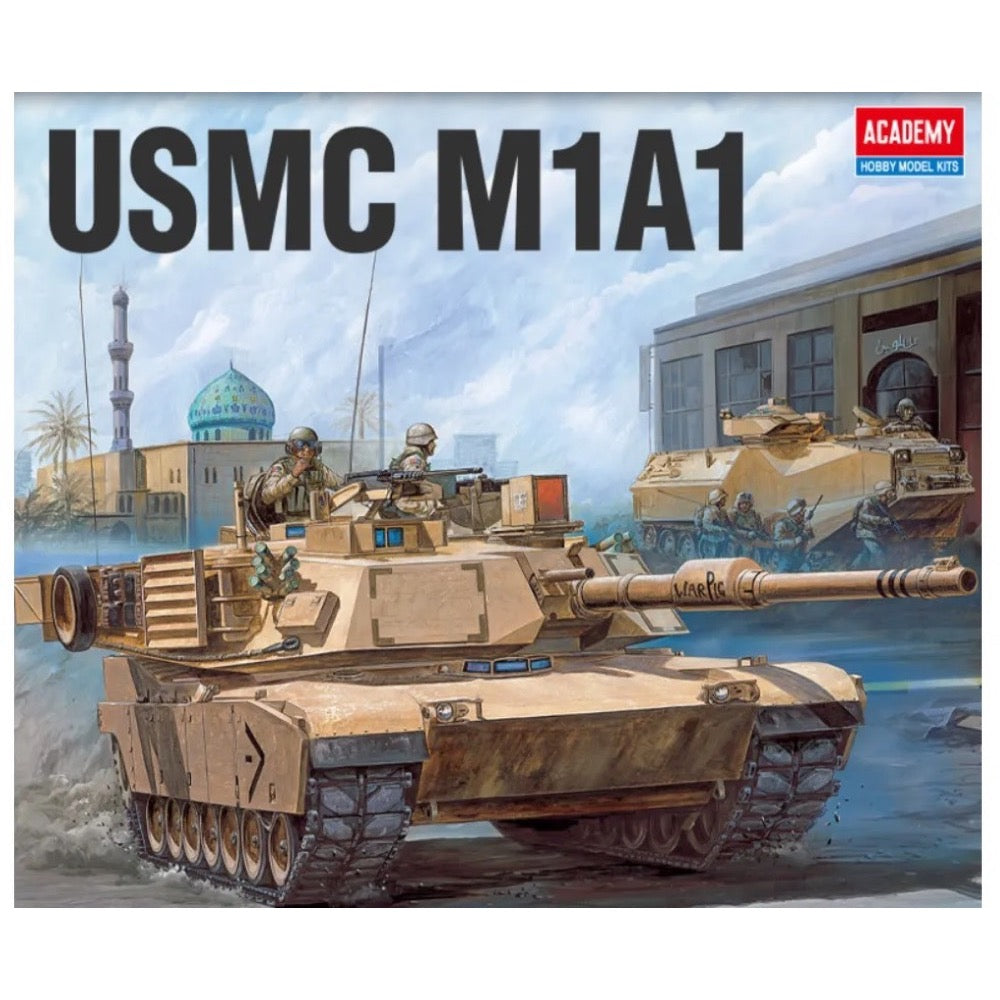
Academy 13430 1/72 USMC M1A1
$23.95
The M1 Abrams, a third-generation American main battle tank, is the backbone of the United States Army and Marine Corps armoured divisions. Renowned for its heavy armour and powerful multifuel turbine engine, the Abrams is a formidable presence on the modern battlefield.
This 1/72 scale model kit by Academy allows you to recreate the iconic M1A1 Abrams in meticulous detail. Explore its sophisticated computerized fire control system and advanced armour plating. Choose from five authentic paint schemes, including a US Marine Corps and an Australian Army variant, and bring this modern military icon to life.
Features
High-quality plastic construction
Detailed 1/72 scale representation of the M1A1 Abrams
Includes a variety of historically accurate details
Features realistic surface textures and panel lines
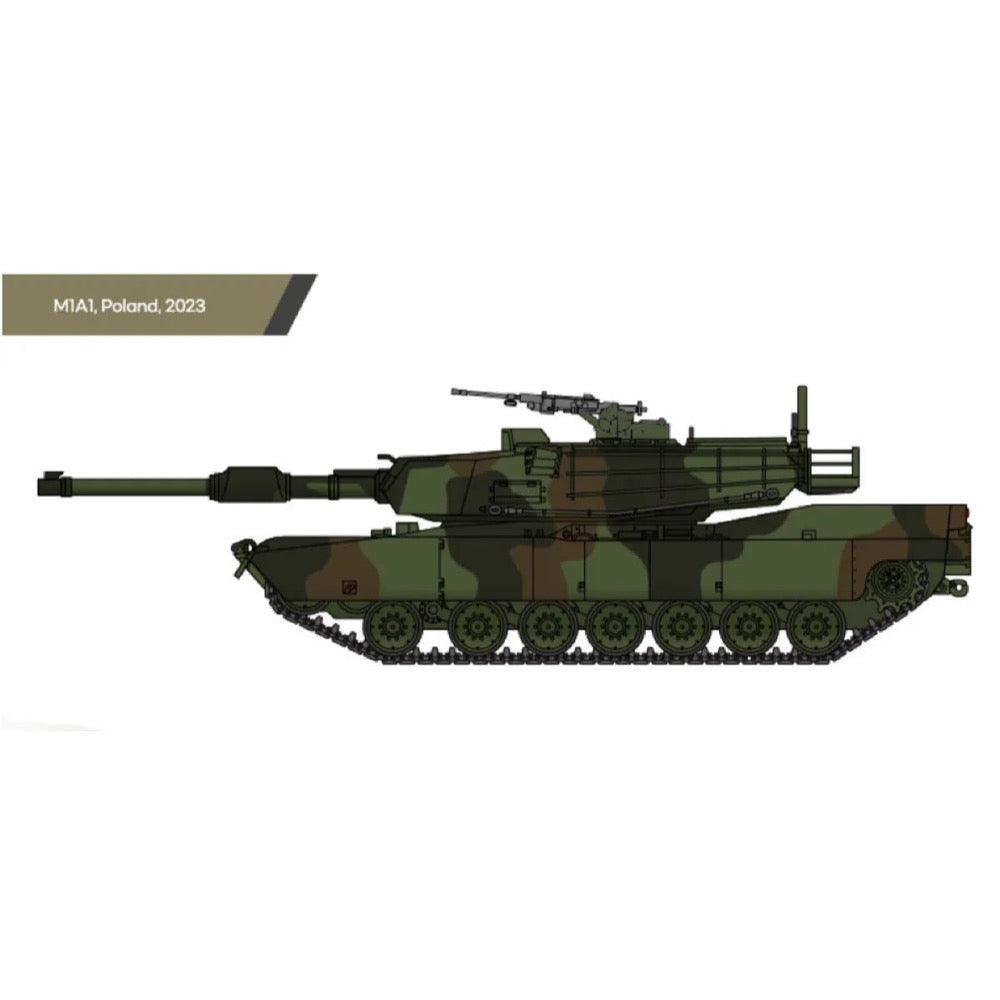
Paint Schemes
M1A1 U.S. Marine. C company, 1st Tank Battalion. Iraq. 2003
M1A1 U.S. Army. B company, 3rd Tank Battalion, 66th Armour Regt. Iraq, 2003
M1A1 Egyptian Army. Cairo. Egypt. 2011
M1A1 Australian Army. B Squadron. 3 Troop, 1st Armoured Regt. 2015
M1A1 Poland, 2023


ACADEMY
Academy 13429 1/72 Merkava ...
$23.95
Following the "Six-Day War," Israel's leader, General Israel Tal, determined that it was time for Israel to have a sufficient and sophisticated armored vehicle. Having scrapped together vehicles from discarded Shermans and Centurions, the time had arrived for Israel to build their tanks. Within nine years of development, the Merkava was born. Manned by four and powered by a Teledyne Continental AVDS-1790 V12 Diesel engine, it was equipped with a 105mm M64 L71A tank gun, a coaxial 7.62mm machine gun, two extra LMGs for the commander and loader. 1989 marks the introduction of Merkava Mk III, the most numerous version in service today. This model faithfully recreates the Merkava Mk.III Tank in 1/72 scale. The fully assembled model is 12.8cm long and 3.8cm wide.
Features
Two roof-mounted 7.62 mm machine guns for use by the commander and loader
A 60mm mortar for firing smoke rounds or suppressing dug-in infantry anti-tank teams
Remote-controlled M2 Browning 0.50 caliber heavy machine gun controlled from the turret
IMI 120mm gun
128mm in length
38mm in width
Includes
Parts for assembling the Merkava Mk.III Tank
MG251 IMI 120mm main gun
7.62mm FN MAG GPMG
M2 heavy machine gun
Semi-connected tracks
Waterslide decals
Detailed manual
Four finishing options
Merkava Mk.III, 188th "Barak" Tank brigade, 1990
Merkava Mk.III Combat-Trainings-Center, 1990/1991
Merkava Mk.III, No.1
Merkava Mk.III, No.20


ACADEMY
Academy 13428 1/72 German A...
$23.95
The Academy 13428 Leopard 2A4 (Polish Painting) 1:72 scale plastic model kit recreates the Leopard 2A4 tank in the colors used by the Polish Army. The Leopard 2A4 is one of the most modern main battle tanks, which has been in service with the Polish Armed Forces since its purchase from Germany in the early 21st century.
The Leopard 2A4 model in Polish paint is a great option for military enthusiasts, especially those interested in the modern Polish armed forces. The set offers a realistic and detailed image of one of the most important tanks used by Poland.
Includes
120mm Rh120/L44 main gun and 7.62mm MG3A1 machine gun
Semi-connected tracks
Decals for 6 versions
Bundeswehr, 361th Pz. Battalion, "Certain Challenge" exercise, West Germany, 1988
Turkish Army, 2th Cavalry Armored Brigade, Turkish-Syrian border, 2016
Turkish Army, 2th Cavalry Armored Brigade, Turkish-Syrian border, 2016
Swiss Army, Pz. 87, 13th Pz. battalion, Steel Army Parade, Thun, 2006
Ejercito de Tierra, Brigada "Extremadura" XI, 16" reg. infanteria mecanizada, 1995
Polish Army, 10th Armored Cavalry Brigade, 1st tank Bn., 2th company, 2012


ACADEMY
Academy 13427 1/72 French A...
$22.95
The first main battle tank independently designed by France. Reboxed Ace Corporation kit. 4 sprues. 120mm CN120-26/52 main gun & 7.62mm AAT-52 NF1 machine gun.
The first prototypes of the French Leclerc 3rd generation main battle tank were made in 1986. Serial production started in 1992, and continues with interruptions (2017) and has resulted in the production of approx. 850 vehicles. The Leclerc tank is powered SAEM UDU V8X 1500 T9 Hyperbar engine with 1500 HP . Its primary armament is the 120mm GIAT CN120-26 / 52 gun, and its auxiliary armament is two 12.7mm and 7.62mm machineguns.
The Leclerc was created in connection with the French army's need for a new main battle tank, intended to replace the AMX-30 or AMX-30B2 tanks with more and more combat capabilities than other Western designs. When designing the new tank on a large scale, modern electronics were used in it, which can be seen especially in the very effective FCS (fire control system), which ensures 95% effectiveness of the first shot! Also, the gun used is in no way inferior to the German or American solutions in the Leopard 2 or M1A1 Abrams tanks. Leclerc is also highly maneuverable and mobile. However, it can be assumed that its armor is of a slightly lower quality than that of other 3rd generation western cars. Another disadvantage is the relatively high price, which in 2001 was estimated at 6.5 million. euro for one tank. The first Leclerc cars reached full combat readiness in the French army in 1995. The only foreign recipient of this vehicle was the UAE, which purchased as many as 436 units - for comparison, the French army purchased 406 units of this tank. Leclerc was used in peacekeeping missions in Kosovo (1999) and in Lebanon (2006), and in combat - in the civil war in Yemen since 2015.
This is an injection-plastic military vehicle model kit.
Includes
5 choice of markings:
(1, 2, 3) Task Force Leclerc, KFOR, Kosovo, 1999
(4, 5) Leclerc T5, France.


ACADEMY
Academy 13422 1/72 Pz. VI T...
$22.95
The Pz.Kpfw VI (Sd.Kfz.181) Tiger is a German heavy tank from World War II, one of the most famous combat vehicles of that time. The German Panzerwaffe command had been carrying around the idea of a heavy tank since the beginning of the war, but the first attempts in the form of the Neubaufahrzeuge multi-tank were unsuccessful. In 1939 and 1940 they were conducted ineffectively, but after the clash with the T-34 and KW-1 on the eastern front, work on the new heavy tank sped up. On April 20, 1942, the prototype of the new tank, under the designation VK 4501 (H), underwent field trials in the presence of Adolf Hitler and was put into mass production shortly after. The first production versions were designated Pz.Kpfw VI Ausf.H1 (later Ausf.E). In the course of production, in the years 1942-1945, the tank was systematically modified by, for example, adding Feifell dust filters, different placement of headlights, modernization of optical equipment, changes to the commander's turret, etc. The drive was provided by a Maybach HL230 P45 12-cylinder carburetor engine with a capacity of 700 HP. The Pz.Kpfw VI tank, although it did not have such a contoured front hull as the T-34 or Pantera, was a heavily armored vehicle (frontal armor up to 120mm), armed with a very effective KwK 36 L / 56 88mm gun, which earned the reputation of being the most effective tank of the Second World War. It was a vehicle much better than the Allied M4 or Churchill and the Soviet T-34/76. He could also easily fight the IS-2 or M-26, surpassing them with the effectiveness of the main armament. On the other hand, the Pz.Kpfw VI had some disadvantages - first of all, it was extremely time-consuming to produce and had a very complicated suspension. In the later period of the war, the quality of the Tiger's armor also deteriorated, which resulted from the lack of access to the molybdenum deposits by the German economy. Despite these drawbacks, the Tiger on the battlefields proved to be a very effective weapon. He successfully fought in Tunisia, the Kursk Arch, Normandy and on the Eastern Front. Technical data: length (with a barrel): 8.45m, width: 3.7m, height: 2.93m, engine power: 700KM, weight: 56.9 t, range (on the road): 100km, maximum speed (on the road) ): 38 km / h, armament: 1 88 mm KwK 36 L / 56 gun, 3 7.92 mm MG 34 machine guns.
This is an injection-plastic military vehicle model kit.


ACADEMY
Academy 13409 1/72 M26 Drag...
$40.95
$44.99
The M26 Dragon Wagon is an American military armored heavy truck from the Second World War. The first cars of this type entered service in 1941/1942 and remained in service until the 1950s. The vehicle was powered by a single engine Hall-Scott 440 with a power of 240 hp. The maximum speed was up to 45 km / h. The armament of the car consisted of a single 12.7 mm machine gun. The M26 Dragon Wagon was developed for the needs of the US Army, which, along with the development of its own armored component, realized that it needed new trucks to transport damaged tanks or to transport them faster by road. Moreover, the new tractor unit was also to have a slightly armored driver's cab. The new car was to complement the M19 line, which entered service in 1940. The M26, compared to the M19, had a clearly more powerful engine, an armored driver's cabin, and was also able to carry much heavier loads. The M26 Dragon Wagon vehicles were used primarily in North-Western Europe in 1944-1945. They were replaced in line by the M123 cars, starting in 1955.
During WWII, when the allies needed to haul something big and heavy, like tanks and other armored vehicles, they used the mighty Dragon Wagon to do the job. Rated to haul vehicles up to 40 tons, the M26 could carry almost any vehicle on its trailer.
Academy's kit of the M26 Dragon Wagon with M25 tractor and M15 trailer is packed with fine detail and features superb molding throughout. The cab interior and complex suspension systems are fully detailed, and the cab's doors and armored visors can be positioned opened or closed. Includes accessories and decals for three versions. Curiously, all three versions (all US Army vehicles) are identified as operating in 1994...a bit of a typo, perhaps? Or did these stalwart beasts of burden actually soldier on in US Army service for more than 50 years?
This is an injection-plastic military vehicle model kit.


ACADEMY
Academy 13404 1/72 German C...
$22.95
This is an injection-plastic military vehicle model kit.


ACADEMY
Academy 1/72 US Cargotruck ...
$22.95
Term 2 , 5 -ton, 6x6 truck (colloquially: deuce and a half) refers to the entire family of medium trucks used by the US armed forces during World War II, but also on a large scale during the Cold War. This family of trucks was designed and produced in the early 1940s for the US Army as a basic 5,000 lb. (2.5 'short' or 2.3 metric) heavy duty truck. terrain and in all weather conditions. From the very beginning it was assumed that these types of cars would be simple in design and that their production would be mass production. During World War II, a total of over 700,000 trucks of this type were created, especially by GMC (CCKW model) and Studebaker. Many of these vehicles found their way to the USSR under the Lend-and-Lease program. The families of these trucks played a gigantic role in the logistics and transport of Allied and Soviet troops during World War II. After 1945, the M35 series trucks were introduced into service, which is also often included in the family 2 , 5 -ton, 6x6 truck.
This is an injection-plastic military vehicle model kit.


ACADEMY
Academy 13296 1/35 US Army ...
$71.95
The M60 Patton was an American 2nd generation Main Battle Tank. The first prototypes of the car were created in the late 1950s, and serial production continued in 1960-1987, ending with the production of over 15,000 copies of this tank. The M60 Patton was powered by an engine Continental AVDA-1790-2 with 750 hp. Armament in the basic version was a 105mm M68 tank gun, 1 12.7mm M85 machine gun and 1 7.62mm M73 machine gun.
Design work on The M60 Patton began as the American intelligence learned that the Soviet Army was going to introduce a new T-62 tank armed with a 115mm gun into the line. In an attempt to respond to this new threat, it was decided to deeply rebuild the M48 tank, creating a de facto new vehicle. First of all, new weapons were used, i.e. the 105mm gun, the armor was significantly strengthened and a new engine with more power was used. The new design was at least comparable to the T-54, T-55 or T-62 tanks, but was inferior to the T-64 and T-72 series vehicles, especially in terms of firepower. Three versions of the M60 were produced in the course of serial production. The first is the M60A1, which entered the line in 1969, had a new turret and even thicker armor. The M60A2 version with a 152mm cannon-launcher capable of firing guided missiles turned out to be a dead end. Finally, the last serial version is the M60A3, which had, above all, a modern fire control system (SKO) with a laser rangefinder and a passive night vision sight. M60 tanks of all versions have been exported to many countries, including: Brazil, Greece, Spain, Israel and Portugal. They also took part in many armed conflicts of the Cold War period, mainly in the Yom-Kippur war of 1973, the Iraqi-Iranian war of 1980-1988 and the war in the Persian Gulf of 1990-1991.
Academy brings us their 1/35 M60A2 Patton scale model kit! This kit features an accurately reproduced turret, cupola, engine grilles, and road wheels. It's an M60 variant with M162 152mm gun launcher. This kit can be assembled with the hatch closed or open. Semi-connected tracks are included, as well as photo-etched parts.
This is an injection-plastic military vehicle model kit.


ACADEMY
Academy 13288 1/35 US Army ...
$69.95
The M10 Wolverine (called Wolverine) is an American tank destroyer from the Second World War. A tank destroyer, a vehicle with high mobility and firepower, was urgently needed in the early 1940s. Efforts were made to speed up the work on the project as much as possible, but it was not accepted until September 1942. The result was a vehicle based on the M4A2 body, slightly flattened at the top, with an unusual semi-open turret. Such a solution, along with minimizing the armor, was supposed to reduce the weight, and thus increase the mobility of the new tank destroyer. The drive was served by 2 coupled 6-cylinder General Motors 6046 engine with a power of 375HP. The M10s were primarily intended for the European theater of operations as a remedy for German armored vehicles. They fought in the Normandy campaign in France and later in Germany in 1945. They also performed well in the fighting in the Apennine Peninsula. They were used by the 1st Armored Division and the 2nd Polish Corps. The M 10 Wolverine was based primarily on its mobility and speed, it had weak armor which made it a rather offensive weapon. Nevertheless, in the hands of a well-trained crew, he could be a formidable opponent. Technical data: length (without barrel): 5.97m, width: 3.05m, height: 2.9m, weight 29.6t, engine power: 375KM, speed (on the road): 50 km / h, armament: 1 cannon H-7 76.2mm and 1 MG Browning HB M2 12.7mm.
This is an injection-plastic military vehicle model kit.


ACADEMY
Academy 13286 1/35 Merkava ...
$79.95
The Merkava (Hebrew for chariot) is an Israeli main battle tank designed since 1974 and entered mass production in 1979. The design team worked under the supervision of Maj. Gen. Izrael Tal - one of the most prominent Israeli armored officers. Merkava is the result of the Israeli army's experience in the Six Day War and the Yom Kippur War. The Israeli Defense Forces commissioned the Merkava tank design to guarantee itself an independent source of heavy combat machinery. The designers of the vehicle were primarily guided by the idea of surviving the vehicle on the battlefield, which is why the Merkava is distinguished by an innovative armor that perfectly protects the crew members, and in the event of damage, it allows you to quickly replace the defective element. The concept of placing the engine at the front of the vehicle is also unique. Four production series were created: Mk.I, Mk.II, Mk.III and Mk.IV, which has been in production since 2001. Compared to the earlier versions in the Mk. III, the suspension has been significantly improved, thus improving the performance and comfort for the crew. A 120mm cannon was also installed, instead of a 105mm cannon. The Mk.III version also has the CVIS command system, which significantly increases its combat value. The armor, guidance and observation systems of the battlefield have been improved in the latest version. According to the fairly unanimous opinion of experts, Merkava and its subsequent modifications provide the Israeli Defense Forces with a decisive advantage over the armored potential of their Arab opponents. Technical data (version Mk.II): length (with a barrel): 8.63m, width: 3.7m, height: 2.66m, weight 60t, engine power: 900KM, speed (on the road): 46 km / h, armament: 1 105mm smoothbore cannon, 3 km caliber 7.62mm and one 60mm mortar.
From Academy comes this top-quality kit of the Merkava Mk.IID. The Markava is an Israeli battle tank built in 1979, used extensively in 1982 Lebanon War.
This is an injection-plastic military vehicle model kit.
Includes
105mm main gun, turret, basket, and two kinds of side skirt from new tooling
Reproduction of ERA armour on upper turret and front body
Optional assembly of two commander's hatches
Highly detailed photo-etched parts
Detailed flexible tracks included
Decals


ACADEMY
Academy 13279 1/35 U.S.ARMY...
$55.95
$78.99
The M36 Jackson or Slugger is an American tank destroyer from the Second World War. The M36 entered combat in the second half of 1944. Despite such a late deadline, he managed to be famous for destroying a large number of enemy vehicles, especially during the German offensive in the Ardennes. Most of the design was based on the proven M10, but a typical turret was introduced that worked in conjunction with the best 90mm M3 anti-tank gun from the American arsenal of the time. Together with the newly introduced new HVAP missiles, it was able to penetrate all German armor without exception. In fact, the M36 Jackson was the only American armored vehicle capable of dealing with the German Tigers and Panthers on its own. The effect of effectiveness was high demand and production, which reached 1,400 units in less than a year. After World War II, M36 continued to be used in fighting in Korea, India's war with Pakistan, and even the Balkan conflicts. In addition to the basic version, two others were produced: M36B1 (turret mounted on the Sherman M4A3 body) and M36B2 (M10 with M36 turret and diesel engine). Technical data: length (with a barrel): 7.46m, width: 3.05m, height: 3.28m, weight 29t, engine power: 450KM, speed: 42km / h, armament: 1 90mm M3 cannon, 1 12.7mm Browning HB M2 machine gun.
From Academy, this is a highly detailed model kit of the U.S. Army M36B1 GMC in 1/35 scale. It features newly molded parts for the engine deck, VVSS, and other accessories. Parts come molded in dark green. Inlcudes photo-etched parts, T48 tracks, and decals for two optional markings.
This is an injection-plastic military vehicle model kit.


ACADEMY
Academy 13267 1/35 Tank Mer...
$54.95
The Merkava (Hebrew for chariot) is an Israeli main battle tank designed since 1974 and entered mass production in 1979. The design team worked under the supervision of Maj. Gen. Izrael Tal - one of the most prominent Israeli armored officers. Merkava is the result of the Israeli army's experience in the Six Day War and the Yom Kippur War. The Israeli Defense Forces commissioned the Merkava tank design to guarantee itself an independent source of heavy combat machinery. The designers of the vehicle were primarily guided by the idea of surviving the vehicle on the battlefield, which is why the Merkava is distinguished by an innovative armor that perfectly protects the crew members, and in the event of damage, it allows you to quickly replace the defective element. The concept of placing the engine at the front of the vehicle is also unique. Four production series were created: Mk.I, Mk.II, Mk.III and Mk.IV, which has been in production since 2001. Compared to the earlier versions in the Mk. III, the suspension has been significantly improved, thus improving the performance and comfort for the crew. A 120mm cannon was also installed, instead of a 105mm cannon. The Mk.III version also has the CVIS command system, which significantly increases its combat value. The armor, guidance and observation systems of the battlefield have been improved in the latest version. According to the fairly unanimous opinion of experts, Merkava and its subsequent modifications provide the Israeli Defense Forces with a decisive advantage over the armored potential of their Arab opponents. Technical data (version Mk.II): length (with a barrel): 8.63m, width: 3.7m, height: 2.66m, weight 60t, engine power: 900KM, speed (on the road): 46 km / h, armament: 1 105mm smoothbore cannon, 3 km caliber 7.62mm and one 60mm mortar.
This is an injection-plastic military vehicle model kit.

ACADEMY
Academy 13241 1/35 Tank M10...
$28.95
High Mobility Multipurpose Wheeled Vehicle (HMMWV or commonly Humwee or Hummer) is a term for a family of 4-wheeled, light multipurpose vehicles from the Cold War and contemporary times. The first vehicles of this type entered service in the early 1980s, and over 280,000 HMMWVs were produced. A single vehicle is 4.57 m long, with a wheelbase of 3.3 m and a width of 2.16 m. The drive can be provided by one of three engines with a capacity of 5.7 to 6.5 litres. The drive is always provided by an automatic gearbox with 3 or 4 gears. The maximum speed of an empty vehicle on the road is about 115 km/h.
This is an injection-plastic military vehicle model kit.

ACADEMY
Academy 13229 1/35 King Tig...
$78.95
PzKpfw VI Ausf. B Tiger II or colloquially Konigstiger (Polish royal tiger) was a German heavy tank from World War II. The first prototypes of the vehicle were built in 1943, and serial production continued in 1944-1945, ending with the production of 487 vehicles. The Tiger II was powered by a single Maybach HL 230 P30 engine producing 700hp. It was armed with 1 88mm PaK 43 L / 71 gun and 2 7.92mm MG34 machine guns.
PzKpfw VI Ausf. The B Tiger II was created in connection with the commission by Albert Speer in January 1943 of the Henschel and Porsche plants to design a new heavy tank for the German armed forces. The first prototypes were ready by October this year, and a car designed by the Henschel company entered mass production, with 50 units of the new tank having a tower designed by Porsche (the so-called Porsche tower). The royal tiger had a great anti-tank gun, capable of destroying any armored vehicle of the Red Army or Allies at the time at a distance of 1500-2000 m. It was also very well armored, and its armor was carefully contoured. In fact, the new German tank was unattainable for most enemy vehicles at distances above 1000-1200 m. Undoubtedly, the Tiger II had numerous disadvantages: first of all, the engine was definitely too weak, which was the same as the 11 tons lighter Tiger I. The gearbox was also damaged. and the entire driveline system, which was extremely failing and prone to failure. The Tiger II was also incredibly time-consuming and expensive to produce, which, taking into account the difficult situation of Germany on the fronts in the period 1944-1945, was also a big minus. The Royal Tiger underwent its baptism of fire during the Normandy operation in the summer of 1944 as part of the 503rd Heavy Tank Battalion and 101st SS Heavy Tank Battalion. Later, units equipped with these tanks also fought on the Eastern Front in 1944-1945, and perhaps the largest number of Tiger II tanks in one operation was used in the offensive in the Ardennes at the turn of 1944-1945.
As they say, you can never have too many Tiger kits. And here's one more: the final production version of the monstrous King Tiger! This all-new tooling includes photo-etched metal detail parts and two crew figures. Decals by Cartograf.
This is an injection-plastic military vehicle model kit.


ACADEMY
Academy 13227 1/35 Merkava ...
$58.95
$69.99
The Merkava (Hebrew for chariot) is an Israeli main battle tank designed since 1974 and entered mass production in 1979. The design team worked under the supervision of Maj. Gen. Izrael Tal - one of the most prominent Israeli armored officers. Merkava is the result of the Israeli army's experience in the Six Day War and the Yom Kippur War. The Israeli Defense Forces commissioned the Merkava tank design to guarantee itself an independent source of heavy combat machinery. The designers of the vehicle were primarily guided by the idea of surviving the vehicle on the battlefield, which is why the Merkava is distinguished by an innovative armor that perfectly protects the crew members, and in the event of damage, it allows you to quickly replace the defective element. The concept of placing the engine at the front of the vehicle is also unique. Four production series were created: Mk.I, Mk.II, Mk.III and Mk.IV, which has been in production since 2001. Compared to the earlier versions in the Mk. III, the suspension has been significantly improved, thus improving the performance and comfort for the crew. A 120mm cannon was also installed, instead of a 105mm cannon. The Mk.III version also has the CVIS command system, which significantly increases its combat value. The armor, guidance and observation systems of the battlefield have been improved in the latest version. According to the fairly unanimous opinion of experts, Merkava and its subsequent modifications provide the Israeli Defense Forces with a decisive advantage over the armored potential of their Arab opponents. Technical data (version Mk.II): length (with a barrel): 8.63m, width: 3.7m, height: 2.66m, weight 60t, engine power: 900KM, speed (on the road): 46 km / h, armament: 1 105mm smoothbore cannon, 3 km caliber 7.62mm and one 60mm mortar.
Nobody does tanks quite like the Israeli Defense Forces, as exemplified by the unique form of the IDF's MBT, the Merkava. The Mark IV LIC is the latest version of this very capable tank, with the most evident signs of evolution being the addition of tons (literally!) of modular armor to the turret, giving it a totally different look than earlier versions. The Merkava packs a mighty wallop with its 120mm main gun, and offers its crew excellent protection with its thick armored hide and front-mounted engine.
Academy's kit of the Merkava Mk. IV LIC features new parts added to its previously released Mk. IV kit. Sharply molded in light tan plastic, the kit features amazing detail, with a nice fret of photo-etched metal detail parts thrown in. The tracks are very nicely detailed injection-molded link-and-length assemblies (no flexible belts here). Markings are included for one vehicle. Includes two figures.
This is an injection-plastic military vehicle model kit.


ACADEMY
Academy 13211 1/35 M113 Ira...
$56.95
$64.99
The M113 is an American armored personnel carrier. The first designs were created in 1956, and serial production at FMC started in 1960. It lasted until 1987 and resulted in the production of 73,000 copies of this vehicle for the US Army's own needs as well as for export. The M113 entered service in as many as 45 countries, including Israel, Spain, Italy, Greece and Germany. The M113 is the most popular transport in the world and forms the basis for the world's largest family of armored vehicles. The M113 hull is constructed of steel and aluminum, with welded armor. This lowers the weight, but protects the crew only against small caliber ammunition. The Israeli army uses Rafael TOGA armor to correct this shortcoming. The driving position is located at the front left and the engine at the front right of the vehicle. Landing soldiers (up to 7 people) sit on benches along the hull and start the fight via the ramp located at the back of the transporter, which is hydraulically lowered. The basic M113 is able to overcome water obstacles, driven by tracks. The M113 was involved in a very large number of conflicts among others. in the Vietnam War, in the Yom Kippur War, in Operation Desert Storm, and in the 2003 Iraq War. In the US Army, it is systematically replaced by the M2 Bradley car. Among the huge family based on the M113 chassis, one can mention the American M901, which is armed with a TOW launcher, or the Israeli M113 Fitter with a special crane mounted, which is the basic vehicle of the Israeli repair and repair services in armored battalions. Fitter is also used by Australia and Belgium. Technical data (version M113A3): length: 4.86m, width: 2.69m, height: 2.54m, weight 12.1t, engine power: 266KM, speed (on the road): 66km / h, armament: 1 machine gun 12.7mm caliber.
Academy's kit of an M113A3 as deployed to Iraq in 2003 features interior parts, exterior accessories and storage racks, a positionable rear door, and your choice of flexible belt-style and indy-link tracks. Includes exploded-view pictorial-type instructions, with some notes in English and Korean.
This is an injection-plastic military vehicle model kit.
ACADEMY
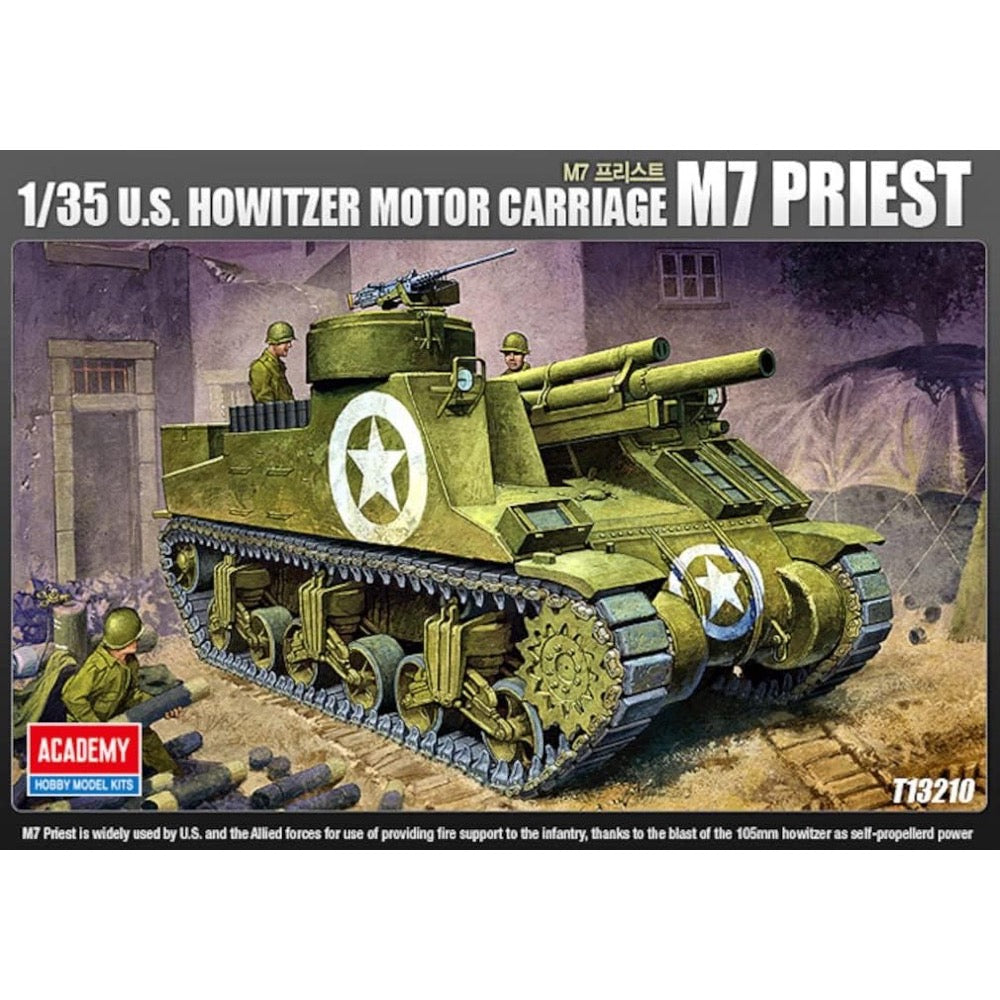
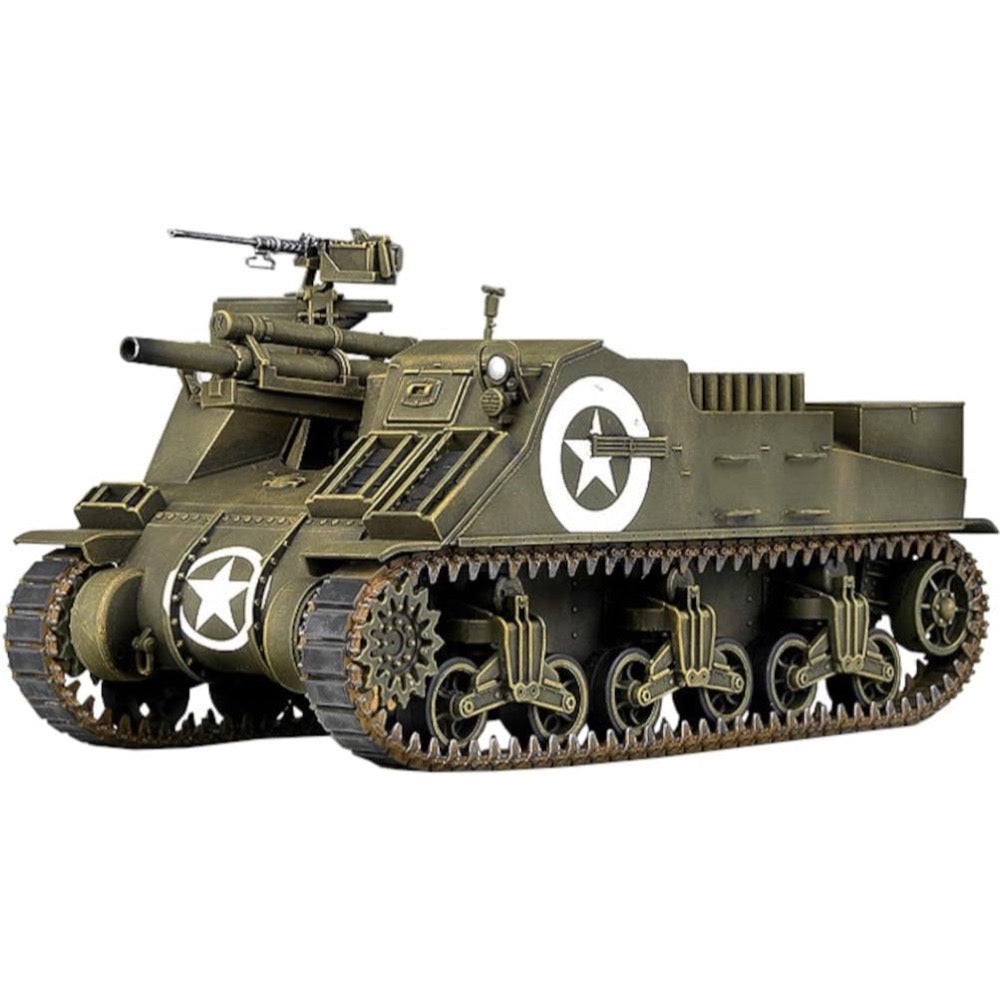
Academy 13210 1/35 M7 Priest
$56.95
$69.99
Academy's 1/35 scale M7 Priest contains new tooling, and a whopping 318 parts. The flexible one-piece track, the new movable 105mm Howitzer, and new armor ride on new tooled suspension as well. The finite exterior, transmission & interior drive station detail can be seen on this historically faithful scale model. Both .50 & .30 caliber guns and accessories are included. Academy has given modelers a precise decal set and paint instructions allowing one of four M7 'Priests' to be built.
Features
Over 318 parts
Decals to build one of four historical models
Early version modeled with Verticle Volute Spring Suspension (VVSS)
Single, flexible one-piecemolded track for ease of assembly
Moveable 105mm Howitzer


ACADEMY
Academy 12645 1/144 USAF B-...
$42.95
The U.S. Air Force stealth strategic bomber B-2A Spirit is now available in 1/144 scale with a completely new mold.
The kit precisely reproduces the aircraft's flying wing shape, panel lines, bomb bay, and mounted armaments (including GBU-57), emphasizing its stealth design.Includes 5 types of U.S. Air Force decals and masking stickers for the canopy.
Features
Precisely Reproduced cockpit, bomb bay and landing gear
Stealth strategic bomber of the US Air Force with a flying wing design
Select from Five different Markings
Accurately engraved panel live
Includes masking Seal