

Reset


ACADEMY
Academy 12651 1/144 Boeing ...
$58.95
Boeing E-737 “Peace Eye”
Academy have really done a great job with their 1/144 models. ACA-12635, P-8A Poseidon has been insanely popular so this kit will even more so. In RAAF service this aircraft is known as the “Wedgetail” and is operated by #2 Squadron at RAAF Williamtown, so we are fortunate to see these aircraft on a regular basis.
This aircraft has been in the news quite a lot recently so awareness of, and interest in this model should work in retailers’ favour. Two, (2) instruction booklets, masks, kit decals by Cartograph, four, (4) sprues of grey plastic and one transparent sprue are included in the box.
Added to this we have been working with Ronin Graphics to produce locally a very comprehensive decal option. We will be including two, (2) additional masking sheets, a full set of decals that will allow the modeller to build any of the RAAF Wedgetails currently is service, and three, (3) double sides pages of instructions complete the additions!
Features
The product reproduces the form of the base aircraft, the Boeing 737-300, the large radar antenna added to the rear of the aircraft, and the panel lines of each part with precise moulding.
Includes decal set and markings for RAAF service.


ACADEMY
Academy 13566 1/35 R.O.K. A...
$58.95
Academy brings us a 1/35-scale, completely new-mold model kit of the K21 infantry fighting vehicle currently in use by the South Korean Army! The complex details of this modern combat vehicle are expressed with precise molding; each hatch can be built opened or closed. The tracks are molded from soft resin, and stickers for each periscope lens, photo-etched parts, and South Korean Army decals are also included.
Includes
Decals, photo-etched parts


ACADEMY
Academy 13277 1/35 Hetzer P...
$39.95
1/35 Hetzer "Prague Uprising 1945"
This kit accurately recreates the late-war German tank destroyer used during the Prague Uprising. Based on the Jagdpanzer 38(t) chassis, this kit captures the Hetzer's low profile, sloped armor, and effective firepower. It includes fine surface detailing, a historically themed finish, and requires glue and paint for assembly. Perfect for historical modelers, this kit highlights the vehicle's role in one of the final conflicts of WWII in Eastern Europe.
Features
1/35 scale replica of Hetzer tank destroyer
Includes detailed sloped armor and compact design
Features intricate surface textures and casting detail
Comes with premium Cartograf decal sheet
Historically accurate markings and finishes
Requires glue and paint for assembly
'Cartograf' Premium Quality Decal Included
This kit features high-resolution decals by Cartograf, the decals apply smoothly and enhance the final finish with vibrant, historically accurate markings that bring the Hetzer to life.
History
The Jagdpanzer 38(t), commonly known as the Hetzer, was a German tank destroyer used during the latter part of World War II. Built on the chassis of the reliable Czechoslovak Panzerkampfwagen 38(t), the Hetzer featured a new low-profile, sloped-armored superstructure designed for ambush tactics and defensive operations. Armed with a 75mm Pak 39 L/48 gun, it combined effective firepower with compact size and affordability, making it suitable for mass production. Its small silhouette made it hard to detect and hit, a critical advantage in late-war battlefield conditions.
The Hetzer was produced primarily by the Škoda factory in occupied Czechoslovakia, with over 2,800 units built between 1944 and 1945. It saw action on both the Eastern and Western Fronts and was praised for its mobility, concealment, and reliability. After the war, Czechoslovakia continued to produce and operate the Hetzer under the designation ST-I, using it well into the postwar years. Its service during the Prague Uprising of 1945 makes this variant historically significant and a favorite subject for modelers and military history enthusiasts alike.


ACADEMY
Academy 12656 1/144 B-26B M...
$16.95
US Air Force B-26B Marauder Medium Bomber
This Academy 1/144 scale model kit recreates the Martin B-26B Marauder, a fast and formidable medium bomber of World War II. Known for its speed and resilience, the B-26 served with distinction in the European and Mediterranean theatres, delivering precision strikes while enduring heavy enemy fire. The kit provides fine surface detail, accurate proportions, and a choice of authentic markings
Fast, twin-engine medium bomber used by the USAAF during World War II. Entering service in 1941, it featured tricycle landing gear, a sleek fuselage, and was powered by two Pratt & Whitney R-2800 radial engines. Early handling challenges were addressed through design changes, including a broader wingspan and tail. Armed with multiple .50 cal machine guns and capable of carrying up to 4,000 lbs of bombs, the B-26 saw extensive use in Europe and the Mediterranean. Over 5,200 were built, also serving with the RAF and Free French forces.
Features
Reissued Minicraft kit.
3 sprues plus clear parts.
Choice of 3 markings: (1) B-26B-25-MA Marauder 131773/PN-O “Flak-Bait” (S/N 41-31773); (2) B-26C-45-MO Marauder 2107614/RJ-H (S/N 42-107614); (3) B-26B-25-MA Marauder 31788/PN-A (S/N 41-31788).
History
The Martin B-26 Marauder was introduced in 1941 as a high-speed twin-engine medium bomber for the US Army Air Forces. Initially criticised for its difficult handling, subsequent modifications transformed it into a durable and reliable aircraft, earning the nickname “Widowmaker” before proving its worth in combat. The Marauder became a workhorse in Europe and the Mediterranean, excelling in precision strikes against bridges, rail lines, and supply depots. One of the most famous aircraft, “Flak-Bait,” flew more than 200 missions—more than any other American bomber in WWII. With over 5,200 built, the B-26 also served with Allied forces including the RAF and Free French Air Force, leaving a legacy as one of the most effective medium bombers of the war.


ACADEMY
Academy 12592 1/72 USMC F-3...
$54.95
US Marines F-35B Lightning II VMFA-242 “Bats” Fighter Aircraft
This 1/72 Academy Scale Model F-35B Lightning II kit depicts the STOVL (short take-off and vertical landing) variant of the modern multirole stealth fighter. Operated by the United States Marine Corps and the Japan Maritime Self-Defense Force, the F-35B is capable of flying from carriers and amphibious assault ships, combining stealth, versatility, and advanced combat systems.
History
The Lockheed Martin F-35B Lightning II is the world’s first operational supersonic stealth fighter with vertical landing capability. Designed for expeditionary operations, it allows forces to project air power from carriers and forward bases with limited runways. VMFA-242 “Bats” was one of the first USMC squadrons to deploy the F-35B in the Pacific, working alongside Japan’s retrofitted Izumo-class carriers. Since 2025, this partnership has demonstrated the strategic importance of the F-35B in regional defence. With cutting-edge sensors, advanced avionics, and multi-role capability, the F-35B continues to strengthen allied air power in modern conflicts.
Features
1/72 scale plastic model kit
Features detailed cockpit, weapons bay, and landing gear
Includes lift fan housing for STOVL configuration
Accurate surface panel lines and stealth contours
Decals for USMC VMFA-242 “Bats” and JMSDF Izumo-based aircraft
Note: This model kit requires assembly and painting. Glue, paints and tools are not included and must be purchased separately.


ACADEMY
Academy 12575 1/72 USMC CH-...
$37.95
The Sikorsky CH-53 Sea Stallion is a heavy, American-made transport helicopter with a metal structure in a classic layout with a main rotor and a tail rotor on the beam. The drive is provided by two General Electric T-64-GE-413 engines with a capacity of 3925 KM each. The flight of the first prototype took place in 1964, and serial production continued in 1966-1978. It is estimated that about 510 copies of this helicopter were built.
The Sikorsky CH-53 Sea Stallion was created in response to a tender for a new transport helicopter launched by the Marine Corps in 1959. The new machine was to be able to launch freely, have a loading ramp at the rear of the hull and carry about 50-60 soldiers. All these criteria were met by the machine of the Sikorsky concern. Many development versions of this very solid helicopter were created in the course of serial production. One of them was the CH-53D version with a stronger hull structure, better performance and higher lifting capacity. Another was the search and rescue version, designated CH-53GE. There were also versions dedicated to foreign recipients with changed avionics or engines (e.g. CH-53G created for the needs of German aviation of land forces). The CH-53 helicopter took an active part in the Vietnam War (1964 / 1965-1975). It has also been exported to several countries, including Austria, Germany, Israel and Mexico.
Features
Tail boom can be built straight or folded
Rear ramp can be built open or closed
Two pilot figures included
Highly detailed cockpit and landing gear
Fully engraved panel lines


ACADEMY
Academy 12138 1/35 USMC UH-...
$84.95
US Marines UH-1Y Venom Utility Helicopter
The Academy 1/35 scale UH-1Y Venom kit replicates the modernised Huey operated by the United States Marine Corps. Equipped with upgraded engines, a four-blade rotor, and advanced avionics, the UH-1Y excels in troop transport, close air support, and medevac roles. This kit captures the versatility and modern features of this key USMC utility helicopter.
The UH-1Y Venom was developed as part of the H-1 upgrade program to replace the ageing UH-1N Hueys. Entering service in the late 2000s, the Venom shares over 80% of its components with the AH-1Z Viper, reducing logistical challenges while improving combat readiness. With its advanced avionics, enhanced survivability, and greater lift capacity, the UH-1Y has been widely used in Iraq, Afghanistan, and beyond, demonstrating reliability in both combat and humanitarian missions. As the modern incarnation of the legendary Huey, the Venom continues to serve as a critical asset to the United States Marine Corps.
Features
A highly modernized version of the legendary UH-1 "Huey," featuring a new four-bladed composite rotor system for enhanced performance and durability.
Shares a high degree of parts commonality (85%) with the AH-1Z Viper, simplifying maintenance and reducing logistical costs for the Marine Corps.
Equipped with a modern "glass" cockpit and advanced avionics, providing pilots with superior situational awareness.
A versatile multi-role platform, capable of performing a wide range of missions, including troop transport, medical evacuation, and fire support.
Contents
Plastic parts for assembling the USMC UH-1Y Venom
Instruction sheet
Paint layout sheet
Five distinct decal schemes
ACADEMY
Academy CAT Cyber Hobby Cat...
$4.95
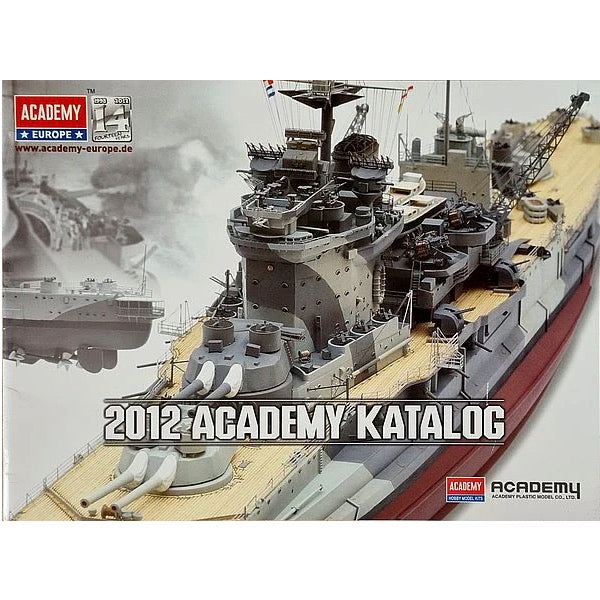
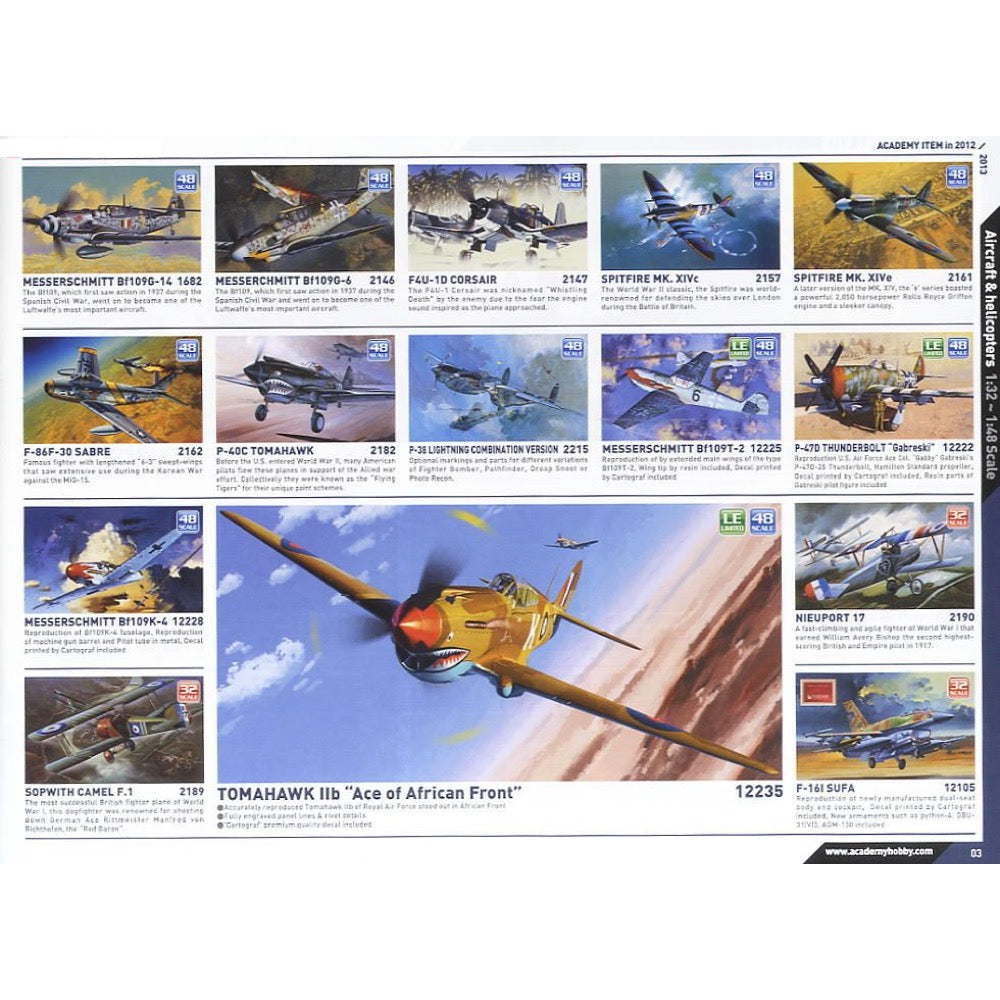
See what Cyber-Hobby has to offer in 2012! Softcover. All text is in English.
This is a English-language hobby product catalog.
ACADEMY
Academy 18175 Davinci Lever...
$24.95
$36.99
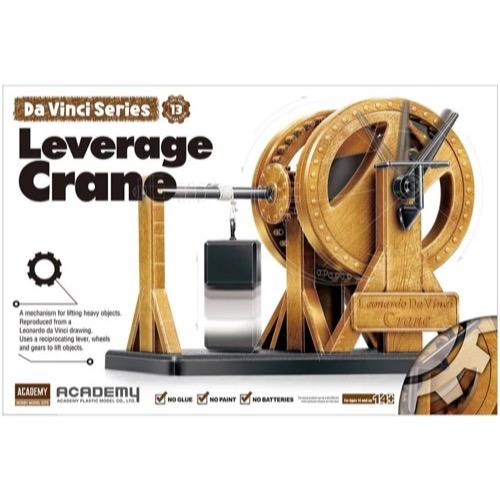
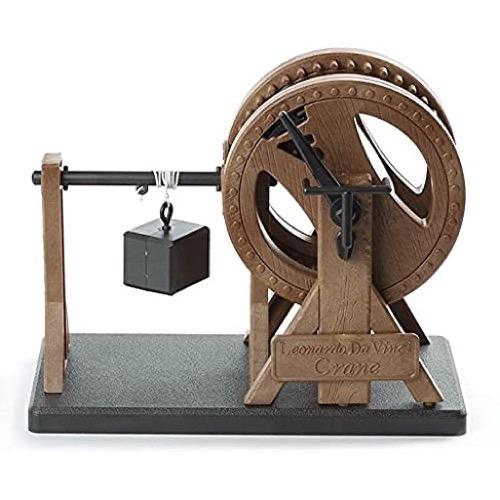
Leonardo Da Vinci (born in 1452, died in 1519) was undoubtedly one of the most brilliant people of the Renaissance and is widely regarded as one of the most talented people in history. He was not only an exceptionally talented painter, author of such masterpieces as "The Lady with an Ermine" or "The Last Supper", but also an extremely prolific inventor and innovator. One of his many inventive designs was a specific Leverage Crane, which used a ratchet mechanism and a rack and pinion mechanism. This crane was supposed to be able to lift materials of considerable mass, using a relatively small force acting on its mechanisms. The use of a ratchet mechanism also meant that the crane could only turn in one direction during rotation. It is worth adding that during the design of this device, Leonardo da Vinci proved to be a great expert on the principles of mechanics.
In addition to many iconic works of art and inventions, the restless mind of Leonardo Da Vinci (1452-1519) was frequently occupied with adding to his voluminous notebooks, filled with designs for machines and structures. This model kit reproduces one of those designs -- a leverage crane! Attach the included weight to the cable and use the ratchet lever to lift it up. This kit assembles without the need for glue, and instructions in English are included.
This is an assembly kit of a space exploration vehicle or other non-fictional mechanism.

ACADEMY
Academy 18153 1/35 DaVinci ...
$28.95
Leonardo Da Vinci (born in 1452, died in 1519) was undoubtedly one of the most brilliant people of the Renaissance and is widely regarded as one of the most talented people in history. He was not only an exceptionally talented painter, author of such masterpieces as "The Lady with an Ermine" or "The Last Supper", but also an extremely prolific inventor and innovator. His great talent in this matter was realized on many levels (flying machines, cannons, etc.), including in the field that today could be called civil engineering. A prime example of this is the design of the Arch Bridge, which would be made of wood. Its biggest advantage would be the possibility of rapid erection and relatively low cost. It is worth adding that if it were to be built, it would in fact be a self-supporting bridge of considerable strength. This seemingly simple design also shows Leonardo Da Vinci's considerable knowledge of the horizontal forces acting on structures and the arc loads on them. He probably acquired his knowledge during his stay in Milan in the years 1487-1489.
This model of the famous arch bridge designed by Leonardo da Vinci uses a self-supporting arch concept to distribute weight throughout the full curve of the arch. Glue and paint are not required for this easily-assembled kit. Includes a sturdy cardboard storage box for parts.
This is a model kit of a building or other structure.

ACADEMY
Academy 18142 Da Vinci Spri...
$29.95
Leonardo Da Vinci (born in 1452, died in 1519) was undoubtedly one of the most brilliant people of the Renaissance and is widely regarded as one of the most talented people in history. He was not only an exceptionally talented painter, author of such masterpieces as "The Lady with an Ermine" or "The Last Supper", but also an extremely prolific inventor and innovator. His great talent was also realized in the construction of war machines and artillery. One of his projects was the so-called Spingard. It was, in essence, a design of a field cannon on a two-wheeled tow truck, which had a wooden "artillery shield" on top to protect the gunner from enemy fire. Interestingly, the project also assumed the use of a mechanism that allows the barrel to rotate horizontally, without moving the entire trailer. Originally, it was assumed to fire from this machine with stone balls and various types of large arrows. Later, however - most likely - Leonardo tended to use shotguns. It is worth adding that the sketch of this gun is located in the so-called The Atlantic Codex, i.e. the collection of notes by Leonardo da Vinci from 1489-1492.
In addition to many iconic works of art and inventions, the restless mind of Leonardo Da Vinci (1452-1519) was frequently occupied with adding to his voluminous notebooks, filled with designs for machines and structures. This model kit reproduces one of those designs -- a retractable cannon! The elevation angle and azimuth angle can be changed, and it also can be loaded and fire spear-shaped parts. This kit assembles without the need for glue, and instructions in English are included.
This is an assembly kit of a space exploration vehicle or other non-fictional mechanism.
Features
Easy to build
Complete step-by-step instructions
No glue, no paint and no tools needed
Beautifully detailed
ACADEMY
Academy 18138 Da Vinci Mech...
$32.95
$36.99
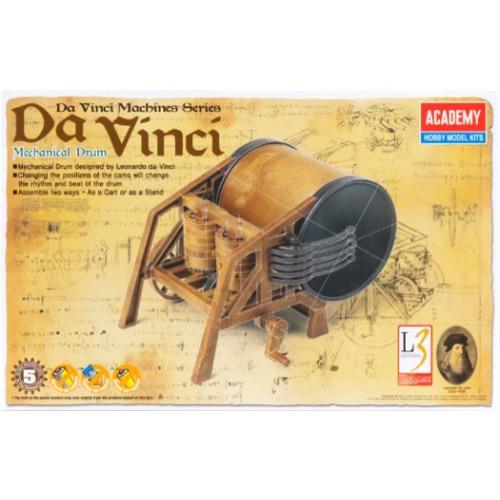
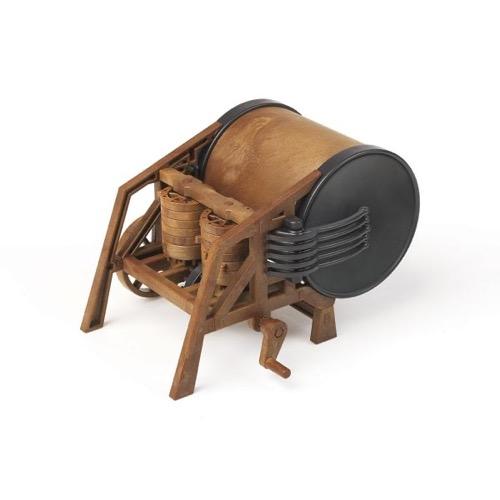
Leonardo Da Vinci (born in 1452, died in 1519) was undoubtedly one of the most brilliant people of the Renaissance and is widely regarded as one of the most talented people in history. He was not only an exceptionally talented painter, author of such masterpieces as "The Lady with an Ermine" or "The Last Supper", but also an extremely prolific inventor and innovator. One of his great passions was music, and this passion led to the design of one of Leonardo's most unusual inventions - the Mechanical Drum. Based on two drawings from the Atlantic Codex, i.e. a collection of notes by Leonardo da Vinci from 1489-1492, it can be concluded that the drum was designed to be used in a variety of situations - both military and civil. The construction was based on placing the drum in front of the device and the use of two wooden rollers rotated by a crank, to which the sticks were to be attached to beat the beat. Interestingly, the sticks and rollers could be set to punch the desired rhythm or melody. The drum was also placed on a circular "chassis", which mechanically beat the rhythm as the device was moved!
In addition to many iconic works of art and inventions, the restless mind of Leonardo Da Vinci (1452-1519) was frequently occupied with adding to his voluminous notebooks, filled with designs for machines and structures. This model kit reproduces one of those designs -- a mechanical drum fitted with a device to play it automatically! It can be assembled on a cart or a stand; assembles without the need for glue, and instructions in English are included.
This is an assembly kit of a space exploration vehicle or other non-fictional mechanism.

ACADEMY
Academy 18137 Da Vinci Cata...
$32.95
Leonardo Da Vinci (born in 1452, died in 1519) was undoubtedly one of the most brilliant people of the Renaissance and is widely regarded as one of the most talented people in history. He was not only an exceptionally talented painter, author of such masterpieces as "The Lady with an Ermine" or "The Last Supper", but also an extremely prolific inventor and innovator. One of the areas that he was keenly interested in was the then military technology, and among the designs of his inventions, you can also find a much improved catapult. This modernization consisted mainly in the addition of two wooden, flexible arms that moved the lever to which in turn was attached a beam with a catapult missile. Thanks to this seemingly simple innovation, the power of the shot increased significantly, which allowed to increase the range of the fire or the penetrating force of the bullet. It is worth adding that Leonardo probably assumed the use of stone or cast metal projectiles. It is worth adding that a few sketches of the above-described catapult are in the so-called The Atlantic Codex, i.e. the collection of notes by Leonardo da Vinci from 1489-1492.
Build your own plastic model Catapult Machine with this quality scale kit
This high quality plastic kit is a to scale model that will require assembly and may require additional tools, sold separately.

ACADEMY
Academy 18136 Da Vinci Armo...
$28.95
$34.99
Leonardo Da Vinci (born in 1452, died in 1519) was undoubtedly one of the most brilliant people of the Renaissance and is widely regarded as one of the most talented people in history. He was not only an exceptionally talented painter, author of such masterpieces as "Lady with an Ermine" or "The Last Supper", but also an extremely prolific inventor and innovator. Among the sketches of many of his inventions, one can find, for example, a design of a combat machine, which is often called a tank nowadays. The project was made by a brilliant Italian in 1487, when it was under the patronage of Ludovico Sforza. The project assumed the creation of an oval vehicle with a turtle-like "armor" at the top, made of wood and reinforced with iron elements. The slope of this "armor" was to encourage the ricocheting of enemy missiles. The vehicle was to be powered by four or six men setting a special mechanism in motion. The "tank" was to be armed with a series of light guns placed around the mahcina hull. The project was never realized during the lifetime of its genius inventor.
Leonardo da Vinci is widely considered to have been one of the most brilliant minds in history, with an impressive resume in the arts, literature, the sciences, engineering, and many other pursuits. This is a pre-painted kit of his amazing design for an "armored car"--although this design has been proven to be impractical as it is (the vehicle would be able to rotate in place, but moving forward would be impossible), this invention is an obvious precursor to the powerful tanks that have become a mainstay of modern-day warfare. Salute the first-ever "Renaissance man" and add a cool historical touch to your collection! Assembly required.
This accurately detailed plastic model kit of Leonardo Da Vinci's armored car operates by mechanical spring. No painting or glue required!
This is an assembly kit of a space exploration vehicle or other non-fictional mechanism.


ACADEMY
Academy 18129 Davinci Self-...
$35.99
Leonardo da Vinci was an Italian polymath painter, sculptor, architect, musician, scientist, mathematician, engineer, inventor, anatomist, geologist, botanist and writer. Leonardo has often been described as the archetype of the Renaissance man, a man whose unquenchable curiosity was equaled only by his powers of invention. He is widely considered to be one of the greatest painters of all time and perhaps the most diversely talented person ever to have lived.
Leonardo was also revered for his technological ingenuity. He conceptualized, among many others, a helicopter, a tank, a paddleboat, a self-propelling cart, concentrated solar power, a calculator, the double hull and outlined a rudimentary theory of plate tectonics. Relatively few of his designs were constructed or were even feasible during his lifetime, but some of his smaller inventions, such as an automated bobbin winder and a machine for testing the tensile strength of wire, entered the world of manufacturing unheralded. As a scientist, he greatly advanced the state of knowledge in the fields of anatomy, civil engineering, optics, and hydrodynamics.
Spring powered cart, possibly the first robot in history, probably designed to bring self-moving characters on the stage in theatrical productions. Uses a power equipment unit designed by Leonardo da Vinci
Features
Easy to build
Complete step-by-step Instructions
No glue, no paint, no tools needed
Beautifully detailed


ACADEMY
Academy 15617 1/24 BRISA
$65.95
Enter the world of style and adventure with the 1:24 Academy 15617 Kia Brisa - MCP with Girl Driver Figure, now available on Most-Models.com! This beautiful scale model brings the elegance of the Kia Brisa and the charm of a Girl Driver to the center of your model collection.
Features
Meticulously crafted to capture the elegant lines and details of this South Korean car. From the streamlined body to the refined finish, every aspect exudes class.
With a scale ratio of 1:24, this model provides a detailed overview of the Kia Brisa, while still being a suitable size for different display areas.
This model kit comes with a Girl Driver Figure, adding a unique and vibrant element to your display.
Made of high-quality materials, this model guarantees durability and maintains its refined appearance. It is a valuable addition for both experienced modelers and enthusiastic beginners.
With detailed instructions, assembling this model provides an enjoyable experience. It's a great opportunity to enjoy the building process and improve your model making skills at the same time.


ACADEMY
Academy 14229 1/700 USS Yor...
$56.95
$64.99
USS Yorktown (CV-5) was an American aircraft carrier laid down in 1934, launched in April 1936, and commissioned with the US Navy in September 1937. The ship was 246.7 meters long, 33.4 meters wide, and had a full displacement of 25,500 tons. The top speed of the USS Yorktown aircraft carrier was around 32-33 knots, and its main armament consisted of 85 on-board planes.
USS Yorktown was the first class aircraft carrier to bear the same name. The experience gained during the operation of Lexington-type vessels was used in the construction of this type of ship. First of all, it was decided to build relatively large aircraft carriers, with the greatest emphasis on the number of planes taken and the maximum speed, at the expense of armor. So they were going in the same direction as the Japanese designers, and in the opposite direction to the British Royal Navy. It is worth adding that the construction of the USS Yorktown was in line with the program of rebuilding the American economy after the Great Depression of 1929, launched by President Franklin D. Roosevelt. At the time of joining the USS Navy, the USS Yorktown belonged to the Atlantic Fleet, but often cooperated with ships belonging to the Pacific Fleet. Ultimately, almost immediately after the Japanese attack on Pearl Harbor (December 1941), it was transferred to the Pacific Ocean, and from January 1942 it belonged to Task Force 17. In February 1942, USS Yorktown took part in air attacks against Japanese forces in Gilbert and Marshall Islands, and then operated in the Coral Sea. In May 1942, he took part in the Battle of the Coral Sea, where it was badly damaged, but thanks to a lightning-fast repair made at Pearl Harbor, he was able to take part in the struggle at Midway in June 1942. In the course of this battle - as a result of an attack by Japanese on-board planes and a torpedo attack by a Japanese submarine - it sank on June 7, 1942.
Academy's newest model kit of the U.S. Navy aircraft carrier CV-5 USS Yorktown is precisely molded to represent all her superstructures and flight decks! The kit can be assembled as a full-hull or waterline version; carrier-based aircraft (SBD, TBD, F4F) are included too.
This is an injection-plastic ship model kit.
Features
Size: 35.3cm long, 5cm wide when completed


ACADEMY
Academy 14222 1/700 USS Mis...
$51.95
THE USS Missouri (BB-63), (“Mighty Mo” or “Big Mo”) is a United States Navy Iowa-class battleship and was the third ship of the U.S. Navy to be named in honor of the U.S. state of Missouri. Missouri was the last battleship commissioned by the United States and was best remembered as the site of the surrender of the Empire of Japan which ended World War II. Missouri received a total of 11 battle stars for service in World War II, Korea, and the Persian Gulf, and was finally decommissioned on 31 March 1992. She remained on the Naval Vessel Register until January 1995.
Features
ALL NEW TOOLING!
Final version of WWII U.S. Navy Battleship Missouri
Multi-Colored Parts (MCP), no painting needed; fast easy assembly
2 Rotatable gun turrets & 1 fixed gun turret
Reconnaissance aircraft included
Includes water transfer decals & stickers.
Full hull and water line option

ACADEMY
Academy 14219 1/800 Battles...
$19.95
Tirpitz was the second of two Bismarck-class battleships built for Nazi Germany's Kriegsmarine (navy) during World War II. Named after Grand Admiral Alfred von Tirpitz, the architect of the Kaiserliche Marine (Imperial Navy), the ship was laid down at the Kriegsmarinewerft Wilhelmshaven in November 1936 and her hull was launched two and a half years later.
This kit is an accurate scale reproduction. When completed is 290 mm long and 45 mm wide. It is suitable for Beginner Skill level modeller.
Glue and paint are required but are not included.
Features
ALL NEW TOOLING!
Final version of WWII U.S. Navy Battleship Missouri
Multi-Colored Parts (MCP), no painting needed; fast easy assembly
2 Rotatable gun turrets & 1 fixed gun turret
Reconnaissance aircraft included
Includes water transfer decals & stickers.
Full hull and water line option


ACADEMY
Academy 14217 1/1000 RMS Ti...
$32.95
RMS Titanic is a British ocean liner built for the White Star Line. It was launched on May 30, 1911 at the Harland and Wolff shipyard. Hailed as a marvel of marine engineering, Titanic was considered an unsinkable ship. This legend turned out to be untrue during its maiden voyage, when the liner hit an iceberg in the North Atlantic and sank on the night of April 14-15, 1912, along with about 1,500 people. It was one of the most spectacular maritime disasters of the 20th century. Technical data: displacement (full): 46,300t, length: 269m, width: 29.41m, draft: 10.5m, maximum speed: 24kt, crew: 892 people and 1,324 passengers.
The Academy 1/1000 RMS Titanic MCP from the plastic ship model kits range accurately recreates the real life famous ocean liner. This model requires paint and glue to complete.
This high quality plastic kit is a to scale model that will require assembly and may require additional tools, sold separately.
This is an injection-plastic ship model kit.
Features
MCP (Multi Coloured Parts)
Assemble without paint or glue
Display stand


ACADEMY
Academy 14214 1/700 Titanic...
$46.95
The RMS Titanic is a British ocean liner built for the White Star Line shipping line. The launch took place on May 30, 1911 at the Harland and Wolff shipyard. Hailed as a marvel of marine engineering, the Titanic was considered unsinkable. This legend turned out to be untrue during its maiden voyage, when the liner hit an iceberg in the North Atlantic and sank along with about 1,500 people on the night of April 14-15, 1912. It was one of the most spectacular sea disasters of the 20th century. Technical data: displacement (full): 46300t, length: 269m, width: 29.41m, draft: 10.5m, maximum speed: 24w, crew: 892 people and 1324 passengers.
The packaging of the Academy 1:700 Scale R.M.S. Titanic model kit features a captivating image of the Titanic embarking on its journey, effectively conveying the ship's monumental size and grandeur. The box design, which includes multilingual information to cater to a global audience, proudly displays Academy's M.C.P. (Multi-Coloured Plastic) logo, a clear indication of the high-quality components within. This kit, designed for experienced modellers, offers an opportunity to add a historically rich and detailed model to their collection. With its meticulous attention to detail and historical accuracy, this Titanic model kit promises an immersive building experience and a stunning final display piece.
Features
Display stand included
Need to assemble
Actual Kit size: Length 380mm (14.96inch)
Contains one unassembled model kit
Easy to follow pictorial instructions in English.
Paint and cement required to complete model


ACADEMY
Academy 14213 1/800 USS Nim...
$40.95
USS Nimitz (CVN-68) is a US nuclear powered aircraft carrier. The keel for this unit was laid in 1968, the launch took place in May 1972, and the commissioning to the US Navy took place in 1975. The total length of the ship is 332.8 meters, the overall width is 76.8 meters, and the full displacement is about 92,000 tons. The maximum speed does not exceed 32-33 knots. The on-board armament currently includes: two Sea Sparrow missile launchers, two RIM-116 launchers and two 20 mm Vulcan Phalanx CIWS sets. The aircraft carrier can take on board up to 90 aircraft of such types as, for example: F / A-18 Super Hornet, EA-18 Growler, E-2A Hawkeye or Sikorsky MH / SH-60.
USS Nimitz (CVN-68) is the lead ship of the aircraft carrier class of the same name. The ships of this type - until the introduction of the Gerald Ford class units - were the largest ships in history. They were also the first class of nuclear-powered carriers in the history of the US Navy. From the outset, they were planned as the backbone of the US Navy strike force, and were expected to work closely with other shielding ships, such as destroyers, frigates, and submarines. They are almost a symbol of the dominance of the US Navy in the seas and world assessments. The leading vessel of this class is the USS Nimitz (CVN-68), which was built at the Newport News Shipbuilding in Newport News, Virginia. The ship did not manage to take part in the Vietnam War (1964 / 1965-1975), and the first major operation in which she took part was the unsuccessful operation Orli Szpon in 1980. A year later (1981), two F-14 Tomcats took off from the aircraft carrier, which shot down two Libyan Su-22s during a skirmish over the Gulf of Great Sirte. In 1985, the aircraft carrier operated in the Lebanon region. USS Nimitz also took an active part in the First Gulf War (1990-1991) and the Second Gulf War in 2003. USS Nimitz remains in active service, but it is expected to be withdrawn from the line around 2022.
This is an injection-plastic ship model kit.


ACADEMY
Academy 14210 1/800 Carrier...
$41.95
USS Kitty Hawk (CV-63) was an American classic-propelled aircraft carrier. The keel for this unit was laid in 1956, the launch took place in May 1960, and the commissioning to the US Navy took place in 1961. The total length of the ship was 323 meters, the overall width was 86 meters, and her displacement was about 84,000 tons. The maximum speed did not exceed 33 knots. The on-board armament initially consisted of Terrier rocket launchers (later replaced by Sea Sparrow launchers, and later - by RIM-116 launchers) and up to 4 sets of Vulcan Phalanx CIWS cal. 20 mm. The aircraft carrier could take up to 85-90 aircraft on board.
The USS Kitty Hawk (CV-63) was the lead ship of the carrier class of the same name - Kitty Hawk. The ships of this type were essentially a modernized version of the Forrestal ships. The main changes concerned the enlargement of ships, changes to the layout of the airlifts and the flight deck. The USS Kitty Hawk (CV-63) was built at New York Shipbuilding. Shortly after entering service, the carrier was directed to the Pacific and assigned to the United States' 7th Fleet. In the years 1962-1964, the unit courteously visited the ports of Japan and the Philippines. Since 1965, the USS Kitty Hawk on-board aircraft attacked targets in North Vietnam during the Vietnam War. In 1980, the unit underwent modernization and extended service life under the SLEP program. Four years later (1984), there was a collision between the aircraft carrier and a Soviet Victor-class submarine. Ultimately, the USS Kitty Hawk was decommissioned in 2009.
This fantastic kit includes a highly detailed superstructure and mast, finely engraved hull and deck details, deck elevators, and more. A full complement of 58 aircraft including fighters, bombers, helicopters, and E-2 Hawkeye Airborne Early Warning aircraft. Deck vehicles are also included in this kit. A comprehensive decal sheet, precise colour chart and a large display stand complete this marvellous kit.
Features
Highly detailed mast & superstructure
Various deck aircraft & vehicles included
Display stand with nameplate included
Requires plastic cement and paint.
ACADEMY
Academy 14209 1/800 USS Car...
$42.95
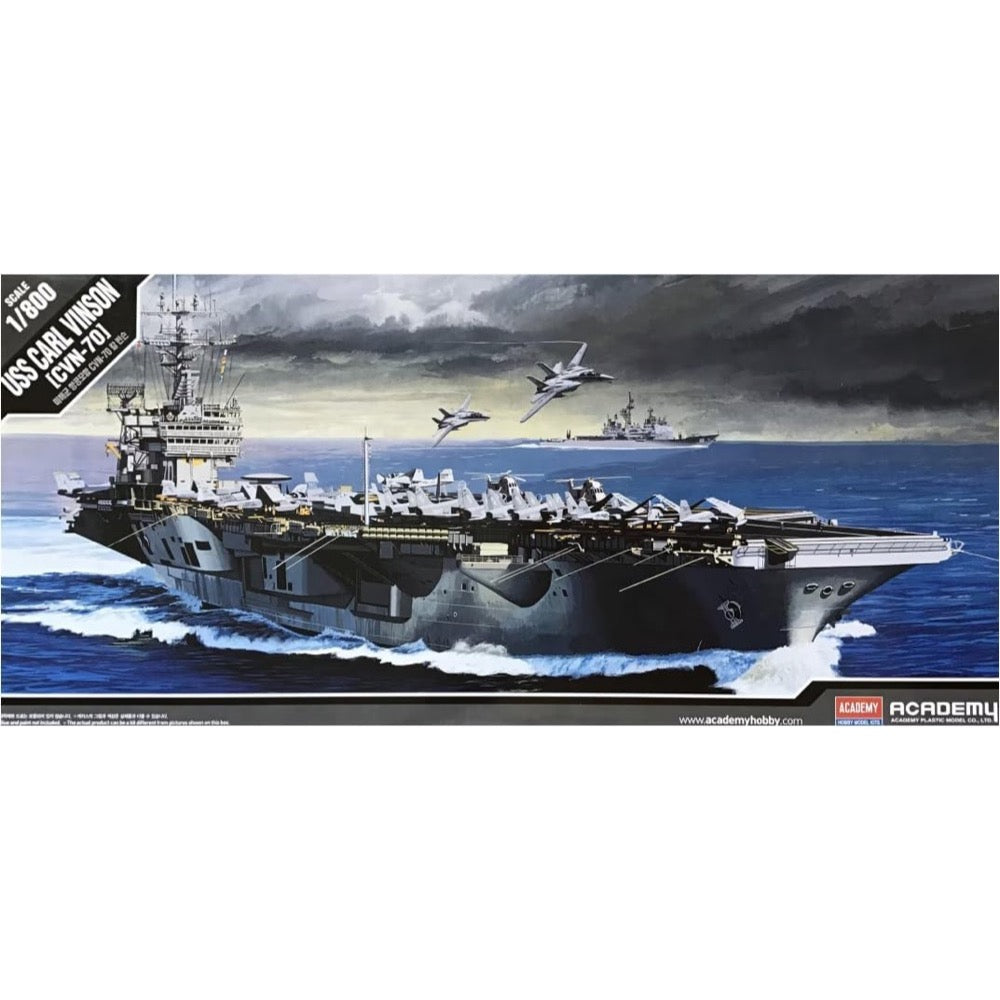
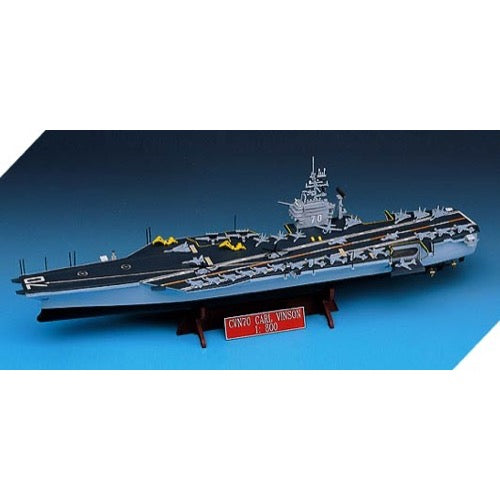
The Academy 14209 CVN-70 U.S.S.CARL VINSON model kit is a perfect replica of the US aircraft carrier. The kit is made of plastic and comes with detailed instructions for assembling. The kit is perfect for those who love to collect military replicas or for those who have served on this carrier. The kit is easy to assemble and has a high level of accuracy in its detailing. The carrier’s length measures 80cm, and the model kit is at a 1/800 scale. If you are an experienced model kit enthusiast or just starting, this kit is perfect for you. Like all model kits, this one will require some effort to put together, but it is well worth the effort. The level of detail you get with this kit is amazing. Once assembled, this model will look stunning when displayed with other replica military kits or by itself. This model also makes a perfect gift for any military or navy enthusiast.
Contents
The assembly instruction
Frames with plastic parts
Decals
Base
Specification
Scale: 1/800
Size: 42,2 x 8,2 x 8,6cm