
Reset


AIRFIX
Airfix A08109 1/48 Canadair...
$61.95
Canadair Sabre F.4
The North American F-86 Sabre was not only Americas first swept-wing fighter, but also the fastest fighter in the world and one of the most important aircraft in the post-war jet era. As one of the world’s first classic jet fighters, the F-86 Sabre was produced in great quantities and went on to serve with around 30 of the worlds air forces, as well as being produced under licence in Canada, Australia, Japan
1:48 Scale
Highly Detailed Model
The last few months of the Second World War saw the introduction of the worlds first operational jet aircraft and with their appearance, a clear indication as to the future of aviation. Taking a significant lead in jet powered aviation technology, Germany was at least 12 months ahead of their Allied adversaries in this regard and with the end of the conflict, there was a rush to gain access to as much of this information as possible, so it could be applied to British, American and Soviet aviation projects. In the US, the aviation industry had concentrated their efforts on perfecting piston powered aviation during the war, a decision which was vindicated through the success of the P-51 Mustang and the sheer numbers available to Allied air forces. Inevitably, this would have an impact on Americas entry into the jet age and whilst their first operational jet fighter, the Lockheed P-80 Shooting Star, was an excellent aircraft, it utilised the straight wing technology synonymous with WWII designs.
With its P-51 Mustang being widely regarded as the best single engined fighter of WWII, it was not long before the designers at North American aviation applied their undoubted talents to producing a new jet powered fighter, one which would incorporate research material obtained from the German jet programme. In their quest for ever greater speed, the new aircraft featured a 35% wing sweep and beautifully streamlined fuselage, whilst retaining the exceptional pilot visibility first introduced on the D variant of the Mustang. With three nose mounted .50 calibre machine guns on either side of the fuselage, the new Sabre shared much with the attributes of its piston engined predecessor, beautiful to look at, but a deadly fighting aeroplane.
The first flight of the XP-86 prototype took place on 1st October 1947, in the hands of famous WWII Pearl Harbor Curtiss P-40 fighter ace George Welsh, who was North Americans chief test pilot at that time. Later in the development programme, an F-86A Sabre would go on to set a new world airspeed record of 670.84 mph, underlining the credentials of this important new fighter.
On entering USAF service in 1949, the North American F-86 Sabre was not only Americas first swept wing fighter, but also the fastest fighter in the world and one of the most important aircraft in the post war jet era. The Korean War would witness the advent of the first jet versus jet combat and pitch Americas new jet fighter against the latest Soviet design, the highly capable Mikoyan Gurevich MiG-15, an aircraft which possessed a great aviation pedigree of its own and one which proved to be quite a shock for Western Powers. With both aircraft possessing advantages over the other, this aerial duel would prove to be quite an even contest, with the more robust training and previous WWII experience of Sabre pilots proving decisive in the end.
Whilst US military planners were quick to publish combat victory ratios of 10:1 in favour of the F-86 Sabre, later research suggested the Sabres dominance was probably nearer 3:1, though still underlining the effectiveness of the aircraft. As one of the worlds first classic jet fighters, the F-86 Sabre was produced in great quantities and went on to serve with around 30 of the worlds air forces, as well as being produced under licence in Canada, Australia, Japan and Italy.
Out of a final total production run which exceeded 9,800 aircraft, the Royal Air Force would operate around 430 Canadian built Sabres from 1953 until 1956, as the introduction of the excellent Soviet MiG-15 continued to have an impact on NATO military strategies. With the indigenously designed Supermarine Swift and Hawker Hunter still in development, the Sabre provided the RAF with a capable jet fighter at a crucial period in world history and whilst they would only see service for a relatively short period, it bought the RAF valuable time until they could introduce their own swept wing fighter designs.
Includes
Sprues
Decals


AIRFIX
Airfix A08111 1/48 North Am...
$85.95
One of the most important aircraft of the early jet era, the North American F-86 Sabre was in many ways a jet powered version of the company’s hugely successful P-51D Mustang from WWII and an aircraft which made full use of captured German aerodynamic research material. Featuring a distinctive 35-degree wing sweep, the Sabre also incorporated three nose mounted .50 calibre machine guns positioned on either side of the aircraft’s nose, with this jet powered gunslinger sharing many design philosophies with its famous piston powered predecessor. On entering service with the U.S Air Force in 1949, the North American F-86 Sabre would have the distinction of not only being America’s first swept wing fighter, but also the fastest fighter aircraft in the world at that time, a true aviation classic.
Arctic Gladiators Aerobatic Display Team
The USAF 720th Fighter Bomber Squadron formed the Arctic Gladiators team in June 1954. The display team consisted of four F-86F Sabre aircraft, which all carried the squadrons silver and red colour scheme, plus extra markings. The display team lasted just 10 years when it came to an end in 1955. Displays were limited to the US state of Alaska.
Scheme A: North American F-86F-30 Sabre
‘Arctic Gladiators’ aerobatic team, 720th Fighter-Bomber Squadron, United States Air Force, Eielson Air Force Base, Alaska, 1955.
Scheme B: North American F-86-25 Sabre
514th Fighter-Bomber Squadron, Royal Air Force Manston, Kent, England, 1954.
Specifications
Pieces: 166
Length: 239mm
Width: 239mm
2 x Decal Options
Includes all parts from previous releases.


AIRFIX
Airfix A09011 1/72 Consolid...
$75.95
The second of America's great four-engined heavy bombers of the Second World War, the Consolidated B-24 Liberator actually began development after the Army Air Corps approached the company to build B-17 Flying Fortresses. Unimpressed at the prospect, Consolidated proposed that they could design and produce their own bomber in the same time it would take them to establish production lines, and it would be better than a Flying Fortress. When their XB-24 prototype took to the air on 29th December 1939, it was a very different-looking aeroplane to the B-17 Flying Fortress, with its shoulder-mounted thin wings, deep, yet narrow fuselage and twin-boom tail, it had a maritime aircraft appearance about it. Following its eventual USAAF introduction in 1941, the B-24 Liberator was produced in vast quantities, serving in every theatre during the Second World War, and making a vital contribution to the Allied War effort.


AIRFIX
Airfix A09171V 1/144 SR.N4 ...
$60.95
Produced at a time when British engineering was the envy of the world, the Saunders Roe/British Hovercraft Corporation SR.N4 was impressive in every respect of the word; a mighty craft heralding a new era in high speed, high comfort, cross-Channel travel for the masses. Entering service in 1969, these Mountbatten Class Hovercraft were able to cruise at speeds in excess of 60 knots, allowing operators to complete 14 return trips each day during the busy summer schedule.
Powered by four marine variants of the Rolls Royce Proteus turboprop engine, each unit drove a massive 5.8 metre diameter variable Dowty Rotol propeller mounted-on pylons, which moved to provide the hovercraft with directional control, along with powered fins and rudders. At the time the SR.N4 entered service, this floating leviathan was the largest passenger hovercraft ever built, equipped with the largest propellers ever produced.
Allowing these fully amphibious craft to use terminals away from existing busy seaports, but close enough to still be convenient for passengers, you definitely knew when one of these mighty craft were inbound, because of the incredible noise produced by its Proteus engines.
Everything about this hovercraft was spectacular, which also made it one of the most impressive Airfix model kits ever produced, one making a welcome return to our 2026 Vintage Classics range in 1:144 scale.
Specification
Item Length - Without Packaging (cm): 27.2
Item Width - Without Packaging (cm): 15.8
How many pieces will be found in the box opened by the customer? 276
Item Scale: 1:144 Scale
Contents (what's in the box) sets: Plastic model kit, instruction sheet, paint layout sheet and decals.
Number of Scheme options: 2
Skill Level: 4
Flying Hours: 4


AIRFIX
Airfix A09178A 1/48 English...
$75.95
This remarkable 1:48 scale model of the English Electric Lightning F.6 showcases one of the most pivotal British aircraft from the post-war period with exquisite detail. Comprising 153 components and featuring a wingspan of 220mm, this kit replicates the pinnacle version of this supersonic marvel, an aircraft that enhanced the capabilities of its predecessors with superior speed, extended range, and improved maneuverability.
Among the notable British aircraft developed after the Second World War, the English Electric Lightning stands out for its significant impact. Initially deployed to defend Britain's V-Bomber bases from Soviet bomber threats, this supersonic marvel was epitomised by the Lightning F.6, which surpassed its predecessors with enhanced speed, range, and handling.
This extraordinary aircraft served the Royal Air Force for an impressive 28 years, navigating some of the most turbulent periods in global history. The F.6 model marked the reintroduction of guns, which had been omitted in the preceding F.3, complementing its pair of Red Top air-to-air missiles, much to the satisfaction of RAF pilots.
While the Lightning was renowned for its incredible speed, pilots believed it was capable of more than just defending points, demonstrating proficiency in dogfighting, provided its cannon armament was retained.
Features
Skill level 3 kit suitable for ages 8 and above
153 plastic parts with impressive detail throughout
Three authentic paint schemes included
220mm wingspan for impressive display presence
Accurately recreates the F.6 variant with restored cannon armament
Includes Red Top air-to-air missile configuration options
Specifications
1:48 Scale
Parts Included: 154
Skill Level: 3
Scheme Options: 3

AIRFIX
Airfix A09186A 1/48 Bristol...
$ PRICE IN PROGRESS!
As the world erupted into conflict in September 1939, the Royal Air Force had more Bristol Blenheims in service than any other aircraft type and it saw extensive service during the savage air battles. Used mainly in the light bomber role, around 200 Blenheims were also modified for use as long range fighter/night-fighters, with these aircraft being equipped with ventral packs mounted on their undersides, housing four forward-firing 0.303 machine guns.
Production of these bespoke components, along with their mounting frames, was sub-contracted to the workshops of Southern Railway at their Ashford site in Kent.
Our Bristol Blenheim model kit offers an impressive interpretation of the original in 1:48 scale.
Specification
Item Length - Without Packaging (cm): 25.3
Item Width - Without Packaging (cm): 37
How many pieces will be found in the box opened by the customer?: 216
Item Scale: 1:48 Scale
License line: BAE SYSTEMS is a registered trade mark of BAE Systems plc.
Contents (what's in the box) sets: Plastic model kit, instruction sheet, paint layout sheet and decals.
Number of Scheme options: 3
Skill Level: 2
Flying Hours: 2
Wingspan (mm): 370


AIRFIX
Airfix A09252V 1/180 Vintag...
$66.95
Launched on 7th May 1765, HMS Victory gained its fame by becoming Admiral Nelson's flagship during the Battle of Trafalgar in 1805. The victory at this battle ended Napoleon's bid for mastery of the sea, but cost Admiral Nelson his life.
She had previously taken part in many major actions against Spanish and French fleets, and is now the oldest serving Royal Naval ship still in service, being the flagship of Portsmouth Command. After being restored to the same condition and appearence as she was at Trafalgar, she can now be seen in all her glory at her home in Portsmouth by visitors from all over the world.
Specification
1:180 Scale
Parts Included: 353
Skill Level: 3
Scheme Options: 1

AIRFIX
Airfix A09254V 1/180 HMS Pr...
$ PRICE IN PROGRESS!
One of the most powerful fighting ships of her day, HMS Prince, or the Royal Prince as she was sometimes referred to, was a 100-gun ‘first rate’ ship of the line and the initial flagship of the Lord High Admiral of the Royal Navy, the Duke of York.
Launched in December 1670, she was never too far away from significant naval actions, suffering damage on several occasions and having to undergo rebuild at least twice.
This spectacular ship from the golden age of sail was eventually broken up in 1813, at the end of an impressive service career. Luckily, you can now rebuild her, thanks to this exciting Airfix model kit.
This 1:180 scale sailing ship model kit is part of our Vintage Classics range.
Specification
Item Length - Without Packaging (cm): 37
Item Width - Without Packaging (cm): 8
How many pieces will be found in the box opened by the customer? 394
Item Scale: 1:180 Scale
Contents (what's in the box) sets: Plastic model kit, instruction sheet, paint layout sheet and decals.
Number of Scheme options: 1
Skill Level: 4
Flying Hours: 3

AIRFIX
Airfix A09256V 1/144 WASA
$60.95
In 1625, while Sweden was busy building an empire around the Baltic Sea, the Swedish King Gustavus Adolphus ordered new warships. Among them was the Wasa. On its maiden voyage in 1628, the Wasa set sail and fired a salute.
But only after a few minutes of sailing the ship began to heel over. She righted herself slightly - and heeled over again and, to everyones horror and disbelief, the glorious and mighty warship suddenly sank.
Specification
1:144 Scale
Parts Included: 229
Skill Level: 4
Scheme Options: 1

AIRFIX
Airfix A10280V 1/72 German ...
$83.95
Restricted by the terms of the Treaty of Versailles, the German Kriegsmarine exploited a loophole by designing a fleet of fast, wooden-hulled attack craft they referred to as Schnellboots. Expertly designed, these vessels were perfected over time and by the outbreak of the Second World War, they had become a devastatingly effective part of Germany’s naval strength. Powered by three diesel engines and featuring a triple rudder arrangement, Germany’s E Boats were some of the fastest warships in the world. With their low profile, high manoeuvrability and torpedo armament, if they penetrated any Allied convoy, they could destroy several vessels and make their escape before coming under return fire.

AIRFIX
Airfix A11007A 1/48 Fairey ...
$ PRICE IN PROGRESS!
The Royal Navy has operated a variety of unique aircraft at sea, but the Fairey Gannet stands out as one of the most unusual in both appearance and sound. In the summer of 1950, a Gannet made history as the first turboprop-powered plane to land on an aircraft carrier's deck. Production of the AS.1 model, the most widely manufactured variant, commenced in 1954.
The Gannet also served in the navies of Australia, West Germany, and Indonesia, with the Royal Navy being the last to retire active examples of this durable naval aircraft. Try your hand at constructing this 1:48 scale model and craft a showpiece for your workbench.
This remarkable 1:48 scale model of the Fairey Gannet AS.1/AS.4 provides modellers with a complex and fulfilling project, featuring 334 components. With a skill level of 4, this intricate kit embodies one of the Royal Navy's most unique carrier-based planes, boasting a wingspan of 344mm upon completion. You can choose from three different paint schemes, each representing various phases of this robust turboprop's service history.
Features
334 plastic components for a detailed and thorough assembly
1:48 scale with a wingspan measuring 344mm
Three paint schemes depicting different service eras
Skill level 4 - ideal for seasoned modellers aged 8 years and older
Captures the unique look of the Royal Navy's turboprop carrier aircraft
Specifications
Item Length - Without Packaging (cm): 29
Item Width - Without Packaging (cm): 34.4
How many pieces will be found in the box opened by the customer?: 334
Item Scale: 1:48 Scale
Contents (what's in the box) sets: Plastic model kit, instruction sheet, paint layout sheet and decals.
Number of Scheme options: 3
Skill Level: 4
Flying Hours: 4
Wingspan (mm): 344
AIRFIX
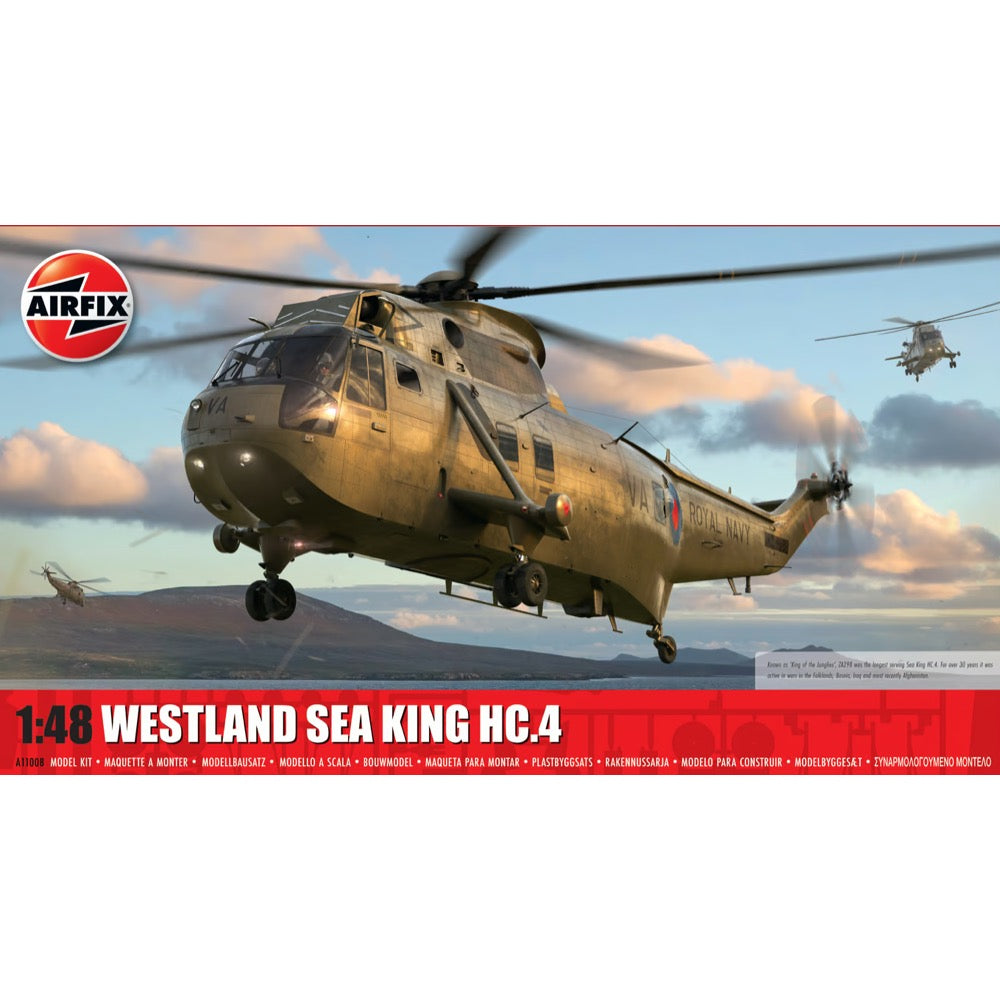
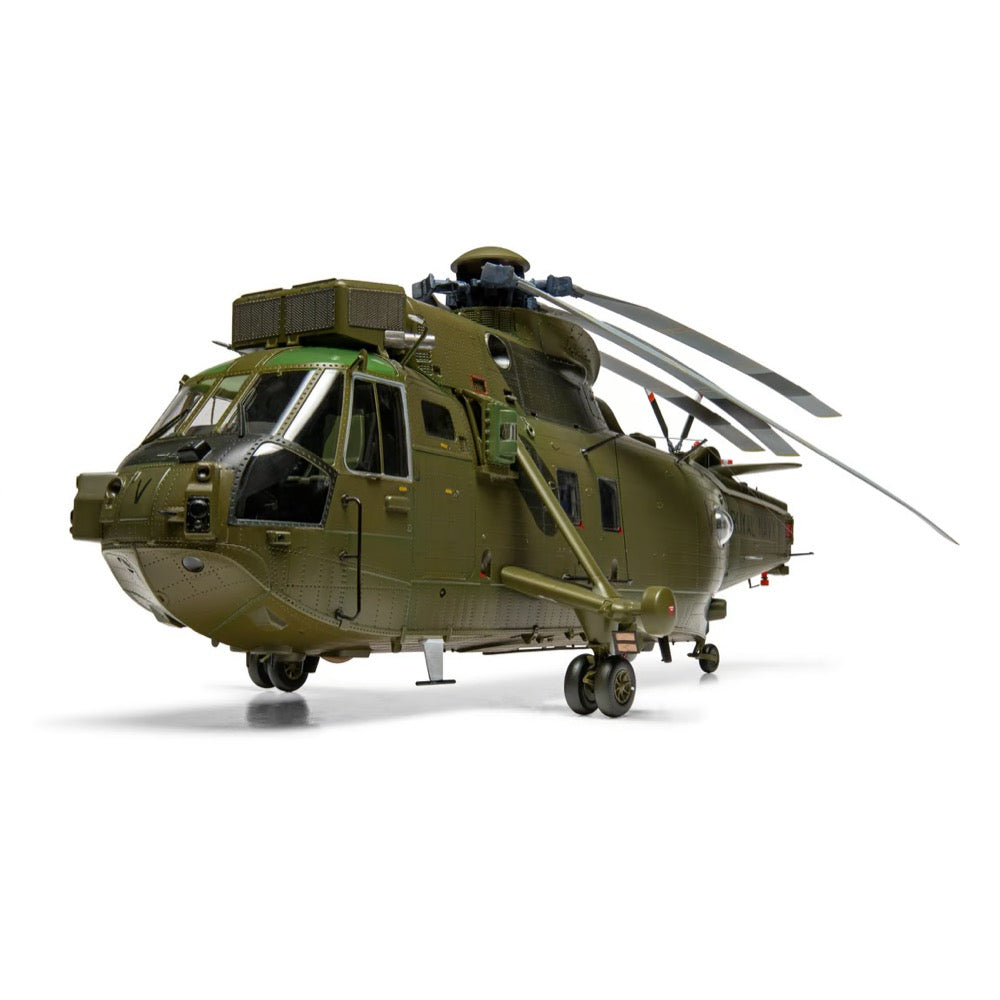
Airfix A11008 1/48 Westland...
$90.95
A specialist variant of the Westland Sea King, the HC.4 was the Royal Navy's Commando troop carrying and resupply helicopter replacement for their Wessex HU.5 helicopters and a development of similar aircraft produced for the Egyptian and Qatari Air Forces. 42 newly built helicopters were eventually produced in this configuration, which by their nature, were never too far from any action hotspots.Deployed to combat zones right across the world during their 36-year service career, the Junglie as it was affectionately known, served with distinction from the Falklands War, through to the UK's campaign in Afghanistan.
King of the Junglies
Known as ‘King of the Junglies’, ZA298 was the longest serving Sea King HC.4. For over 30 years it was active in wars in the Falklands, Bosnia, Iraq and most recently Afghanistan.
This latest iteration of our 1:48 scale Westland Sea King 2023 tooling includes new parts, not included in the first release. These include:
Folding rotor blades and tail
Undercarriage without sponsons unique to HC.4 variant
New interior parts including lengthened cabin and extra seats
Open/closed door option
GPMG machine gun mount
New cockpit detail parts
Extra antenna and countermeasures detail parts to suit the HC.4’s front-line role


AIRFIX
Airfix A11009 1/48 Fairey G...
$103.95
Arguably the most unconventional Fairey-designed aircraft to enter full production, the Gannet was developed to meet a 1945 Royal Navy requirement for an advanced carrier-based turboprop-powered anti-submarine hunter-killer.
Intended to counter the recent expansion of the Soviet submarine fleet at the start of the Cold War era, the Gannet was equipped with the last electronic detection equipment and if an enemy submarine was detected, it could be marked, tracked and attacked using bombs, depth charges, rockets and air-launched acoustic torpedoes. It was a highly effective anti-submarine aircraft, able to attack submarines on the surface or submerged.
One feature of the Gannet that gave it a unique appearance was its innovative Armstrong Siddeley Double Mamba powerplant. This arrangement saw two gas turbine engines mounted side by side, sharing a common gearbox, but operating independently, each engine driving its own coaxially mounted, contra-rotating propeller. Another unique feature was the bi-folding wing system, designed to allow this large aircraft to be stored aboard relatively small aircraft carriers.


AIRFIX
Airfix A11010 1/48 SEPECAT ...
$90.95
In May 1965, the Defence Ministries of France and the UK agreed on a joint programme to develop a supersonic trainer and tactical strike aircraft. France had already decided upon the Brequet 1221 design and this, together with the Rolls-Royce/Turbomeca Adour engine became the basis of the Jaguar. Design leadership was with both Brequet Aviation and the British Aircraft Corporation, so the companies established the joint company SEPECAT to coordinate production.
The first two-seat Jaguar trainer flew in September 1968 and the first single-seater in March 1969. Production GR.1 aircraft entered RAF service with 54 sqn in March 1974. The French Air Force phased the type into service earlier in June 1973. The GR.1 for the RAF was a single-seat all-weather strike and ground attack fighter equipped with NAVWASS (navigating and weapons aiming sub-system) enabling it to attack without using radars.
Based mostly in Germany, RAF Jaguars were used for rapid deployment and regional reinforcement, and others flew in the tactical nuclear strike role carrying the WE177 bomb. Upgraded GR.1A Jaguars flew successfully in the 1990 Gulf War, where 12 aircraft flew 612 combat sorties without loss. The final Jaguars were retired from RAF service in April 2007.

AIRFIX
Airfix A11011 1/48 SEPECAT ...
$ PRICE IN PROGRESS!
Although the SEPECAT Jaguar actually started its development life as a joint Anglo-French project to produce an advanced new jet training aircraft for service with both nations, it later became a highly capable strike platform, with some aircraft further developed to undertake the pilot training and conversion roles.
Always regarded as an attractive aeroplane, the tandem cockpit arrangement of the two-seat Jaguars made these aircraft even more appealing from an aesthetic perspective, with many enthusiasts regarding the training variant of the Jaguar as perhaps the best-looking of all Royal Air Force aircraft from the Cold War era.
You can now build this beauty in 1:48 scale model kit form.
Specification
Item Length - Without Packaging (cm): 36.6
Item Width - Without Packaging (cm): 18.1
How many pieces will be found in the box opened by the customer?: 245
Item Scale: 1:48 Scale
License line: BAE SYSTEMS is a registered trade mark of BAE Systems plc.
Contents (what's in the box) sets: Plastic model kit, instruction sheet, paint layout sheet and decals.
Number of Scheme options: 3
Skill Level: 4
Flying Hours: 4
Wingspan (mm): 181

AIRFIX
Airfix A11012 1/48 Westland...
$ PRICE IN PROGRESS!
One of the most significant aircraft of the post-war era, even though Britain’s Westland Helicopters eventually produced well over 300 of the American Sea Kings, only a small number of these machines became some of the highest profile aircraft to ever serve within Britain’s armed forces. The robust and stable Sea King was an ideal aircraft with which to undertake the specialist Search & Rescue role across the UK, and Westland developed a number of Sea Kings specifically for this task.
Designated HAR.3 and produced for the Royal Air Force, Search & Rescue Sea Kings were fitted with highly advanced search and navigation equipment and were capable of operating in this demanding role in all weather and at any time, night or day.
Always on station in times of need, these yellow Sea Kings became some of the most famous and best loved aircraft in Britain’s skies, with crews never in any doubt as to the affection in which they and their aircraft were held by the public.
If this is a machine you've admired for some time, then the Airfix Westland Sea King model kit must be destined for your workbench.
This military aircraft kit is in 1:48 scale, allowing you to build a detailed replica of an icon.
Specification
Item Length - Without Packaging (cm): 46
Item Width - Without Packaging (cm): 39.7
How many pieces will be found in the box opened by the customer? 361
Item Scale: 1:48 Scale
License line: The Westland Sea King is a product of Leonardo UK Ltd and all rights in it, including its name, are hereby reserved. The models have been produced with the permission and assistance of Leonardo MW Ltd.
Contents (what's in the box) sets: Plastic model kit, instruction sheet, paint layout sheet and decals.
Number of Scheme options: 3
Skill Level: 4
Flying Hours: 4
Rotorspan (mm): 397

AIRFIX
Airfix A11013 1/72 Avro Sha...
$ PRICE IN PROGRESS!
Tracing its lineage back to the famous Lancaster of the Second World War, the Avro Shackleton was a long-range maritime patrol aircraft used primarily for anti-submarine operations, but it was also required to perform several other roles.
Entering RAF service in 1951, the majority of Shackletons were powered by the mighty Rolls Royce Griffon engine, and became the last aircraft in the illustrious line of four-engined propeller-powered bomber/strike aircraft to see service with the Royal Air Force.
The decision to scrap HMS Ark Royal left the Royal Navy concerned that their ships would lose vital airborne early warning cover, however, a proposal to fit the radar units from Ark Royal’s former AEW Fairey Gannets to RAF Avro Shackletons allayed those fears.
Twelve Shackleton airframes were converted to AEW Mk.2 standard and operated in the colours of No.8 Squadron at RAF Lossiemouth, where they remained until the unit finally disbanded in 1991.
Our Avro Shackleton model kit allows you to build this classic aircraft in detailed 1:72 scale.
Specification
Item Length - Without Packaging (cm): 37
Item Width - Without Packaging (cm): 50.8
How many pieces will be found in the box opened by the customer? 290
Item Scale: 1:72 Scale
License line: BAE SYSTEMS is a registered trade mark of BAE Systems plc.
Contents (what's in the box) sets: Plastic model kit, instruction sheet, paint layout sheet and decals.
Number of Scheme options: 3
Skill Level: 3
Flying Hours: 4
Wingspan (mm): 508


AIRFIX
Airfix A12009 1/72 Handley-...
$124.95
The Handley Page (HP) Victor was a jet-powered, strategic bomber which, alongside the other ‘V’ bombers, the Avro Vulcan and Vickers Valliant, formed an essential part of Britain’s nuclear deterrent during the early part of the Cold War. The Victor was designed to carry out long-range, low-altitude attacks, but was later relegated to an aerial refuelling role when it was no longer deemed effective as a strategic bomber.
Subject to RAF’s requirements for greater tactical manoeuvrability and a higher ceiling, the B.2 variant with more powerful Rolls Royce Conway engines was developed in 1959. Thirty-four were produced and several were later converted for reconnaissance and aerial refuelling purposes. Two RAF squadrons formed on the B.2 after it entered service in 1962, but it was soon succeeded by the B.2R, a conversion which allowed them to carry ‘Blue Steel’ nuclear missiles in addition to free-fall nuclear payloads. Following the introduction of submarine-launched Polaris missiles in 1969, the Victor was gradually relieved of its role as a nuclear deterrent.


AIRFIX
Airfix A12011 1/72 Avro Vul...
$121.95
Avro Vulcan B.2
The Vulcan has been designed with the modeller in mind. The wings, historically in three pieces, now come in two to simplify and fortify your build. Through every step of the design process, our developers continued to keep modellers at the forefront of every choice they made.
1:72 Scale
Wingspan: 470 (mm)
Scheme option A - Avro Vulcan B.Mk.2 XM594, The Scampton Wing
From the mid 1960s, Scampton’s Vulcans gave up their iconic white anti-flash paint scheme for one which featured standard RAF camouflage on all upper surfaces, reflecting the tactical change from high to low altitude operations. Significant advances in Soviet SAM missile capability meant that Vulcan crews could no longer be expected to safely conduct their original high altitude Blue Steel delivery missions and were forced to ‘head for the deck’.
Scroll down for the paint schemes and a comprehensive list of paints needed.
Scheme option B - Avro Vulcan B.Mk.2 XM602, RAF No.12 Squadron
As the massive construction hangar doors at Avro’s Woodford factory aerodrome were pushed open on 30th August 1952 and Avro Vulcan prototype VX770 was wheeled out onto the hardstanding, she must have made for an awe-inspiring sight. Looking absolutely resplendent in its all-over white ‘Anti-Flash’ paint finish and proudly wearing its Royal Air Force insignia, what the Avro engineers had managed to produce was not only the world’s first delta bomber, but also the most advanced bomber in the world at that time.
Occupying a significant position in the history of post war British aviation, the Avro Vulcan was without doubt one of the most distinctive aircraft ever to take to the skies, with its huge delta wing profile becoming almost as iconic as the elliptical wing of the Supermarine Spitfire. Built to satisfy an extremely demanding Air Ministry requirement for a fast, high altitude strategic bomber, capable of carrying a special payload of 10,000 imperial pounds in weight (a nuclear device), the new aircraft was intended to serve as an airborne deterrent to any future military threat against the UK, with the required specifications representing a 100% increase in the capabilities of any previous British bomber aircraft. When the Vulcan made its maiden flight in August 1952, the Avro team were well on the way to presenting the Royal Air Force with not only the worlds first delta bomber, but also one of the worlds most effective strike bombers.
Interestingly, all this was achieved just nine years since the Avro Lancasters of RAF No.617 Squadron had launched their famous raid against the great dams of the Ruhr Valley. As the Avro Vulcan entered squadron service with No.83 Squadron at RAF Waddington in July 1957, Britain now possessed the fastest nuclear capable bomber in the world. It seems strange to describe an aircraft which possessed such potential for untold destruction as Britains most effective peace keeping asset, however, that is exactly what the Vulcan turned out to be. Throughout the aggressive posturing of the Cold War, the Warsaw Pact nations were in no doubt that if they dared to launch an attack against a NATO member country, the consequences of the inevitable retaliatory strike would be catastrophic. Without Doubt, during the early years of its service career, nothing represented this doomsday scenario more effectively than the mighty Avro Vulcan.
As the Royal Air Force exhaustively trained their new Vulcan crews to provide Britain with an effective Quick Reaction Alert strike force, Avro engineers were already working to improve the capabilities of their original, iconic design. In order to ensure the aircraft continued to maintain its effective deterrent threat and stayed one step ahead of advances in Easter Bloc fighter and surface-to-air missile technology, designers incorporated developments which endowed the aircraft with greater range, speed and altitude performance. The installation of more powerful versions of the Vulcans Bristol Olympus engines would result in a number of unforeseen stability issues with these first bombers, which concerned designers enough to necessitate a re-design of the original wing shape.
By the time the definitive B.2 variant of the Vulcan entered service, the aircrafts wing area had increased significantly and although still classed as a delta, would look quite different from the first bombers which entered service. To cope with the increased power availability from subsequent engine upgrades and to cure the instability issues of the original straight wing design, the B.2 wing had two defined kinks in its leading edge, well forward of the profile of the original wing design. Rather than detract from the pleasing aesthetics of the early Vulcans delta wing, the B.2 actually enhanced the profile of the aircraft and even though these changes were obviously made for reasons of operational effectiveness, as opposed to appearance, the B.2 would go on to be considered the most famous (and most numerous) of all the RAFs Vulcans. The service introduction of the Vulcan B.2 in July 1960 coincided with the availability of more capable nuclear weapons for the V-bomber force, both in number and destructive potential. It would also bring about a change in thinking regarding the delivery of such weapons, as significant advances in Soviet anti-aircraft technology now threatened the success of a free-fall gravity bomb mission. A significant new weapon would have to be developed in order to maintain the deterrent threat of the Vulcan and its V-bomber partners.
Developed to maintain the validity of Britain's nuclear deterrent threat, designers at Avro produced the powerful Blue Steel air-launched, nuclear stand-off missile, which would allow V-bomber crews to launch their attacks 100 miles away from their intended target and out of the range of Soviet surface-to-air missile batteries, allowing crews valuable additional time to avoid the resultant blast. Further boosting the effectiveness of the V-bomber force, the arrival of Blue Steel raised the nuclear stakes in Britains favour once more and would have caused much consternation amongst the Warsaw Pact nations.
The responsibility of providing Britain's strategic nuclear deterrent passed to the submarines of the Royal Navy in July 1969 and saw the RAF performing its final V-bomber Blue Steel mission late the following year. Although taking on a more conventional strike role, RAF Vulcans would retain a nuclear capability and maintain their position as one of the worlds most effective bombers for the next fourteen years, before finally being withdrawn from service. Due to the affection in which this aircraft was held by the British public, the Vulcan Display Flight was almost immediately formed to operate one aircraft on the UK Airshow circuit for a further nine years, before itself being disbanded.
To the amazement of the historic aviation world, the last flying Avro Vulcan, XH558, the aircraft which had previously served as the Vulcan Display Flight aircraft, triumphantly returned to the air once more, this time in the hands of a civilian organisation in October 2007. Over the course of the next eight years, the Vulcan thrilled millions of people around the country, becoming something of an aviation national treasure a relic of the Cold War which was held in great public affection.
Includes
Sprues
Decals

AIRFIX
Airfix A12015 1/48 McDonnel...
$ PRICE IN PROGRESS!
Without doubt, one of the most successful jet aircraft of the post-war era, the incredible American-produced McDonnell Douglas F-4 Phantom saw service with a number of international air arms, with Britain becoming a significant operator.
Originally purchased to equip the Royal Navy with a modern replacement for their ageing De Havilland Sea Vixens, Fleet Air Arm Phantoms had the primary role of defending the fleet against air attack in all weather, with a secondary role of providing devastating strike support.
Designated Phantom FG.1, these Naval jets were an impressive sight and are still considered some of the most attractive aircraft to have ever served with Britain’s armed forces.
Operating this huge aircraft from the relatively diminutive deck of HMS Ark Royal required a number of significant modifications to British Phantoms, in addition to the carrier itself, with their successful operation dictating only cream of Britain’s fast jet pilots were selected to fly them.
An aircraft that looks this good deserves to be on display, and our military aircraft model kit allows you to build this in fine, 1:48 scale detail.
Specification
Item Length - Without Packaging (cm): 36.7
Item Width - Without Packaging (cm): 24.5
How many pieces will be found in the box opened by the customer?: 285
Item Scale: 1:48 Scale
License line: Produced under licensed. (Vehicle/Aeroplane Models) the distinctive logos, product markings, and trade dress are all trademarks of The Boeing Company.
Contents (what's in the box) sets: Plastic model kit, instruction sheet, paint layout sheet and decals.
Number of Scheme options: 3
Skill Level: 4
Flying Hours: 4
Wingspan (mm): 245


AIRFIX
Airfix A1351 1/35 Panzer IV...
$83.95
The German medium tank Panzerkampfwagen IV was developed in the late 1930s and was used extensively during WWII. The production of the Panzer IV Ausf. H started in June 1943. This version was designated the Sd. Kfz. 161/2. Compared to the previous variants, this model had Zimmerit paste on all the vertical surfaces of its armour in order to prevent adhesion of magnetic anti-tank mines.The turret roof was reinforced from 10mm to 16 and 25mm segments. 5mm hull skirts and 8mm turret skirts were added for further protection, which resulted in the elimination of the vision ports on the hull side. Later on, the hull was also fitted with triangular supports for the easily damaged side skirts. Along with some other modifications, these additions to the design increased the tank's weight to 25 tonnes, and the maximum speed dropped to 16 km/h on cross country terrain.Specifications
Item Length - Without Packaging (cm): 20.1
Item Height - Without Packaging (cm): 7.66
Item Width - Without Packaging (cm): 8.2
Item Scale: 1:35
Contents (what's in the box) sets: Sprues & decals
Finish: Plastic
Number of Scheme options: 2
Skill Level: 3
Flying Hours: 3


AIRFIX
Airfix A1352 1/35 Panther A...
$94.95
On 3rd April 1944, M.A.N. reported that it had successfully completed trial production runs of the new Ausf.G chassis. M.A.N. built about 1143 Panther Ausf.G tanks between March 1944 and April 1945. Between July 1944 to March 1945 M.N.H. constructed 806 Panther Ausf.G tanks.Daimler-Benz finished 1004 Panther Ausf.G tanks between May 1944 and April 1945. There were some minor differences between factory built tanks. M.N.H. fitted a cast steel Gleitschuh skid shoes instead of a rubber tire return roller behind the front track drive sprocket. The other two factories continued to fit rubber rimmed return rollers.Specifications
Item Length - Without Packaging (cm): 24.7
Item Height - Without Packaging (cm): 8.51
Item Width - Without Packaging (cm): 9.8
Item Scale: 1:35
Contents (what's in the box) sets: Sprues & decals
Finish: Plastic
Number of Scheme options: 2
Skill Level: 3
Flying Hours: 3


AIRFIX
Airfix A1353 1/35 JagdPanze...
$58.95
The Jagdpanzer 38(t) (Sd.Kfz. 138/2), later known as Hetzer (baiter), was a German light tank destroyer of the Second World War based on a modified Czechoslovakian Panzer 38(t) chassis. The project was inspired by the Romanian Mareºall tank destroyer. The name Hetzer was at the time not commonly used for this vehicle. It was the designation for a related prototype, the E-10.The Skoda factory, for a very short period, confused the two names in its documentation and the very first unit equipped with the vehicle thus for a few weeks applied the incorrect name until matters were cleared. However, there exists a memorandum from Heinz Guderian to Hitler claiming that an unofficial name, Hetzer, had spontaneously been coined by the troops. Post-war historians basing themselves on this statement made the name popular in their works, the vehicle was never named as such in official documents.Specifications
Item Length - Without Packaging (cm): 24.3
Item Height - Without Packaging (cm): 6.2
Item Width - Without Packaging (cm): 9.1
Item Scale: 1:35
Contents (what's in the box) sets: Sprues & decals
Finish: Plastic
Number of Scheme options: 2
Skill Level: 3
Flying Hours: 3


AIRFIX
Airfix A1354 1/35 Tiger I E...
$63.95
Following their disastrous defeat at Stalingrad during the winter of 1942-43, the German armed forces launched a major offensive in the East known as Operation Citadel on July 4th, 1943. The climax of Operation Citadel, the Battle of Kursk, involved as many as 6,000 tanks, 4,000 aircraft and 2 million fighting men and is remembered as the greatest tank battle in history.The peak of the battle was the massive armour engagement at Prochorovka, which began on July 12th. Prochorovka is one of the best-known of the many battles on the Eastern Front during World War II. Tiger heavy tanks with deadly 88mm cannons, lumbered forward while hundreds of nimble Soviet T-34 medium tanks raced into the midst of the SS armour and threw the Germans into confusion. The Soviets closed with the Panzers, negating the Tigers 88mm guns, outmanouvered the German armour and knocked out hundreds of German tanks.The Soviet tank forces audacious tactics resulted in a disastrous defeat for the Germans, and the disorganised SS divisions withdrew, leaving 400 destroyed tanks behind, including between 70 and 100 Tigers and many Panthers. Those losses smashed the SS divisions fighting power, and as a result Hoths Fourth Panzer Army had no chance to achieve even a partial victory in the south of the Soviet Union. After receiving the news of the Allied invasion of Sicily, as well as reports of impending Soviet attacks on the Mius River and at Izyum, Hitler decided to cancel Operation Citadel. From then on the German forces were on the back-foot and the war had now turned against them.Specifications
Item Length - Without Packaging (cm): 24.1
Item Height - Without Packaging (cm): 8.57
Item Width - Without Packaging (cm): 10.2
Item Scale: 1:35
Contents (what's in the box) sets: Sprues & decals
Finish: Plastic
Number of Scheme options: 2
Skill Level: 4
Flying Hours: 3