
Reset


AIRFIX
Airfix A02029B 1/72 Messers...
$19.95
One of the finest fighting aeroplanes in military history, the Messerschmitt Bf 109 series was developed continually throughout the Second World War, with the 'Gustav' being the last major variant and the one most heavily produced.
Flown by many of the Luftwaffe's most proficient aces, the 109G was adapted to perform a variety of operational roles and was heavily deployed against the huge USAAF daylight bombing raids which were sent against targets deep into Europe.
Includes
Sprues
Decals


AIRFIX
Airfix A02033A 1/72 Superma...
$20.95
Considered by many to be the ultimate Spitfire, the F Mk.22 shared only a very passing resemblance to its early Spitfire ancestors. Equipped with a more powerful Griffon engine as well as a larger tail unit and cut-down rear fuselage, the F Mk.22 was the most powerful Spitfire to see service, as well as the most capable. Serving in only small numbers and too late for the Second World War, the F Mk.22 was the penultimate land based variant of the classic Spitfire design.
Includes
Sprues
Decals

AIRFIX
Airfix A02041B 1/72 Hawker ...
$25.95
By 1943, the RAF needed a dedicated ground attack fighter and the Typhoon was suited to the role. The powerful engine allowed the aircraft to carry a load of up to two 1,000lb (454kg) bombs. From September 1943, Typhoons could also be armed with four, eight or, in some cases, even 12 "60lb" RP-3 rockets.
Specifications
Item Length - Without Packaging (cm): 13.4
Item Height - Without Packaging (cm): 6.46
Item Width - Without Packaging (cm): 17.4
How many pieces will be found in the box opened by the customer?: 74
Item Scale: 1:72 Scale
License line: BAE SYSTEMS is a registered trade mark of BAE Systems plc.
Contents (what's in the box) sets: Plastic kit, instruction sheet, paint guide and decal sheet.
Finish: Plastic
Number of Scheme options: 2
Skill Level: 1
Flying Hours: 1
Wingspan (mm): 174

AIRFIX
Airfix A02043V 1/72 F-80C S...
$18.95
F-80C Shooting Star
Initially developed around the British Halford H.1 engine taken from the de Havilland Vampire prototype, the project advanced under the strictest secrecy, with a team from 'Skunk Works' producing an airframe in an impressive 143 days. It is reported that two operational sorties were flown by the jet during WWII, however, these were non-combat missions and of a highly classified nature.
The development of the Shooting Star leant heavily on early jet technology supplied by the British, as the Americans were lagging behind both Britain and Germany regarding jet propulsion and the discovery of the Luftwaffe's Messerschmitt Me 262 highlighted the need for their own viable jet fighter. Initially developed around the British Halford H.1 engine taken from the de Havilland Vampire prototype, the project advanced under the strictest secrecy, with a team from 'Skunk Works' producing an airframe in an impressive 143 days. The Shooting Star showed great promise during testing, attaining a speed of 500mph in level flight, the first turbojet powered USAAF aircraft to do so.
Produced just too late to see combat during WWII, it is interesting to note that two pre-production Shooting Stars were sent to England during WWII for familiarisation purposes, with a further two sent to Italy with the 1st Fighter Group at Lesina. It is reported that two operational sorties were flown by the jet during WWII, however, these were non-combat missions and of a highly classified nature. The F-80C would be used extensively during the Korean War, where the aircraft would equip ten USAAF fighter/fighter bomber squadrons and one reconnaissance unit, but by then, this elegant early jet was already beginning to be outclassed. By the end of its production run, over 1700 Shooting Stars of all variants had been produced.
Includes
Sprues
Decals


AIRFIX
Airfix A02047A 1/72 North A...
$20.95
The North American P-51 Mustang is regarded by many as one of the most iconic American fighters of the Second World War. Designed to fulfil an RAF specification, the Mustang was transformed once the Rolls Royce Merlin engine was installed. The P-51D model's long range and excellent firepower made it a superb escort fighter, able to protect the bombers all the way to Berlin and back. The P-51 is recorded as being the top scoring Allied fighter of the war with 4,950 enemy aircraft destroyed. In 1948 the type designation for the Mustang changed to F-51D and it continued in USAF and RAAF service as a ground attack aircraft through the Korean War.
Contains
Sprues
Decals


AIRFIX
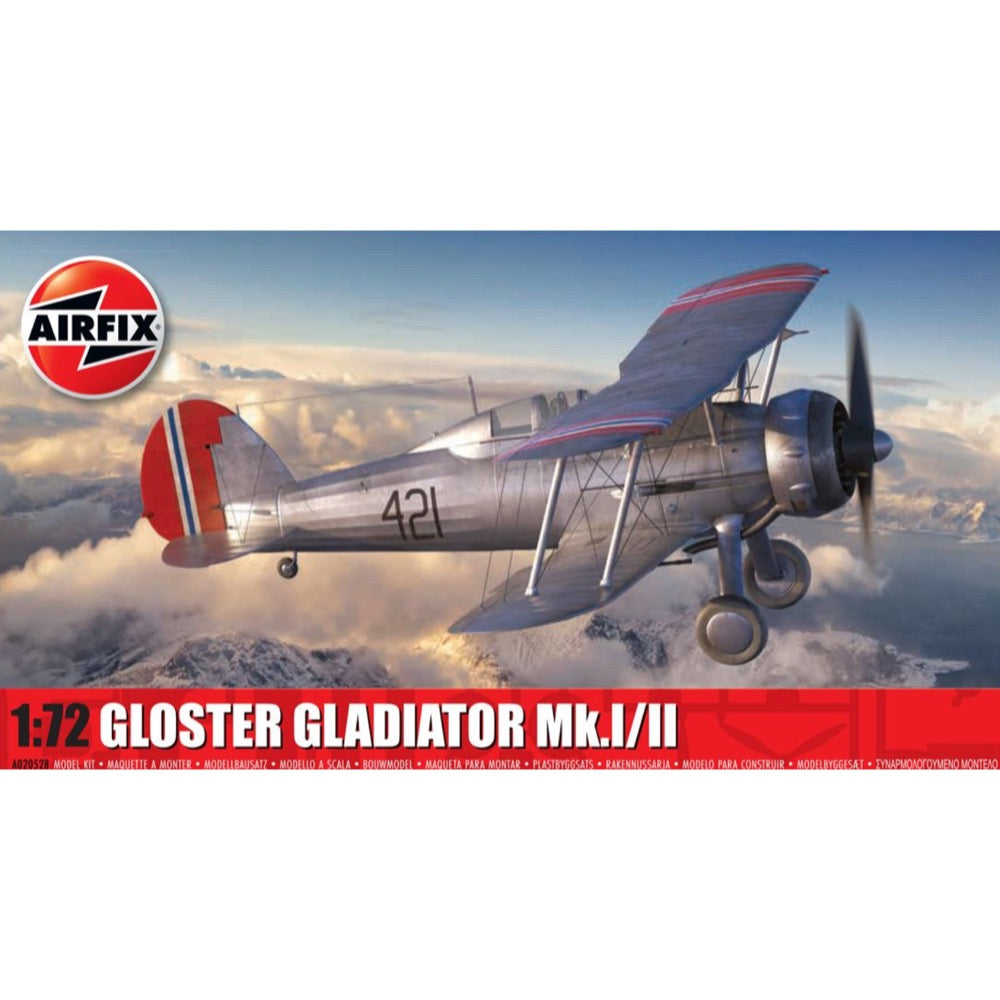
Airfix A02052A 1/72 Gloster...
$22.95
The Gloster Gladiator was developed from the Gloster Gauntlet as a private venture, and represented both the peak and the end of the biplane fighter. In many air arms it smoothed the transition to monoplane fighters, and in confronting aircraft of its own era it performed well.
Such a high-performing and equally eye-catching aircraft has well and truly deserved a spot in your Airfix collection. With two choices of livery to choose from and complete with sprues and decals, the Gloster Gladiator Mk.I/Mk.II airfix model kit is a worthy addition, not to mention a fantastic gift for military enthusiastst and model makers alike.
BAE SYSTEMS is a registered trade mark of BAE Systems plc.
Includes
Sprues
Decals
AIRFIX
Airfix A02052B 1/72 Gloster...
$25.95
The Gloster Gladiator was developed from the Gloster Gauntlet as a private venture and represented both the peak and the end of the biplane fighter. In many air arms it smoothed the transition to monoplane fighters. And when confronting aircraft of its own era, it performed well.
Specifications
Item Length - Without Packaging (cm): 11.8
Item Height - Without Packaging (cm): 4.97
Item Width - Without Packaging (cm): 13.7
How many pieces will be found in the box opened by the customer?: 51
Item Scale: 1:72 Scale
License line: BAE SYSTEMS is a registered trade mark of BAE Systems plc.
Contents (what's in the box) sets: Plastic kit, instruction sheet, paint guide and decal sheet.
Finish: Plastic
Number of Scheme options: 2
Skill Level: 2
Flying Hours: 1
Wingspan (mm): 137


AIRFIX
Airfix A02056V 1/72 Westlan...
$20.95
Westland Whirlwind Helicopter
As helicopter technology continued to advance apace following the end of the Second World War, named the Whirlwind, the first British build prototype flew in August 1953, with the type going on to enter Royal Navy service in July 1954.
As helicopter technology continued to advance apace following the end of the Second World War, the operational flexibility offered by rotary powered aircraft resulted in a race to develop a machine with the power and range to carry both troops and supplies efficiently. The breakthrough came with the introduction of the US Sikorski H-19 Chickasaw, an aircraft which was the envy of the world, with the British military being particularly keen admirers. Having successfully evaluated a number of aircraft, a licence agreement was signed to allow Westland Aircraft based at Yeovil to produce the helicopter for British service. Named the Whirlwind, the first British build prototype flew in August 1953, with the type going on to enter Royal Navy service in July 1954.
Includes
Sprues
Decals
License line
The (Vehicle/Aeroplane Model) is a product of Leonardo MW Ltd and all rights in it, including its name, are hereby reserved. The models have been produced with the permission and assistance of Leonardo MW lTD

AIRFIX
Airfix A02066A 1/72 Focke-W...
$18.95
First flying in 1939, the Focke-Wulf FW190 was an immediate threat to RAF fighters when introduced in late 1941, being faster and more manoeuvrable than the Spitfire V then in service.
The F-8 was the ground-attack version and differed primarily in its lack of outboard cannons. Various combinations of underwing weapons were fitted, but the most common was one centreline bomb and four small bombs on the wings.
The A-8 version was the most numerous, heavily armed variant and entered service in 1944 in an attempt to stop Allied daylight raids. By then, however, the new Allied fighters had begun to outclass it.

AIRFIX
Airfix A02067A 1/72 Hawker ...
$20.95
The aviation hero of the Battle of Britain, the Hawker Hurricane is one of the most significant aircraft in British aviation history - the RAF’s first production aircraft to exceed 300mph and the first multi-gun monoplane fighter in RAF service. Thirty-two Squadrons of Hurricanes saw action during the Battle of Britain.


AIRFIX
Airfix A02069 1/72 Boulton ...
$18.95
As an aircraft that was able to conduct such combat during the Battle of Britain, it has definitely earned a spot in any Airfix collector's range! Also featuring two livery schemes, sprues and decals, you can recreate the legacy of the Boulton Paul Defiant aircraft today!The Boulton-Paul Defiant was the only 'turret fighter' to enter service with the RAF. The Defiant used the philosophy that a fighter aircraft, armed solely with a turret bristling with machine guns would be able to enter a bomber stream causing havoc and the turret would also enable it to defend itself from enemy fighters.During its first few engagements during the Battle of Britain in 1940, enemy pilots were taken by surprise and the Defiant fared well but soon the Luftwaffe pilots worked out its weaknesses, especially the lack of forward firing guns and the Defiant was soon relegated to night fighting duties were it fared better.Specifications
Item Length - Without Packaging (cm): 15
Item Height - Without Packaging (cm): 4.79
Item Width - Without Packaging (cm): 16.6
How many pieces will be found in the box opened by the customer?: 70
Item Scale: 1:72
License line: BAE SYSTEMS is a registered trade mark of BAE Systems plc.
Contents (what's in the box) sets: Sprues & decals
Finish: Plastic
Number of Scheme options: 2
Skill Level: 1
Flying Hours: 1
Wingspan (mm): 166


AIRFIX
Airfix A02070A 1/72 Grumman...
$18.95
F4F-4 Wildcat
The F4F-4 Wildcat was the US Navy's primary carrier borne fighter aircraft, by the time of the crucial battles for Midway and Guadalcanal the F4F-4 model had become the most numerous variant and new tactics enabled American naval and marine pilots to gain the upper hand.
1:72 Scale
Wingspan: 160 (mm)
Highly Detailed Model
The F4F Wildcat was the US Navy's primary carrier borne fighter aircraft at the start of the Second World War. Characterised by its stubby appearance the Wildcat had been developed as part of a successful range of pre-war biplanes and had entered service with the US Navy a year prior to the Japanese attack on Pearl Harbor. By the time of the crucial battles for Midway and Guadalcanal the F4F-4 model had become the most numerous variant and new tactics enabled American naval and marine pilots to gain the upper hand on the previously all-conquering Mitsubishi Zero.
Includes
Sprues
Decals


AIRFIX
Airfix A02099V 1/72 Commonw...
$18.95
Commonwealth CA-13 Boomerang
An aircraft which has often been described as 'Australia's panic fighter', the Boomerang would often be used to mark targets for ground attack Corsairs during the latter stages of WWII, a role which earned the distinctive little aircraft the nickname 'Smoky Joe'.
An aircraft which has often been described as 'Australia's panic fighter', the decision to build the indigenous Commonwealth Aircraft Corporation Boomerang came in the wake of continued Japanese aggression in the Pacific and the need to ensure a continuous future supply of new fighters for the RAAF. By using many sections and components from existing aircraft types under construction in Australia, the first Boomerang was produced just sixteen weeks after the original design decision was made and 250 of these diminutive fighters would eventually be produced. Possessing excellent low altitude performance, the Boomerang would often be used to mark targets for ground attack Corsairs during the latter stages of WWII, a role which earned the distinctive little aircraft the nickname 'Smoky Joe'.
Includes
Sprues
Decals


AIRFIX
Airfix A02101 1/72 Royal Ai...
$20.95
The stable flight characteristics of the government-designed Royal Aircraft Factory BE2c made it an ideal home-defence night-fighter aircraft. It famously claimed the destruction of the first German airship over Britain on 3rd September 1916, earning pilot Lt. William Leefe Robinson a Victoria Cross.
This Royal Aircraft Factory BE2c plastic model kit comes with two paint scheme options, bringing variety to a popular design. With 54 well-engineered parts, this 1:72 scale kit is a joy to build.
Specification
Item Length - Without Packaging (cm): 11.5
Item Width - Without Packaging (cm): 15.6
How many pieces will be found in the box opened by the customer?: 54
Item Scale: 1:72 Scale
Contents (what's in the box) sets: Plastic model kit, instruction sheet, paint layout sheet and decals.
Finish: Plastic
Number of Scheme options: 2
Skill Level: 2
Flying Hours: 1
Wingspan (mm): 156

AIRFIX
Airfix A02103A 1/72 Hunting...
$25.95
For most RAF pilots serving between 1960 and 1988, the Hunting Aircraft (BAC) Jet Provost is extremely familiar. Forming the backbone of RAF pilot training during this period, the Jet Provost was distinctive by its broad fuselage profile, which allowed for a relatively spacious side-by-side cockpit arrangement.Specifications
Item Length - Without Packaging (cm): 13.7
Item Width - Without Packaging (cm): 15.6
How many pieces will be found in the box opened by the customer?: 45
Item Scale: 1:72 Scale
Contents (what's in the box) sets: Plastic kit, instruction sheet, paint guide and decal sheet.
Finish: Plastic
Number of Scheme options: 2
Skill Level: 1
Flying Hours: 1
Wingspan (mm): 156


AIRFIX
Airfix A02105 1/72 Folland ...
$18.95
The diminutive Folland Gnat was originally developed as a light and affordable jet fighter, but went on to be used extensively by the Royal Air Force as an advanced fast jet training aircraft. Entering RAF service in 1959, the Gnat was responsible for training many hundreds of future fast jet pilots during its 20 year service career.
Includes
Plastic model kit
Instruction sheet
Paint layout sheet
Decals.


AIRFIX
Airfix A02106 1/72 deHavill...
$22.95
Still a familiar sight at airfields all over the world, the de Havilland Tiger Moth primary trainer made its first flight back in 1931 and went on to provide British and Commonwealth air forces with thousands of trained pilots for their operational squadrons. Performing a similar role to this day, the Tiger Moth allows prospective Warbird pilots to gain valuable experience in flying a tail-dragger aircraft.
From its eye-catching livery to impressive service history, the Tiger Moth will truly complete any military or aircraft model range! With a choice of two schemes, contaiuning 42 pieces and measuring 102mm in length, the Tiger Moth Airfix kit will be adored by both new and experienced collectors alike.
Scheme 1: De Havilland DH.82a Tiger Moth Royal Naval Air Station Abbotsinch, Paisley, Scotland, 1962.
Scheme 2: De Havilland DH.82a Tiger Moth No,12 Local Air Supply Unit (LASU), Kiarivu Airfield, Papua New Guinea, August 1945.
BAE SYSTEMS is a registered trade mark of BAE Systems plc.
Includes
Sprues
Decals

AIRFIX
Airfix A02106A 1/72 De Havi...
$25.95
Still a familiar sight at airfields all over the world, the de Havilland Tiger Moth primary trainer made its first flight back in 1931 and provided British and Commonwealth air forces with thousands of trained pilots for their operational squadrons. Performing a similar role to this day, the Tiger Moth allows prospective Warbird pilots to gain valuable experience in flying a tail-dragger aircraft.
Specifications
Item Length - Without Packaging (cm): 10.2
Item Height - Without Packaging (cm): 3.76
Item Width - Without Packaging (cm): 12.4
How many pieces will be found in the box opened by the customer?: 42
Item Scale: 1:72 Scale
License line: BAE SYSTEMS is a registered trade mark of BAE Systems plc.
Contents (what's in the box) sets: Plastic kit, instruction sheet, paint guide and decal sheet.
Finish: Plastic
Number of Scheme options: 2
Skill Level: 2
Flying Hours: 1
Wingspan (mm): 124


AIRFIX
Airfix A02108 1/72 Spitfire...
$22.95
A much more complicated aeroplane than the Hawker Hurricane which preceded it into RAF service, the Spitfire represented the pinnacle of aviation design when the first examples were delivered to No.19 Squadron at Duxford in the summer of 1938. As the clouds of war were gathering, the RAF were going to need as many of these magnificent aeroplanes as they could get.
The Spitfire's Finest Hour came during the savage dogfights of the Battle of Britain, where the enduring reputation of this iconic fighter was secured in a four month struggle for aerial supremacy in the skies above Southern England. Fighting alongside the more numerous Hawker Hurricanes, Fighter Command thwarted the Luftwaffe in their attempt to clear the skies of British fighters and effectively removed the immediate threat of German invasion. Following the end of the Battle of Britain and a period of rest and replenishment, the RAF were ready to go on the offensive, with raids across the Channel selecting targets of opportunity and attempting to lure the Luftwaffe into combat. The Spitfire has the distinction of being the only Allied fighter to be in continuous production throughout the Second World War and was constantly upgraded to keep it at the forefront or wartime fighter technology. The Spitfire Mk.V combined the additional power of the Rolls Royce Merlin 45 engine with the original Mk.I/II airframe (plus a number of design improvements for the proposed future Mk.III) and proved to be more than a match for the latest Luftwaffe fighter. Spitfire Mk.V fighters were produced at a spectacular rate with almost 6,500 manufactured. Seeing service in every theatre the Allies contested the war, Spitfire Mk.Vs fought in the home defence role above the deserts of North Africa and jungles of the Far East.
Introduction of the Spitfires C or Universal Wing was something of an engineering triumph and provided the fighter with a wing capable of supporting various weapons configurations. The new wing strengthened the undercarriage, making the challenging ground handling a little more manageable for pilots. In order to preserve engine life whilst operating in hot and dusty airfield environments, the fitting of a Vokes Air Filter under the front cowling of the aircraft may have done little for the aesthetic appeal of the Spitfire, yet it clearly illustrated that many would go on to operate in environments from which the aircraft was never originally intended. This further enhanced the enduring legacy of this magnificent aeroplane.
For many people, the Supermarine Spitfire is regarded the most famous fighting aeroplane ever to take to the skies, and you can now bring this legacy home as part of your Airfix collection today. With a highly impressive history of service in the RAF and ability to survive even the most toughest of environments, this aircraft has definitely earned a spot in your Airfix collection! The Spitfire has two livery schemes as well as sprues, decals and vomces with 73 pieces in each kit. Described as arguably the most effective stop-gap aircraft the RAF ever introduced, this makes the Supermarine Spitfire a number one choice for Airfix fans and military enthusiasts alike.
Includes
Sprues
Decals


AIRFIX
Airfix A02109 1/72 Hawker T...
$22.95
Hawker Tempest Mk.V
An aircraft which has to be considered one of the finest aeroplanes of the Second World War. The Hawker Tempest V entered Royal Air Force service in early 1944 and was a real brute of an aeroplane, fast, heavily armed, and possessing performance that could better any fighter the Luftwaffe had in service.
1:72 Scale
Wingspan: 173 (mm)
Highly Detailed Model
New Mould
An aircraft which has to be considered one of the finest aeroplanes of the Second World War, the Hawker Tempest V could trace its design lineage back to the Hurricane fighters which proved so decisive during the Battle of Britain only two years earlier, but would represent the absolute zenith of piston engined fighter design. Indeed, when accomplished designer Sydney Camm was looking to produce his '˜Super Hurricane'™ replacement for the aviation saviour of the Battle of Britain, the aircraft he surely had in mind was the Tempest V. As it was, the Tempest is often confused with its predecessor in Royal Air Force service, the Typhoon, even though the two are very different aeroplanes.
The original fighter replacement for the Hawker Hurricane was the Typhoon, an aircraft which attempted to combine the most powerful piston engine available at the time with a small, yet strong and heavily armed airframe. Although intended as an interceptor fighter, it became apparent during development that the new aircraft would not be able to fulfil this role, as the thickness of the wing was not conducive to high performance at high altitude. In fact, the Typhoon would endure quite a troubled development and service introduction, to the point where cancellation of the programme was seriously considered at one time. Nevertheless, the Typhoon would eventually go on to find its aviation niche as a hard-hitting ground attack aircraft and one which would come into its own during the time of the Allied invasion of Normandy.
Aware that their Typhoon had great potential but was in need of improvement, the Hawker design team started work on a new fighter project, one which incorporated many of the same philosophies as Typhoon, but also, several significant modifications. Indeed, the new aircraft was initially referred to as the Typhoon Mark II, but this was changed to Tempest as the prototype aircraft'™s first flight approached. Although this was still a big aeroplane for a single engined fighter, its airframe was light and it would be powered by the massively powerful 24 cylinder Napier Sabre engine, a powerplant which would give the new fighter spectacular performance. Making its first flight on 2nd September 1942, the new Hawker Tempest featured a newly designed laminar flow wing, which was much thinner than the wing used on its predecessor and allowed the new fighter to slip through the air at incredible speed.
At first glance, the Typhoon and Tempest do share many similarities, however, if you know where to look, it is not difficult to tell them apart. Without doubt, the wing is the most obvious distinguishing feature, as not only is this thinner than the one used on the Typhoon, it is also a completely different shape. With a straighter leading edge and more elliptical trailing edge, the Tempest'™s wing was designed for speed, even though it could still be used effectively in a ground attack role. Other Tempest design differences include a slightly longer nose and a tail section which appears to be much larger, with a more generous vertical stabiliser which features a pronounced dorsal fillet. During the prototype aircraft'™s maiden flight, it posted an impressive top speed of 477 mph in level flight, impressing both the design team and the watching Air Ministry.
The Hawker Tempest V entered Royal Air Force service in early 1944, with the first two squadrons to receive the type having both previously operated the Typhoon. It was thought that managing the incredible power generated by the Tempest'™s engine could pose problems for pilots converting from smaller aircraft types and that former Typhoon units would be best placed to negotiate its squadron introduction. In advance of the D-day landings, Tempests were being used in a similar ground attack role to the one being flown so effectively by Typhoon squadrons, however, should it be required to make the shift to air combat operations mid-mission, the Tempest was much more suited to this task. Possessing significantly greater range than the Typhoon, Tempests could loiter in the combat zone for longer periods, allowing offensive strikes deeper into occupied Europe, or allowing pilots to wait patiently for the Luftwaffe to come up and fight, where they could show them what their new fighter could really do.
As the fastest Allied fighter at low and medium altitudes, Tempest squadrons were held back for home defence duties in the weeks which followed the successful D-day landings, due to the onslaught of a sinister new weapon, the V-1 '˜Doodlebug'™ pulse jet flying bomb. The Tempest proved to be an excellent V-1 killer, using the speed of the fighter, effectiveness of its guns and bravery of its pilots to destroy large numbers of these terrifying weapons before they could wreak their havoc on British towns and cities. Britain'™s most effective force against these indiscriminate weapons, hundreds of Doodlebugs were shot down by the RAF'™s Hawker Tempest V squadrons, with Squadron Leader Joseph Berry proving to be the most proficient at this work, with no fewer than 61 V-1 '˜kills'™ to his name.
With the V-1 threat diminishing, the RAF'™s Tempest V squadrons were free to embark on aggressive seek and destroy missions into occupied Europe, using the speed, range and firepower of their latest fighter to great effect. Looking for potential V-1 launch sites and increasingly, the new German jet fighters which had started operating against the Allied air forces, the Tempest began to show that it was undoubtedly one of the most capable fighting aeroplanes in the world. Indeed, it has been reported that the aggressively flown Tempest was the Allied aircraft Messerschmitt Me262 jet pilots most feared during those early days of jet powered operations, particularly if they were caught during the landing and taking off phases of flight, when their jets were much more vulnerable.
There is no doubt that the Hawker Tempest V was a real brute of an aeroplane, fast, heavily armed and possessing performance which could better any fighter the Luftwaffe had in service, perhaps with the exception of the Me262 at full speed. Pilots who had experience flying both the Tempest V and its predecessor, the Typhoon, describe the difference as being like night and day - they actually said that it was like comparing a cart horse with a race horse. Although this seems a little harsh, as they flew the aircraft in combat, we should certainly bow to their judgement. Although appearing relatively late in WWII, the Tempest V still takes its place as one of the most effective piston engined fighters of the Second World War and was perhaps the '˜Super Hurricane'™ designer Sydney Camm had always envisaged developing.
Includes
Sprues
Decals

AIRFIX
Airfix A02301V 1/76 Scammel...
$18.95
The British Army would use the Scammell Pioneer Tank Transporter for many uses during the war. The trailor was fixed to the tractor and not demountable like modern semi-trailer trucks. Hinged ramps were used to get the tank onto the trailer, which if immobilised could be pulled on with the tractor unit's winch.Measuring at 210mm in length and containing 107 pieces, this is definitely a model you don't want to miss out on! Now available as an Airfix model in 1:76 scale, you can bring home the legacy of the Scammel Tank Transporter home today for your military or wartime tank collection.Specifications
Item Length - Without Packaging (cm): 21
Item Height - Without Packaging (cm): 3.91
Item Width - Without Packaging (cm): 3.8
How many pieces will be found in the box opened by the customer?: 107
Item Scale: 1:76
Contents (what's in the box) sets: Sprues & decals
Finish: Plastic
Number of Scheme options: 1
Skill Level: 2
Flying Hours: 1


AIRFIX
Airfix A02302V 1/76 Buffalo...
$19.95
This landing vehicle was designed for the US Army, and later used by the British Army. Although usually associated with the Pacific theatre, toward the end of the war LVT's were employed in Europe as well.If you're looking for something to vary your Airfix range then the Buffalo Willys MB Jeep is the perfect option. Measuring at 101mm and containing 107 pieces, sprues and decals, this vehicle is brimming with detail yet the perfect size to accompany your existing collection! This box also contains the Willys jeep, so why not grab yours to bring home today!Jeep, the Jeep grille and related logos, vehicle model names and trade dress are trademarks of FCA US LLC and used under license by Hornby Hobbies LTD. 2019 FCA US LLC.Specifications
Item Length - Without Packaging (cm): 10.1
Item Height - Without Packaging (cm): 2.33
Item Width - Without Packaging (cm): 4.4
How many pieces will be found in the box opened by the customer?: 107
Item Scale: 1:76
License line: "Jeep, the Jeep grille and related logos, vehicle model names and trade dress are trademarks of FCA US LLC and used under license by Hornby Hobbies LTD. 2022 FCA US LLC.
Contents (what's in the box) sets: Sprues & decals
Finish: Plastic
Number of Scheme options: 1
Skill Level: 2
Flying Hours: 1

AIRFIX
Airfix A02303V 1/76 Vintage...
$18.95
The '88' proved to be an excellent anti-tank gun in France in 1940. By the time it arrived in North Africa it was a feared tank killer, which could knock out any Allied tank at distances well over 1000 metres. The Sd.Kfz.7 could carry gun crews of up to 12 men in theatre-type seats.Enjoy the nostalgia of Airfix Vintage Classics with the 88mm Gun & Tractor! With a simple yet eye-catching paint scheme as well as 4 crew included, what's not to love about this model? And now, is available for you to bring home today for your Airfix collection! Mould Tools made in 1967, pack illustration by Roy Cross, 1967.Specifications
Item Length - Without Packaging (cm): 18
Item Height - Without Packaging (cm): 2.76
Item Width - Without Packaging (cm): 3.1
How many pieces will be found in the box opened by the customer?: 114
Item Scale: 1:76
Contents (what's in the box) sets: Sprues & decals
Finish: Plastic
Number of Scheme options: 1
Skill Level: 2
Flying Hours: 1

AIRFIX
Airfix A02305V 1/72 Chiefta...
$ PRICE IN PROGRESS!
The British Army’s main Battle Tank from the late 1960s until the 1990s, the Chieftain was developed to counter the latest Soviet heavy tanks, but with firepower being its primary consideration.
The Chieftain featured a powerful and incredibly accurate 120mm gun, with British crews posting impressively high first hit rate performance when using it during training.
Thankfully, this Cold War sentinel never had to fire its main gun in anger.
Build the mighty machine for yourself with this 1:76 scale Chieftain Tank model kit.
Specifications
Item Length - Without Packaging (cm): 13.6
Item Width - Without Packaging (cm): 4.5
How many pieces will be found in the box opened by the customer?: 105
Item Scale: 1:76 Scale
Contents (what's in the box) sets: Plastic model kit, instruction sheet, paint layout sheet and decals.
Number of Scheme options: 2
Skill Level: 3
Flying Hours: 1