
Reset
ACADEMY
Academy 12354 1/48 North Am...
$ PRICE IN PROGRESS!
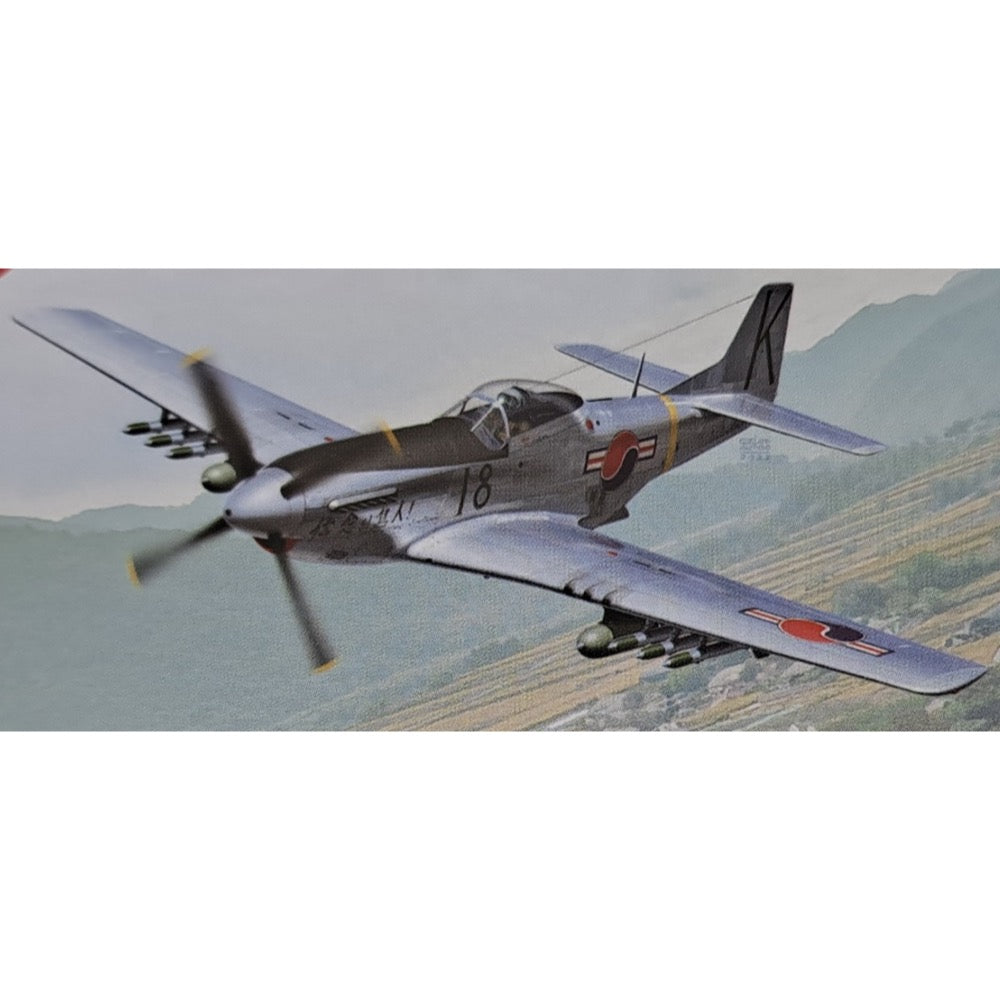
With its excellent balance of high-speed, range, and maneuverability, the P-51D Mustang was considered by many to be the best piston-engined fighter of WWII. After the war, the U.S. Air Force became an independent entity and the P-51D's designation likewise changed to F-51D. The aircraft was still in service when the Korean War broke out and this kit depicts aircraft which saw action during this conflict. The form of the Mustang has of course been accurate reproduced and a wide range of ordnance, including two 500lb bombs, six HVAR rockets, and two 75-gallon drop tanks used as napalm canisters, has been added for extra value. One pilot figure and three marking options are also included.
This is an injection-plastic aircraft model kit.
ACADEMY
Academy 12355 1/48 Grumman ...
$46.95
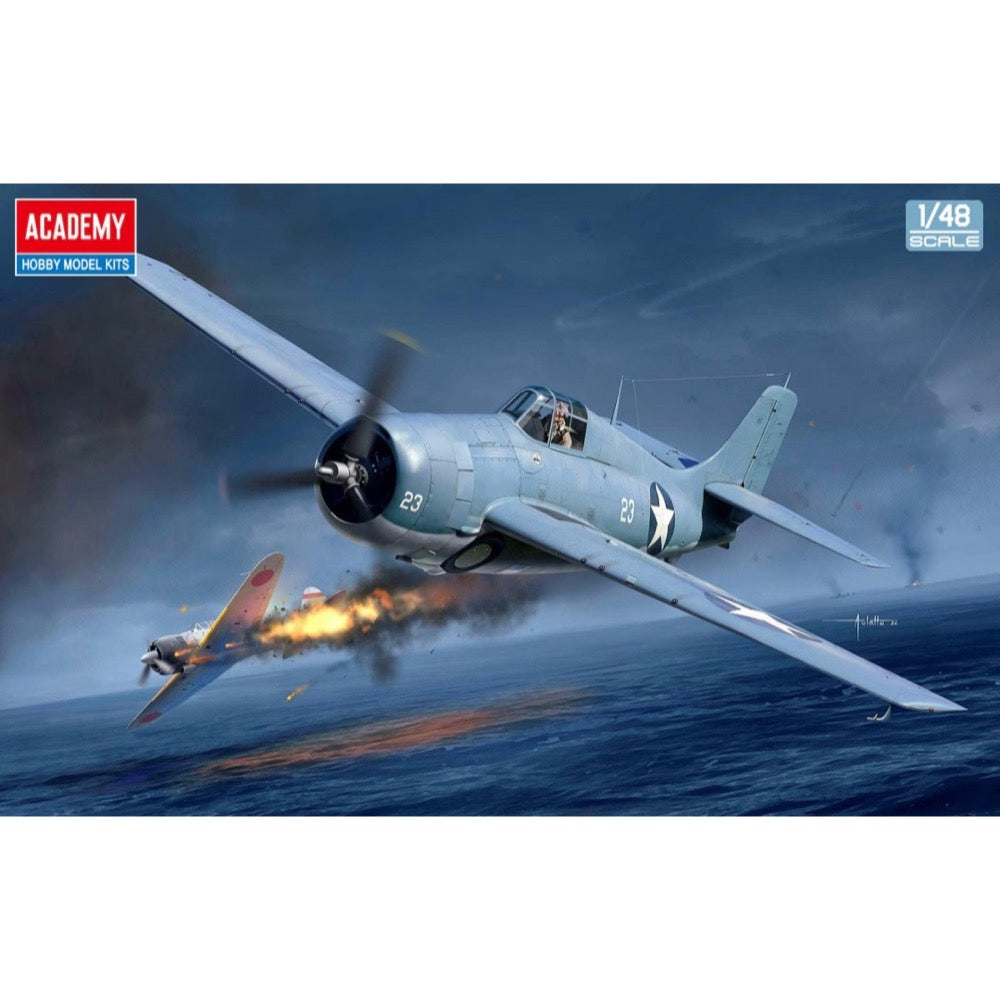
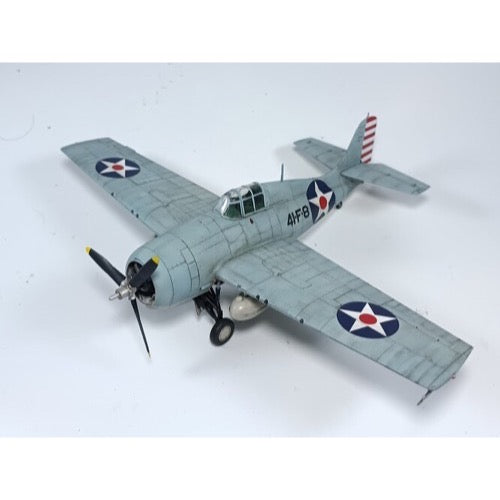
The U.S. Navy's flagship carrier-based fighter, the F4F-4 Wildcat, is now available from Academy as a completely new-mold 1/48-scale model kit! Its panel lines and form have been recreated in intricate detail; the main wings can be assembled folded or unfolded. Photo-etched parts, canopy masking stickers, and decals for four aircraft that took part in Operation Midway are included too.
Features
Precise details: The model is characterized by high quality of reproduction, including details of the fuselage, wings, armament and the pilot's cabin, which can be made in an open or closed version.
Authentic Decals: The kit includes decals depicting the historical markings of US Navy aircraft used during the Battle of Midway.
Movable elements: The set offers the possibility of folding the wings in a folded or unfolded position, which allows for greater flexibility in presenting the model.
High-quality materials: Parts are made of durable plastic, which makes assembly easier and ensures the longevity of the model.
Realistic scale: 1:48 scale provides the perfect combination of precision and ease of assembly, making the model an excellent choice for both beginners and advanced modelers.
Includes
Plastic elements for self-assembly,
Detailed assembly instructions,
Decals with historical markings.


ACADEMY
Academy 12357 1/48 IL-2m3 "...
$56.95
The Academy 12357 Il-2m3 Berlin 1945 1:48 scale model pays homage to one of the most important attack aircraft in aviation history, the famous Il-2m3 . Designed by Soviet engineer Sergei Ilyushin, this aircraft was known for its exceptional durability, being able to survive damage that would be fatal to other aircraft. The version of the Il-2m3 featured in this model was specifically designed to improve performance and increase firepower, which was crucial during the final stages of the war, including the Battle of Berlin in 1945.
The 1:48 scale model kit from Academy allows you to recreate this historic aircraft with attention to detail. It consists of plastic elements that the modeler must assemble and paint themselves. The high quality of the molds and details means that the finished model faithfully reflects the original aircraft, making it attractive to modeling enthusiasts and history buffs. The kit includes detailed assembly instructions, as well as stickers that allow you to recreate the authentic paint scheme used in 1945. Thanks to this, the modeler can indulge in their passion for creation and at the same time appreciate the historical significance of this aircraft.
Features
Includes decals with seven marking options for various units
Detailed cockpit and accurately replicated propeller and armament
Paint index for authentic color finishing
Ideal for historical aircraft enthusiasts and model builders
ACADEMY
Academy 12360 1/48 USAF F-1...
$65.95
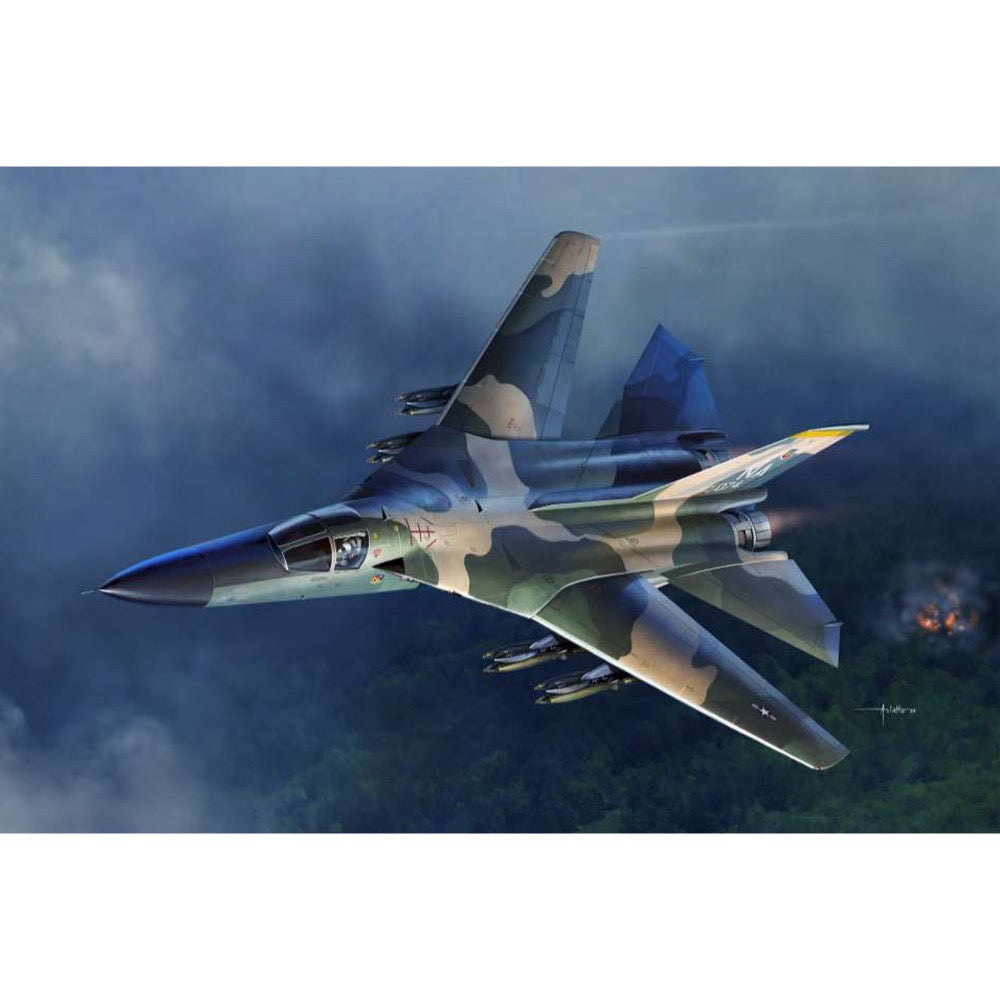
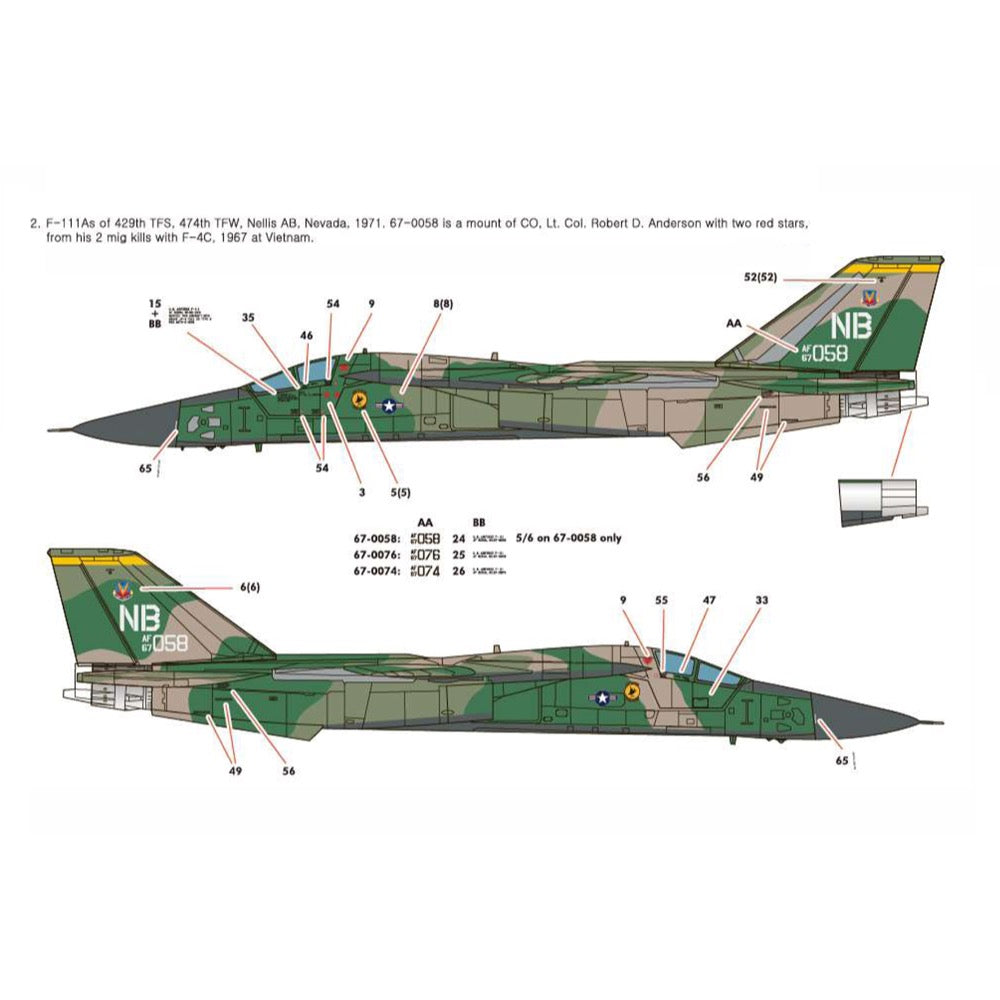
General Dynamics F-111A Vietnam War
Features
7 sprues.
Improved nose gear parts.
Air-to-ground weapons & metal pitot tube included.
Choice of 4 markings: (1) F-111As of Det 1, 428th TFS, 474th TFW at Operation Combat Lancer, Takhli RTAFB, 1968. 66-0018 was the mount of the commander Lt Col Benjamin C Murph.
Crew names were applied on their way back to the US; (2) F-111As of 429th TFS, 474th TFW, Nellis AB, Nevada, 1971. 67-0058 is a mount of C.O. Lt Col Robert D Anderson with two red stars from his two MiG kills by McDonnell F-4C, Vietnam 1967; (3) F-111s of 3474th TFW, Takhli RTAFB, 1972-73.
429/430th TFS participated in Operation Constant Guard V / Linebacker II carrying ordnance more than 4 times that of McDonnell F-4 Phantom IIs with no need for Wild Weasel, electronic countermeasure or tankers; (4) F-111s of 429/430th TFS, Takhli RTAFB, 1973.
347th TFW took command of these units with new tailcode of HG, and flew combat missions until its deactivation in June 1975 at Korat RTAFB


ACADEMY
Academy 12361 1/48 USN T-34...
$31.95
Training aircraft used by U.S. Navy.
The Beechcraft T-34 Mentor was an American military low-wing metal training aircraft from the Cold War and modern times. The flight of the prototype took place in 1948, and the plane entered service in 1953. About 2,300 machines of this type were created in the course of production. The propulsion, in the T-34C version, was provided by a single Pratt and Whitney Canada PT6A-25 turboprop engine with 550 HP. The length of the aircraft was 8.75 meters with a wingspan of 10.16 meters. The machine did not have a permanent on-board armament.
The T-34 Mentor aircraft was initially developed as a grassroots initiative by Beechcraft Aircraft Corporation, which aimed at creating a training and training aircraft that was cheap to produce and operate. It was planned to be an economical alternative to the T-6 Texan. The assumptions of the Beechcraft company partially proved successful and in 1953 the T-34 aircraft began to be used by the US Air Force, and later also by the US Navy. In the course of production, three main military versions of this aircraft were created: T-34A (version dedicated to USAF), T-34B (version dedicated to US Navy) and T-34C (version with turboprop engine). It is worth adding that the machine was also quite successful on foreign markets and was or is still operated in countries such as Argentina, Chile, France, Japan (license production) and Turkey.
Features
Reboxed Minicraft with new decals
Detailed cockpit
Landing gear.
Includes
Choice of 3 markings:
T-34B BuNo 140950, USN Training Sqn 5 (VT-5), 1976;
T-34B BuNo 144090, USN Training Sqn 5 (VT-5), 1984;
T-34B BuNo 140702, USN Training Sqn 1 (VT-1), Air Station Saufley Field FL, 1976.Masking for canopy included.
ACADEMY
Academy 12363 1/48 USN XF5F...
$39.99
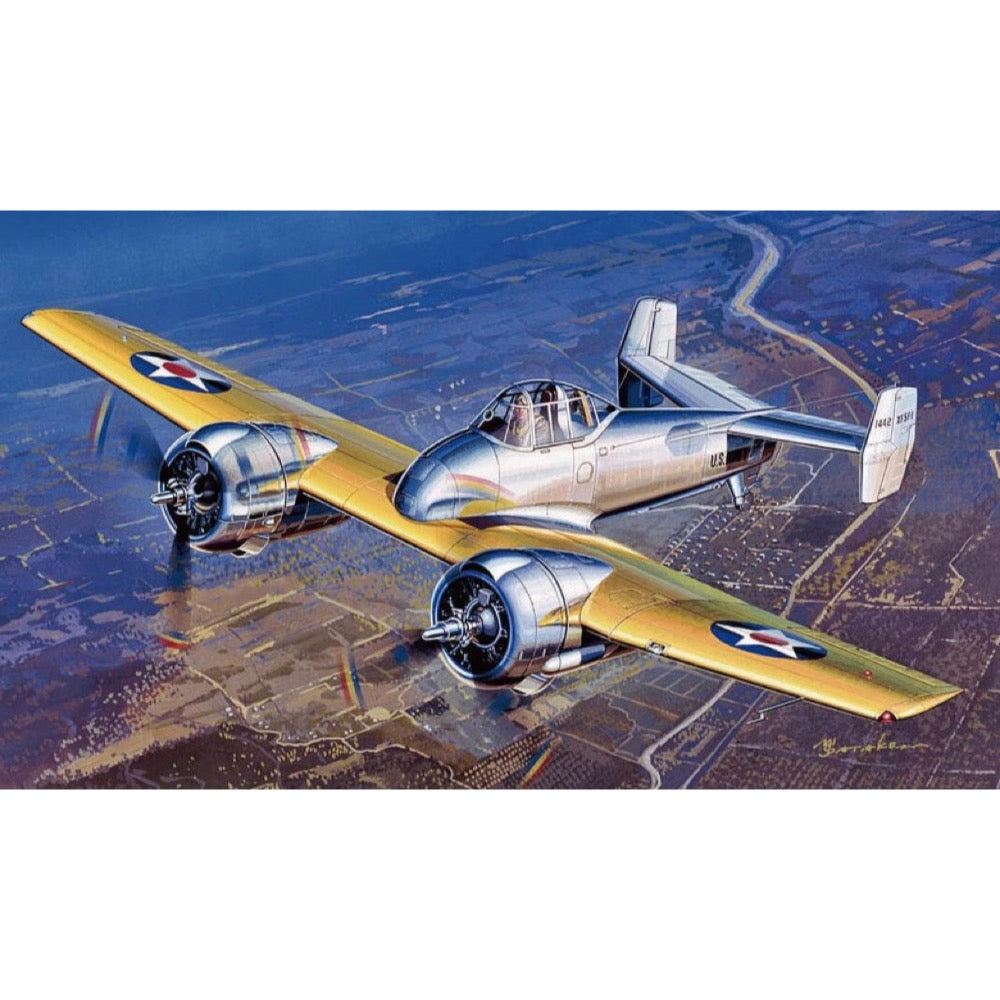
Experimental twin-engine carrier fighter aircraft developed by Grumman for the U.S. Navy in the late 1930s.
Powered by two Wright R-1820 Cyclone counter-rotating radial engines, the Skyrocket’s top speed was 358 mph and could climb 10,000 ft in just over four minutes. During diving tests the Skyrocket reached a speed of 485 mph.
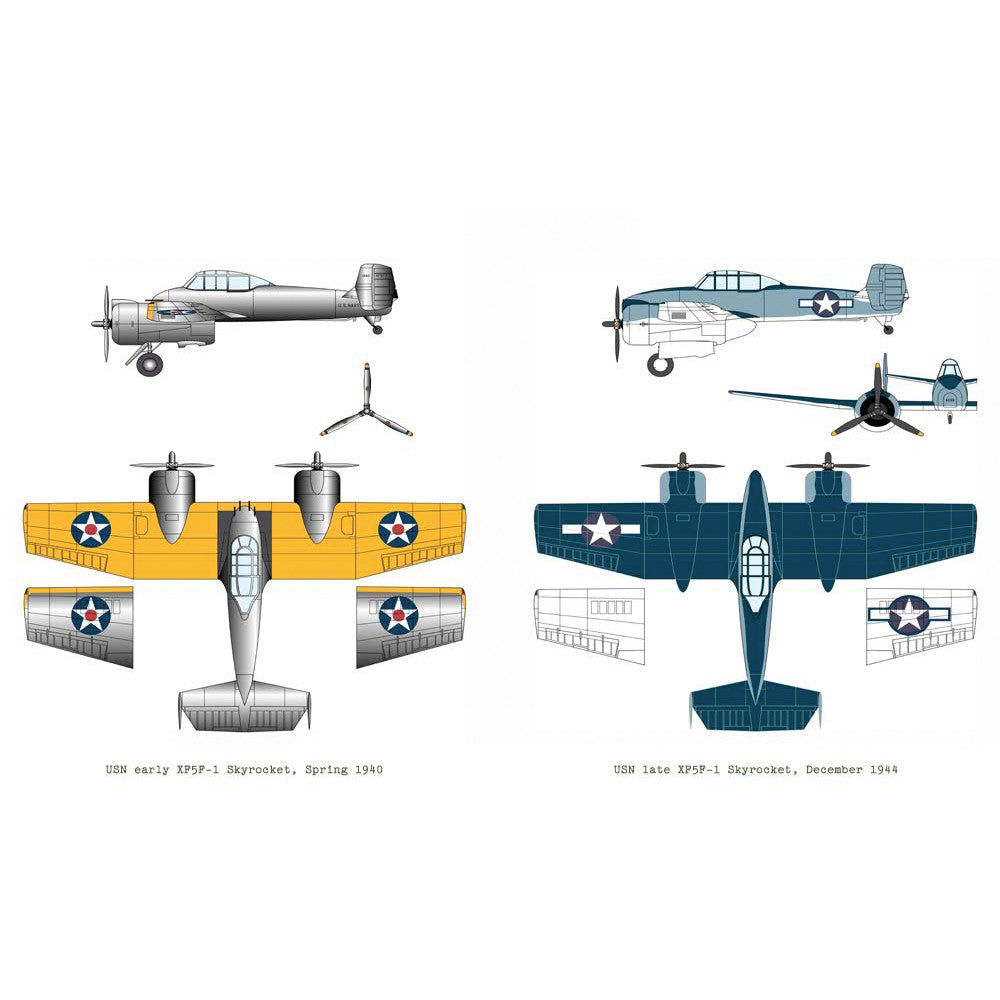
One prototype was built and its first flight was on April 1st 1940. At the time it was the Navy’s largest fighter, with a wingspan of 42 ft and length just under 29 ft.
The unique Skyrocket served for research purposes until being dismantled after an accident in late 1944.
The reissue kit by Academy includes parts for the early truncated-nose & short engine nacelles and the late long-nose & extended engine nacelles, originally released by Minicraft as two separate kits.
ACADEMY
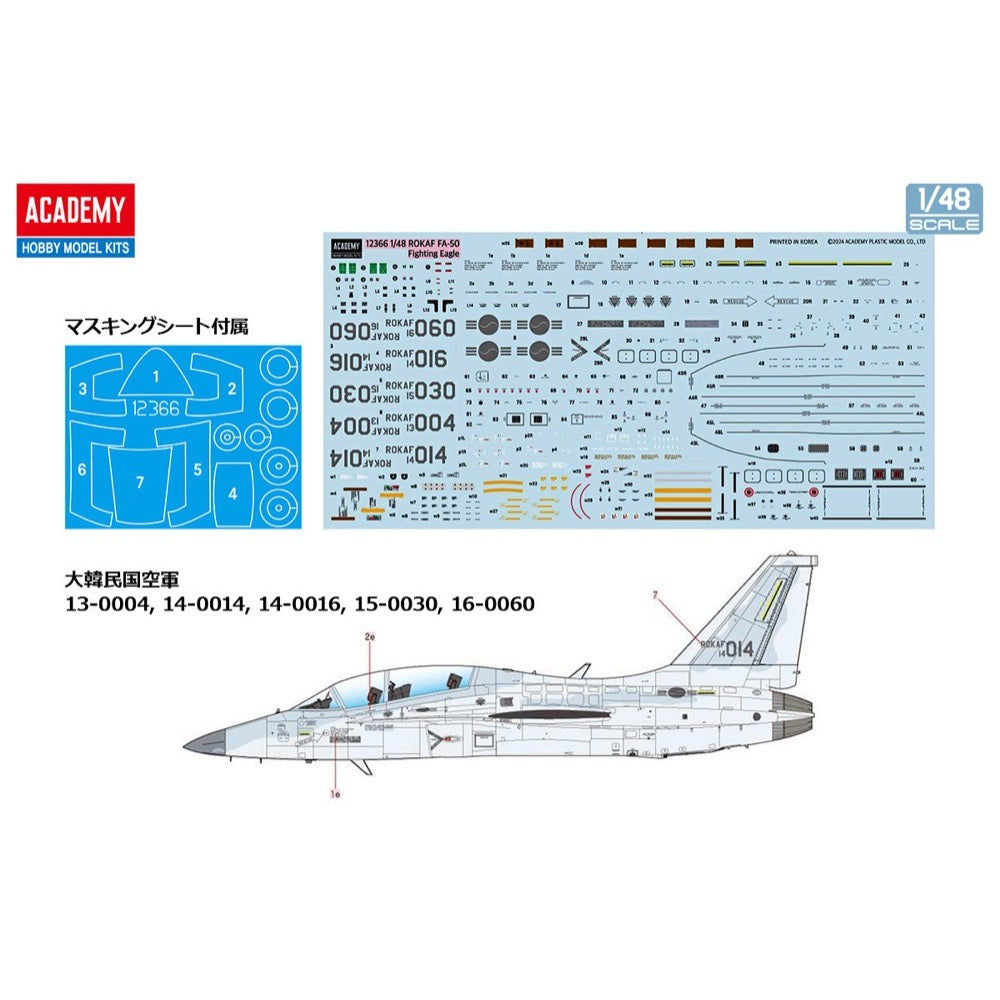
Academy 12366 1/48 ROKAF FA...
$52.95
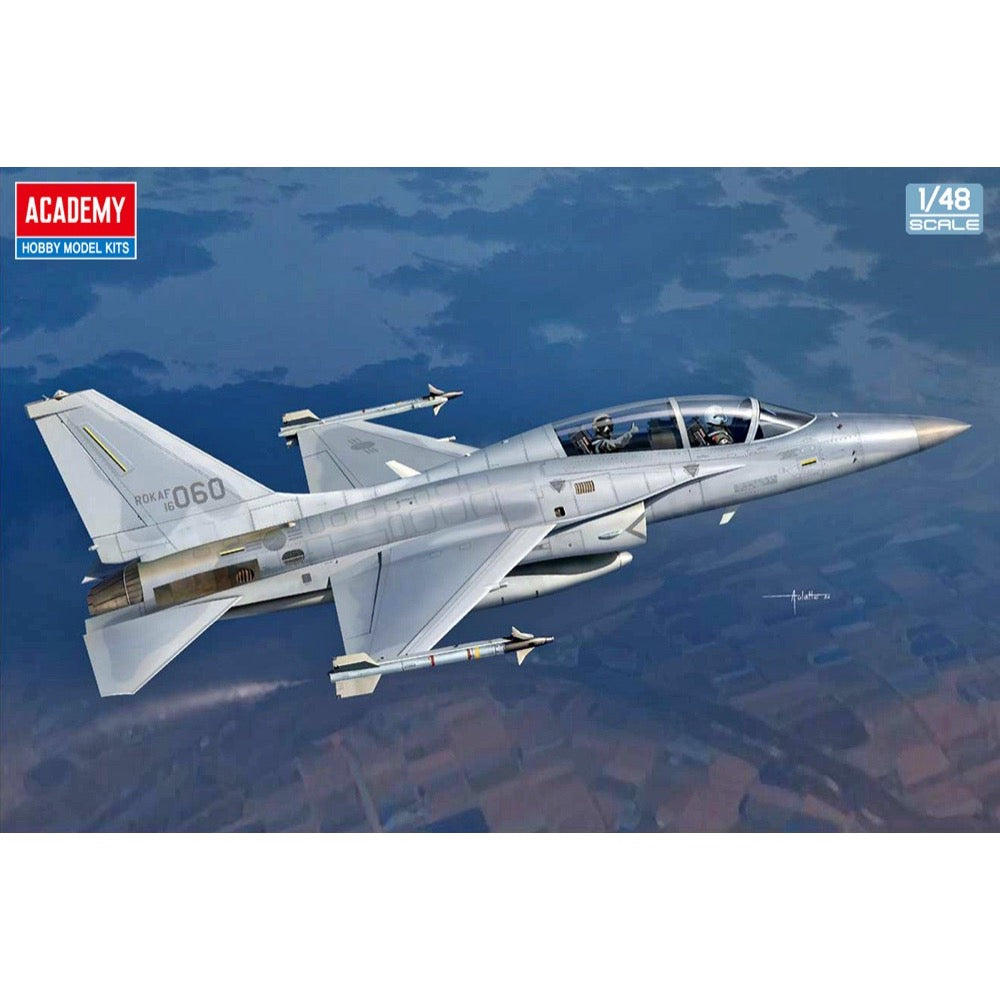
The South Korean Air Force FA-50 Fighting Eagle is a light combat aircraft developed by Korea Aerospace Industries (KAI) in collaboration with Lockheed Martin. Derived from the T-50 Golden Eagle advanced trainer, the FA-50 is designed to perform a wide range of missions, including air-to-air combat, air-to-ground strikes, and reconnaissance.
Equipped with advanced avionics and weapon systems, the FA-50 can carry a variety of munitions, including precision-guided bombs, air-to-surface missiles, and air-to-air missiles. Its multi-role capability and affordability make it an attractive option for smaller air forces seeking to modernize their fleets without the cost of heavier fighter jets like the F-16. With a top speed of Mach 1.5, the FA-50 provides excellent agility and combat readiness, while its advanced radar and avionics ensure situational awareness and engagement precision.
The FA-50's versatility and cost-effectiveness have made it a key asset for South Korea's air defense strategy and a popular choice for export to other nations looking for a reliable, modern light fighter.
The product reproduces the aircraft's form and various weapons (air-to-air AGM-65 / air-to-ground guided missile KGGB) with precise molding.
Includes decals and canopy masking stickers for five Republic of Korea Air Force aircraft.


ACADEMY
Academy 12367 1/48 Cessna 1...
$33.95
Features
Precisely designed cockpit and passenger seats
Intricately engraved panel lines and rivets
Cowlong can be selectively assembled to enable engine display
Masking Seal included
Includes U.S. Civil Air Patrol (CAP) and Korean Air Force Decal

ACADEMY
Academy 12368 1/48 Rafale M...
$ PRICE IN PROGRESS!
To reduce development costs and increase sales opportunities, France entered into an agreement with the United Kingdom, Germany, Italy and Spain to develop an agile, multi-role 'Future European Fighter Aircraft', which would eventually lead to the Eurofighter Typhoon. However, disagreements over the division of labor and differing operational requirements led France to pursue its own development program. Dassault built a technology demonstrator, which made its first flight in July 1986 as part of an eight-year test program that eventually led to the project being approved.
The Rafale differs from other European fighters of the same period in that it was developed almost entirely by a single country. Major French defense companies, including Dassault, Thales and Safran, were involved in its production. Many of the avionics and systems, such as voice control, the RBE2 AA active electronically scanned array (AESA) radar and the infrared search and track (IRST) sensor, were developed and produced in France specifically for the Rafale. The Rafale was originally scheduled for operational deployment in 1996, but post-Cold War budget cuts and changing priorities caused significant delays to the project.
There are three main variants: the Rafale C, a single-seat land-based version, the Rafale B, a two-seat land-based version, and the Rafale M, a single-seat carrier-based version.
ACADEMY
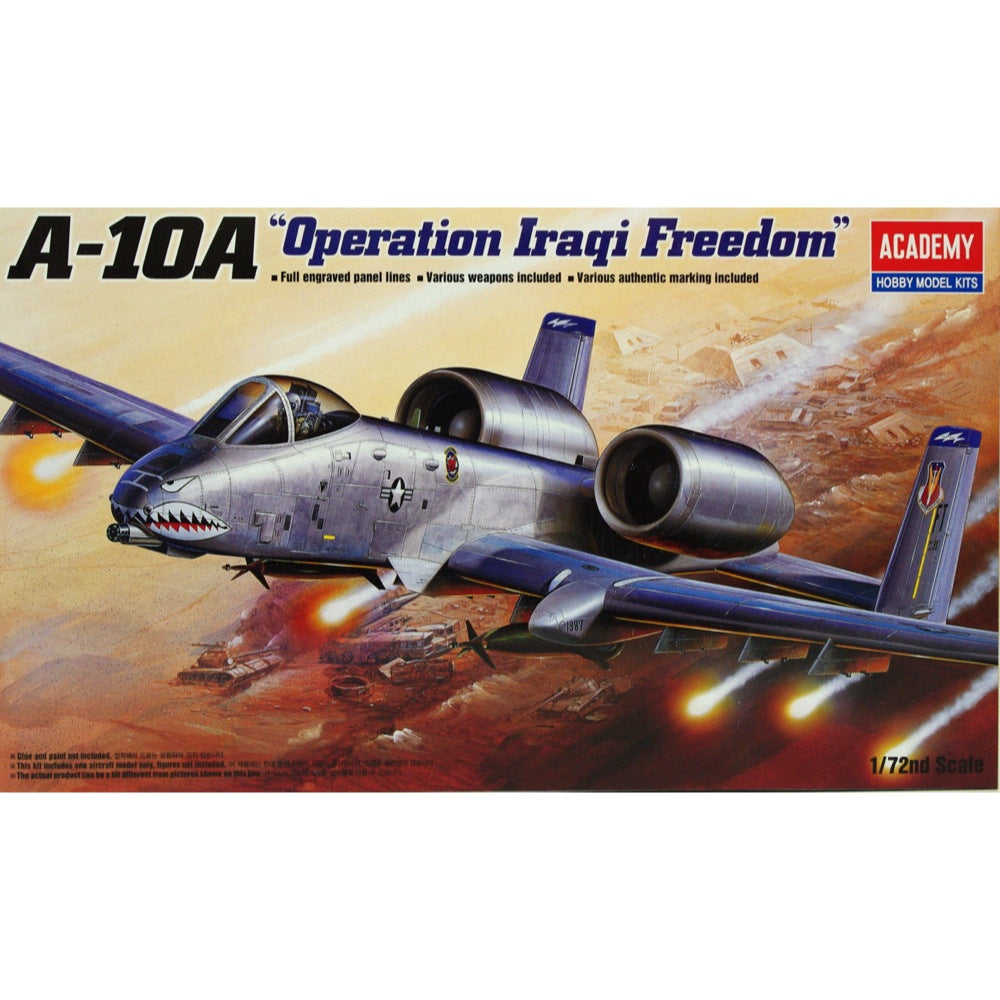
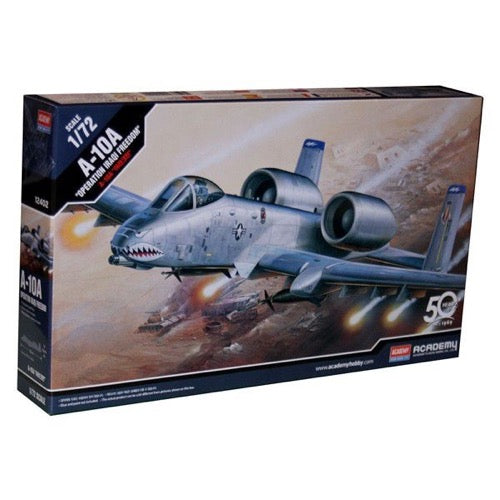
Academy 12402 1/72 A-10A "O...
$23.95
The Fairchild-Republic A-10 Thunderbolt II is a turbo-fan powered single-seater attack aircraft. The prototype flight took place in 1972, and serial production took place in 1975-1984. In total, 715 examples of this aircraft were built. The main task of the A-10 was to combat armor of the Warsaw Pact in central and western Europe. It was also supposed to balance the quantitative advantage of the USSR over NATO troops in armored weapons. Such a task resulted in the fact that the plane is characterized by a great resistance to damage, unheard of in other assault machines, the armor of the cockpit and a very high overall durability of the structure. The A-10 is also manoeuvrable - at 275 km / h, the turning radius is 300 meters, increasing to just 400m with a speed increase of 550 km / h. The main armament is the 30mm GAU-8 / A rapid-fire cannon. In addition, the plane can carry from 6,500 to 7,300 kg of weapons depending on the amount of fuel transferred. The A-10 Thunderbolt II was used in combat in Operation Desert Storm, where it performed excellently and proved its high value. Technical data: Top speed: 706 km / h; maximum range: 3950 kg, climb speed 30.5 m / s.
This is an injection-plastic jet aircraft model kit.
ACADEMY
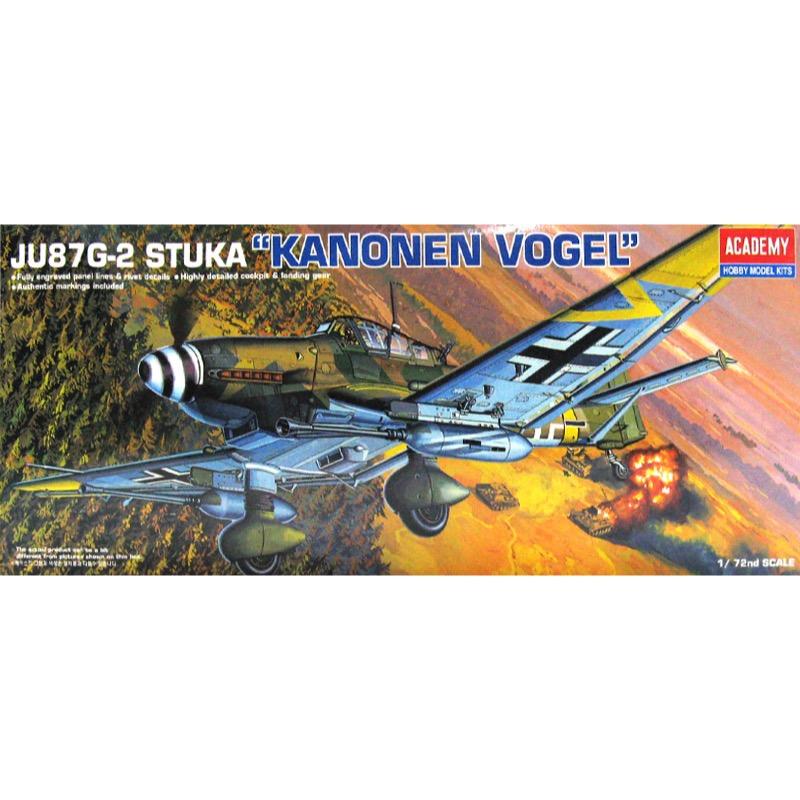
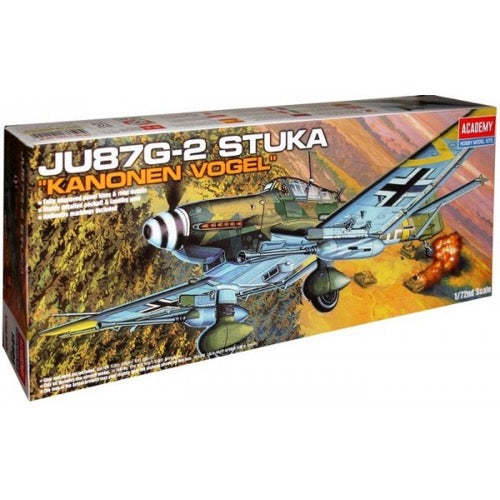
Academy 12404 1/72 Ju87G-2 ...
$19.95
The Junkers Ju-87 Stuka (short for German Sturzkampfflugzeug, meaning dive bomber) is a German single-engine dive bomber with a classic tail, wings in an inverted gull-wing configuration and all-metal construction. The Ju-87 is one of the most famous Luftwaffe aircraft, a symbol of its power next to the Me-109. At the beginning of the war (1939-1941) it became a symbol of the Blitzkrieg, often causing panic among enemy soldiers by installing acoustic sirens (the so-called jerychońskie trunks), causing a specific sound during a diving flight. The creator of the machine was Hermann Pohlmann, and the Ju-87 first flew into the air in 1935, and went into production two years later. Technical data (version Ju-87B): length: 11m, wingspan: 13.8m, height: 4.23m, maximum speed: 390km / h, maximum range: 500km, maximum ceiling 8200m, armament: fixed - 3 machine guns cal .7.92mm, suspended - up to 450 kg of bombs.
This is an injection-plastic jet aircraft model kit.


ACADEMY
Academy 12414 1/72 B-17G "N...
$64.99
$69.99
Heavy Bombing Capability: The B-17G was designed for strategic bombing missions, capable of carrying up to 8,000 pounds (3,600 kg) of bombs. It played a crucial role in the daylight precision bombing strategy against industrial and military targets in Nazi-occupied Europe. Its ability to deliver heavy payloads deep into enemy territory made it a cornerstone of the U.S. Army Air Forces' (USAAF) aerial strategy.
Enhanced Defensive Armament: To counter increasingly sophisticated Axis fighter threats, the B-17G featured an upgraded armament configuration, including a chin turret with twin .50-caliber machine guns, giving it a total of 13 .50-caliber machine guns positioned across the aircraft. These guns provided comprehensive defensive coverage, enhancing the bomber’s ability to defend against enemy fighters from all directions.
Robust Airframe: The B-17G's airframe was renowned for its durability and resilience, capable of sustaining significant battle damage and still returning to base. This robustness earned it the nickname "Flying Fortress," reflecting its ability to withstand heavy anti-aircraft fire and fighter attacks while maintaining operational effectiveness.
Crew Coordination: Typically manned by a crew of ten, the B-17G required effective coordination among its crew members, including the pilot, co-pilot, navigator, bombardier, radio operator, gunners, and flight engineer. Each crew member played a vital role in navigating, operating, and defending the aircraft during combat missions.
Operational Range and Performance: Powered by four Wright R-1820 Cyclone radial engines, the B-17G could achieve a maximum speed of 462 km/h (287 mph) and a service ceiling of 10,800 meters (35,600 ft). Its range of approximately 3,200 km (2,000 miles) with a full bomb load allowed it to reach and bomb distant targets, extending its strategic impact.
Markings options for 6 aircraft
B-17G-50-DL 44-6483, 550BS/385BG 'Ruby's Raiders
B-17G-25-DL 42-38050, 359BS/303BG 'Thunderbird'
B-17G-35-BO 42-32076, 401BS/91BG 'Shoo Shoo Baby'
B-17G-30-BO 42-31909, 323BS/91BG 'Nine-O-Nine'
B-17G-20-BG 42-31585, 323BS/91BG 'Mount ‘N Ride'
B-17G-35-VE 42-97880, 324BS/91BG 'Little Miss Mischief'


ACADEMY
Academy 12421 1/72 McDonnel...
$ PRICE IN PROGRESS!
The McDonnell-Douglas F-4 Phantom is a long-range, twin-engine, two-seater multi-role fighter designed for operations in difficult weather conditions. The flight of the prototype took place on May 27, 1958, and serial production began in 1961. Originally, the F-4 was intended only as a stormtrooper, but from 1955 on, the design work went towards meeting the US Navy's need for a new on-board fighter. The F-4 Phantom turned out to be a very successful machine, produced in several versions, exported to many countries and produced under license. The first versions are models from A to D intended for fighter-bombers. The next version is the F-4E, produced since 1967 as a long-range fighter. Reconnaissance versions were also created: RF-4B, RF-4C and RF-4E. The latest versions are the F-4F and F-4G Wild Weassel - these are electronic warfare planes and designed to fight the enemy radars. The F-4 took part in the Vietnam War, the conflicts in the Middle East (1967, 1973) and the Iran-Iraq War (1980-1988). In total, 5,057 F-4 Phantom aircraft were built. Technical data (version F-4E): Maximum speed: 2370 km / h, speed of climb: 210 m / s, maximum ceiling 18300 m, maximum range: 2600 km, armament: fixed - 1 20mm M61A-1 cannon, Suspended - up to 7255 kg of bombs and rockets.
This is an injection-plastic jet aircraft model kit.
ACADEMY
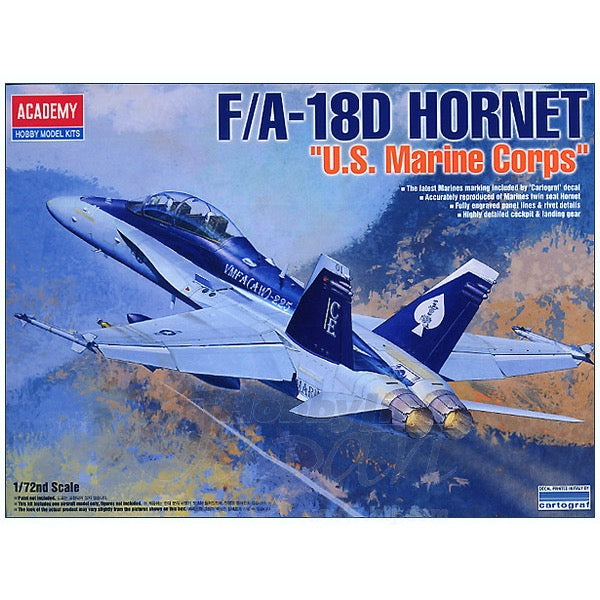
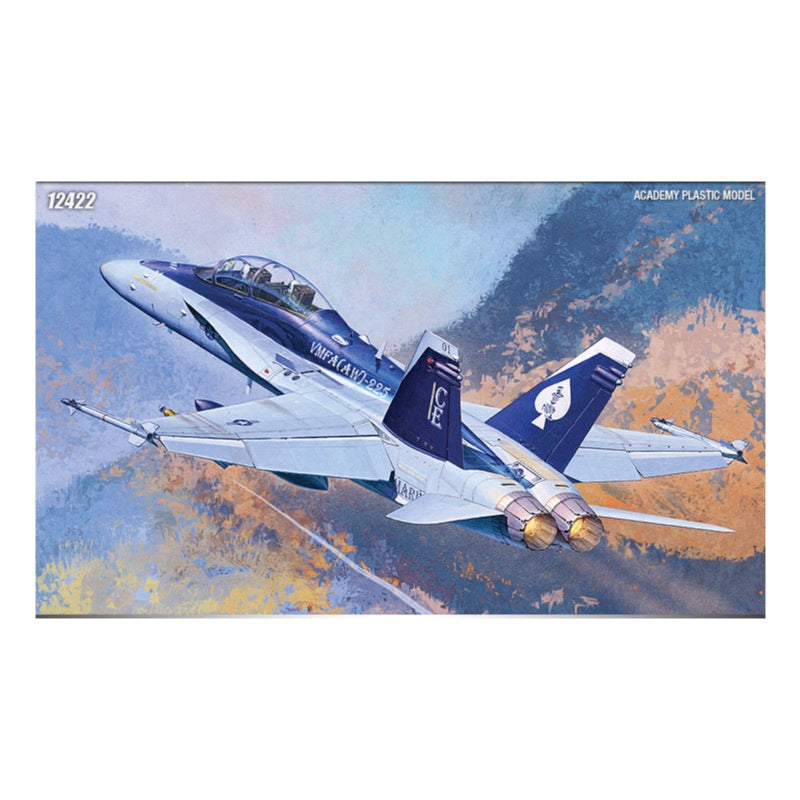
Academy 12422 1/72 F/A 18D ...
$46.95
The single-seat F/A-18 Hornet is the United States Navy and Marine Corps premiere strike fighter, and fills a variety of roles; air superiority, fighter escort, suppression of enemy air defenses (SEAD), close and deep air support (CAS/DAS), interdiction, and forward air control (FAC). The Hornet has exceptional maneuverability and superior turn characteristics, allowing it to hold its own against any adversary.
This is an injection-plastic jet aircraft model kit.
Features
Type A rudder included; and Australian, Canadian and Spanish Hornet decal included by Cartograf.
3 Versions Buildable
F/A-18 Hornet, A21-3, No.3 Squadron Royal Australian Air Force, 2005
CF-188(CF-18A) Hornet, 188776, No.433 "Porcupines" Squadron Canadian Armed Force, 2000
C.15(EF-18A) Hornet, C15-02, Ala de Caza 15, Ejercito del Aire (Spanish Air Force), 2007


ACADEMY
Academy 12423 1/72 F-22A Ai...
$55.95
$69.99
The Lockheed F-22 Raptor is an American air superiority fighter with highly developed ground attack capabilities as well as electronic warfare and electronic watch. The F-22 was in April 1991 the winner of the competition announced by the USAAF for the Advanced Tactical Fighter, which dates back to 1981. It was then that a $ 12 billion program was launched and the construction of a highly maneuverable, indirectly controlled, Stealth fighter began. The US Navy joined the program in April 1986, hoping to build a successor to the F-14 Tomcat. Later that year, the Department of Defense announced that Lockheed and Northrop had advanced to the next stage. Each of the companies was to build a prototype, designated YF-22 and YF-23, respectively. From then on, Lockheed joined forces with Boeing and General Dynamics, which later resulted in the division of work on serial aircraft between the Boeing and Lockheed plants. The first prototype of the YF-22 was called 87-3997 / N22YF and was equipped with newly constructed General Electric YF120 engines. The flight of the plane took place on September 29, 1990. Shortly thereafter, on October 30, 1990, a second 87-3998 / N22YF prototype was flown, powered by an alternative Pratt-Whitney YF119 engine. After a careful comparison of the parameters with the competing YF-23 by the Northrop / McDonnell Douglas team, it was announced that the winner of the competition was the YF-22 with the YF119 engine. The design of the final version of the F-22A was frozen in March 1992. The differences compared to the prototype included an increase in the wingspan of a trapezoidal shape to 13.59 m, which, however, did not increase the wing surface, a reduction in the thickness of the wing profile at the root and its twisting, which ensured better controllability of the aircraft in terms of supersonic speeds. The area of the double vertical tail was also reduced to 27.2 m2. The Lockheed F-22 Raptor is one of the first, if not the only, fifth generation fighter in the world. Thanks to the use of a completely new power unit (two Pratt-Whitney F119-PW-100 engines with vector thrust) and low aerodynamic resistance, the speed of the F-22 - according to unofficial data - exceeds 2.4Ma. In addition, it is highly maneuverable, which allows you to perform such acrobatic figures as, for example, the Pugacheva cobra or Kulbit. Another important feature of the F-22 is the Stealth technology, however, based less than the F-117 on RAM, and more on the aerodynamic excellence, overall shape of the airframe and refined exterior details. The exact radar view (RCS), however, is still classified. It is also very important to use the highly innovative AN / APG-77 radar, thanks to which it is possible to detect objects from about 250 km. Moreover, this radar enables the F-22 to act as a "mini-AWACS" aircraft, which significantly increases the combat capabilities of the strike teams with this aircraft. AN / APG-77 can also be used to attack the enemy's electronic radar and overload his sensors. Production of the F-22 ended in 2011, with the production of 187 serial aircraft, with Lockheed obliged to maintain the production lines and facilities. Due to its technological advancement, the F-22 is not exported.
This is an injection-plastic jet aircraft model kit.
ACADEMY
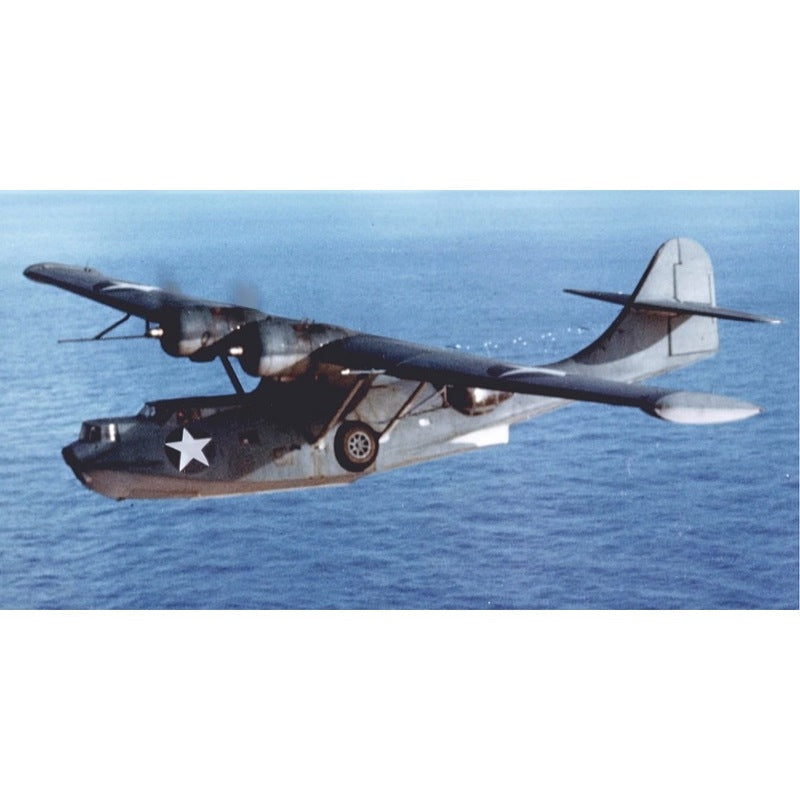
Academy 12430 1/72 Consolid...
$ PRICE IN PROGRESS!
In October 1933, the US Navy placed an order with Consolidated and Douglas for prototypes of new machines. The prototype constructed by Consolidated, designated XP3Y-1, became a flying boat built in the largest number of copies. The internal designation assigned to the structure by the company is Consolidated 28. The aircraft, just like its predecessor - P2Y - had a high wing system. Technical data (PBY-5A version): length: 19.46m, wingspan: 31.7m, height: 6.15m, maximum speed: 314km / h, rate of climb: 5.1m / s, practical ceiling: 4000m, range maximum: 4050 km, armament: fixed - 3 machine guns caliber 7.62 mm and 2 machine guns caliber 12.7 mm, suspended - up to 1814 kg of bombs.
This is an injection-plastic jet aircraft model kit.
ACADEMY
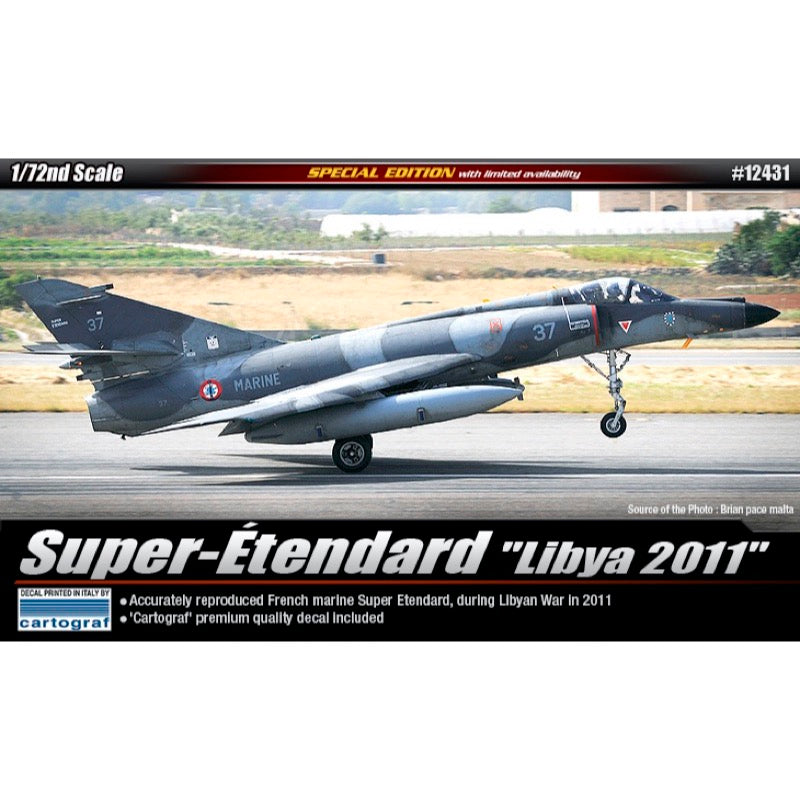
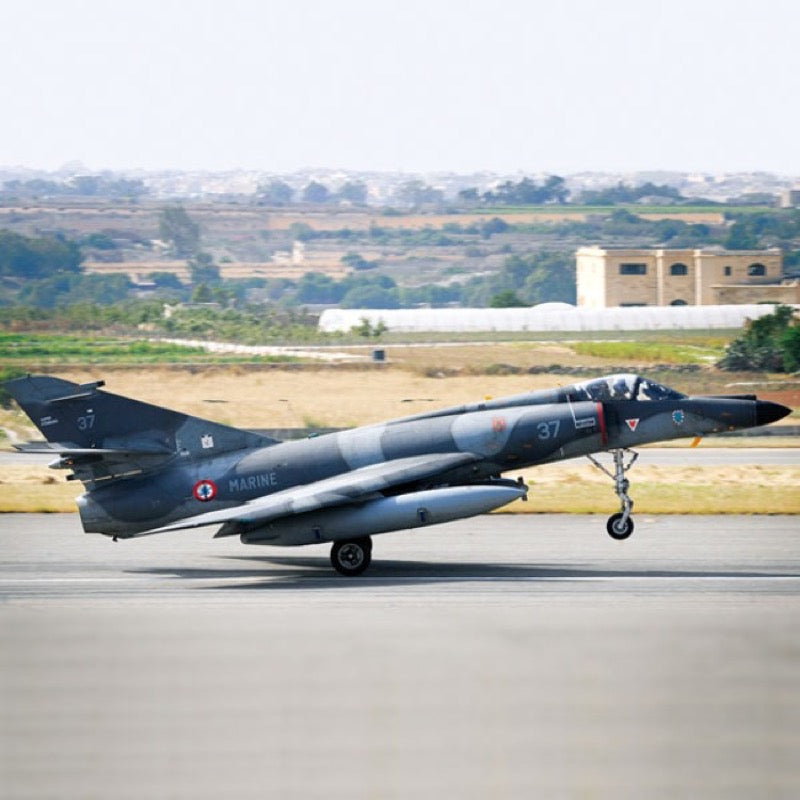
Academy 12431 1/72 Super Et...
$21.95
The Dassault-Breguet Super Etendard is a French, single-engine, airborne fighter-attack aircraft, flown on October 28, 1974. The drive is provided by a single SNECMA Atar motor with a thrust of 4900 daN. The machine was created as a modernization of the Dassault Etendard IVM aircraft. Two versions of the Super Etendard were created: "M, which is a fighter-attack model, and" P "- a reconnaissance aircraft. Serial production of this machine was small: 71 were produced for the use of the French Navy, 14 were exported to Argentina, and 5 to Iraq. took part in the war for the Falklands, where they sunk the destroyer HMS Sheffield, HMS Atlantic Conveyor and seriously damaged HMS Glamorgan using AM-39 Exocet II missiles.
Kit has engraved panel lines, basic cockpit, boxed-in wheel wells, detailed undercarriage, optional position speed brakes, filigree antennae and probes, optional extended refueling probe, 1100 gallon drop tank, R.550 Magic missiles (x2), AM39 Exocet missile and 2-piece optional position canopy.
Decals and Painting guide
No. 55 of Flottille 11F during 2008
No. 10 of Flottille 17F onboard the carrier Charles de Gaulle during Operation Harmattan (Libyan raid), 2011.

ACADEMY
Academy 12441 1/72 P-51C Mu...
$17.95
The North American P-51 Mustang is an American, single-engine, long-range fighter and attack aircraft with a classic tail and all-metal construction. The flight of the prototype took place on October 26, 1940. The P-51 Mustang has earned a reputation as one of the best, if not the best, WWII fighter. Replacing the Allison V-1710-39 engine from the first project with a Rolls-Royce Merlin motor (P-51 Mustang Mk.Ia version) made the Mustang, like never before, reached perfection. Technical data (P-51D version): length: 9.83m, wingspan: 11.28m, height: 4.08m, maximum speed: 703km / h, rate of climb: 16.3m / s, maximum range: 2755km, ceiling practical: 12800m, armament: fixed - 6 12.7mm M2 machine guns, suspended - up to 908 kg of bombs or 10 127mm HVAR rocket launchers.
This is an injection-plastic jet aircraft model kit.
ACADEMY
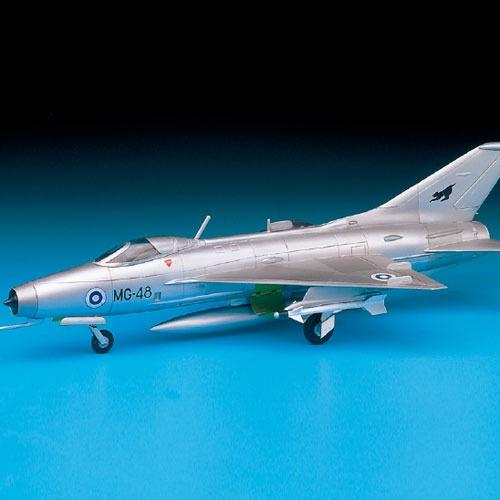
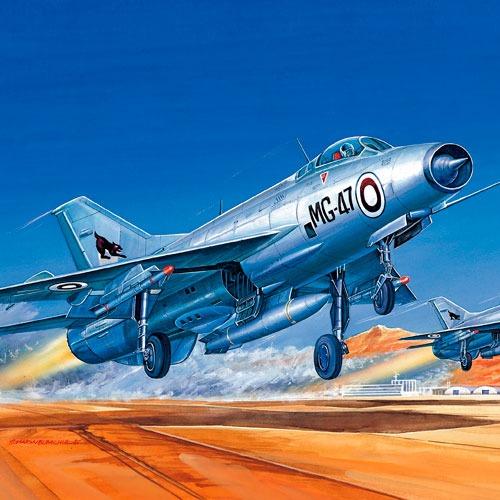
Academy 12442 1/72 Mikoyan ...
$12.95
The Mikojan-Guriewicz MIG-21 (NATO: Fishbed) is a Soviet light fighter with a duralumin, half-shell structure, in a mid-wing design, with a delta blade with a 57-degree slope. The prototype flight took place on June 16, 1956. The prototype of the MIG 21 is considered to be the E-5 prototype powered by the RD-11 engine. After its flight, several other prototypes were created, which, incidentally, were breaking various international airspeed records. Technical data: length: 13.46m, wingspan: 7.15m, height: 4.1m, maximum speed: 2130km / h, climb speed: 120m / s, maximum range: 1100km, maximum ceiling 19000m, armament: fixed - single 23 mm GSz-23 cannon (M version), suspended - up to 2000 kg of cargo.
This is an injection-plastic jet aircraft model kit.
ACADEMY
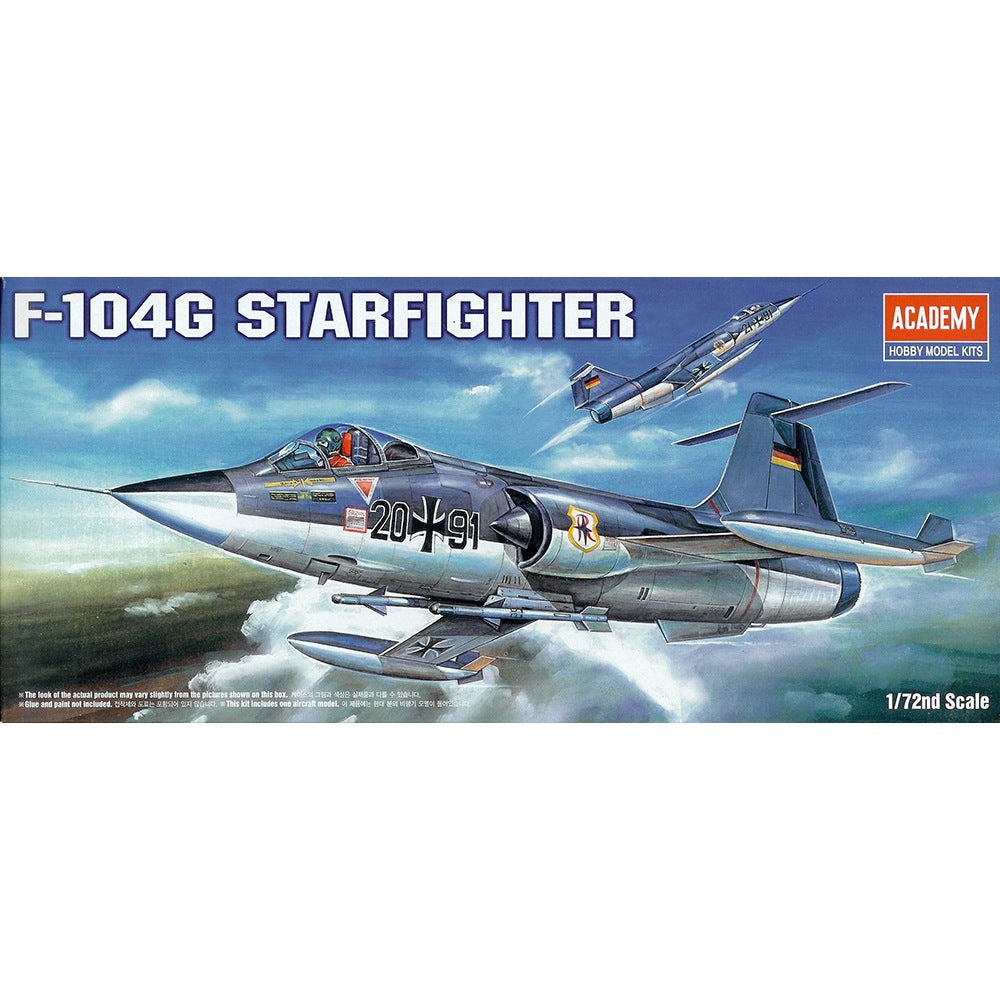
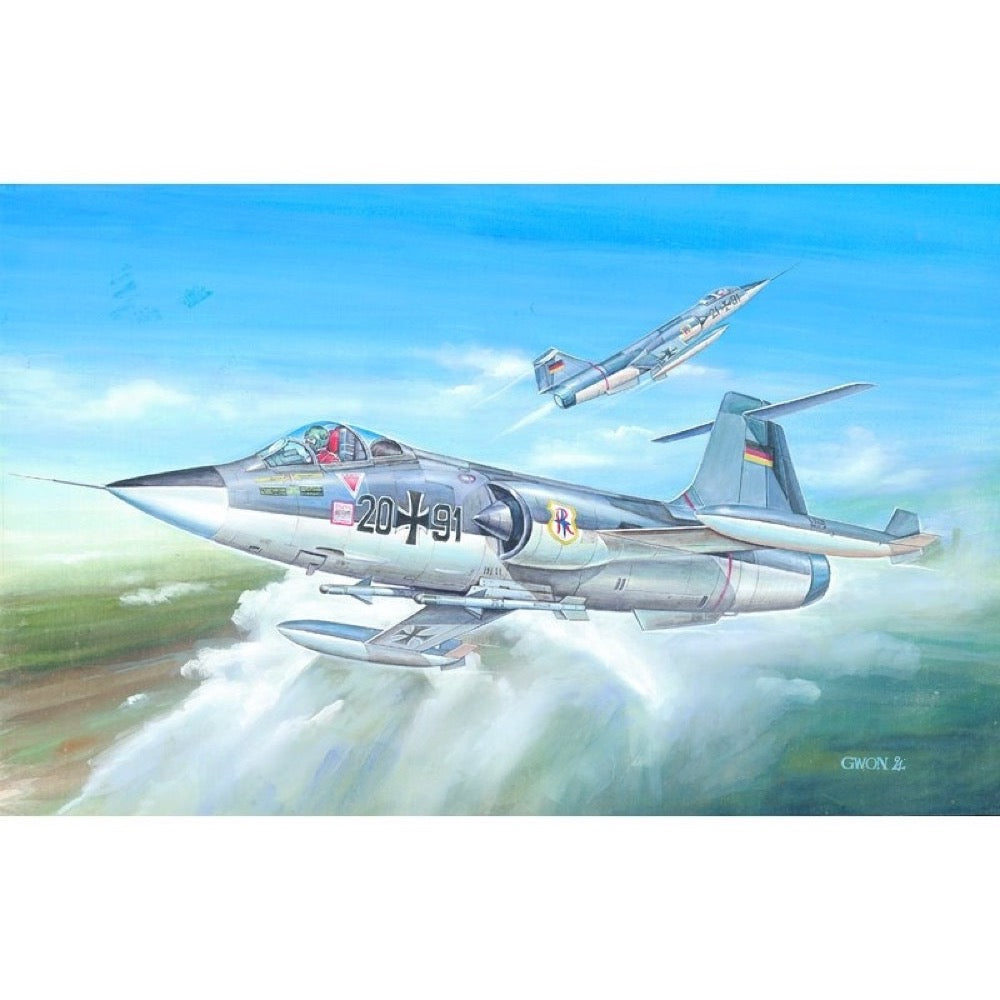
Academy 12443 1/72 F-104G S...
$15.99
The Lockheed F-104 Starfighter is an American supersonic interceptor and fighter-bomber. The F-104 is the fruit of the American experience of the Korean War, where most air victories were achieved in one surprising blow. This, in turn, meant that the new USAAF fighter should, above all, be fast and have a high rate of climb. Technical data (version F-104G): Maximum speed: 2137 km / h, speed of climb: max. 254 m / s, maximum altitude 27,400 m, maximum range: 2,920 km, armament: fixed - one 20mm six-barrel M61A-1 cannon, suspended - up to 1,814 kg of cargo.
This is an injection-plastic jet aircraft model kit.
ACADEMY
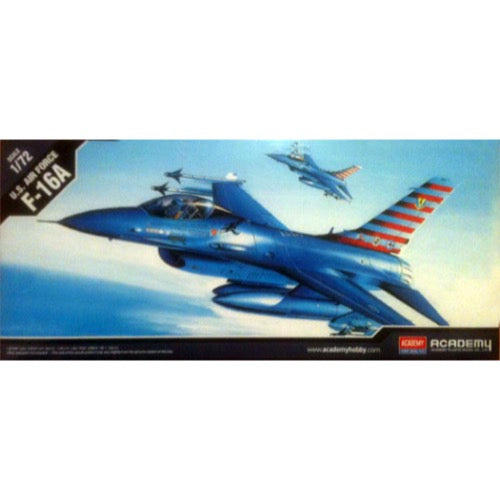
Academy 12444 1/72 F-16A Fi...
$13.99
The General-Dynamics F16 Falcon is an American single-engine, multi-role light fighter and stormtrooper. Work on the F-16 project began in 1971 at the General Dynamics concern (which in 1993 was part of the Lockheed Martin giant), entering the competition for a light multi-purpose fighter (LWF) for the US Air Force. The YF-16 prototype first flew on February 2, 1974. A breakthrough in technical terms was the use of a computerized electric fly-by-wire control system, which made it possible to reduce the area of the wings and tail, and thus reduce the weight of the entire aircraft. The F-16 was the first fighter in the world to use such a system. The first versions were to a large extent made of aluminum alloys (about 83% of the total structure), but with time they gave way to composites. Technical data: Maximum speed: 2,170 km / h, rate of climb: 254 m / s, maximum ceiling 15240m, maximum range: 3890km, armament: fixed - one 20mm six-barrel M61A-1 cannon, suspended - up to 9275 kg of cargo.
This is an injection-plastic jet aircraft model kit.
ACADEMY
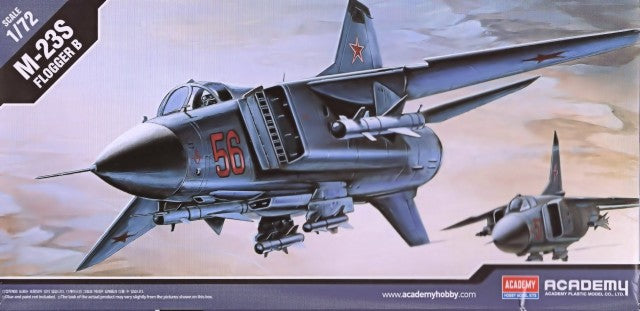
Academy 12445 1/72 M-23S Fl...
$14.95
Mikojan-Guriewicz MIG-23 is a Soviet, single-engine fighter-attack aircraft with variable wing geometry, with a classic tail. The flight of the prototype took place on June 10, 1967, and shortly thereafter, it lasted until 1985. The MIG-23 was clearly influenced by the design of the French Mirage G, although the MIG-21PD machines were initially tested, with the MIG-21 wing, R-27-300 engine and RD-36-35 auxiliary starters placed vertically in the fuselage. Airplanes of this type took part in numerous conflicts, among others in the Iran-Iraq War (1980-1988), in Afghanistan (1979-1989) and during the Gulf War (1990-1991). Technical data: length: 17.18m, wingspan (maximum): 13.97m, height: 4.82m, maximum speed: 2.35Ma, climb speed: 35.7m / s, maximum range (with additional tanks): 2500km , maximum ceiling 17500m, armament: fixed-single, double-barreled GSz-23Ł cannon, caliber 23mm, suspended - up to 4500 kg of cargo.
This is an injection-plastic jet aircraft model kit.
ACADEMY
Academy 12446 1/72 SPAD XII...
$9.99
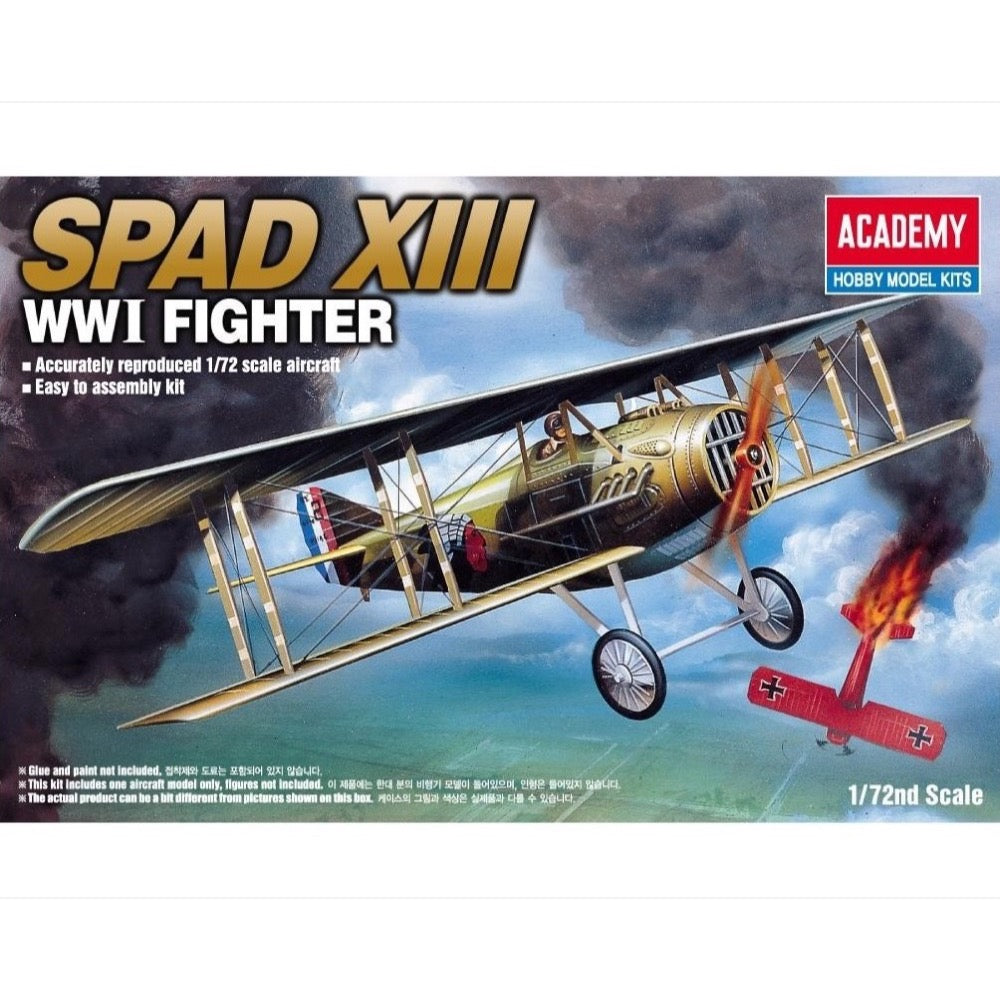
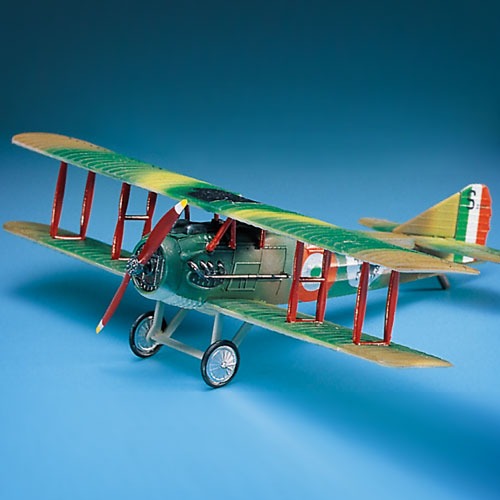
The SPAD S.XIII was a French fighter plane of a mixed structure, with mainly wooden elements, in a biplane configuration. The drive was provided by a single Hispano-Suiza 8Be V-engine with 235 HP. The flight of the prototype took place on March 4, 1917, and serial production began in May that year, which was completed only in 1919 with the production of over 8,400 copies of this very successful aircraft.
This is an injection-plastic jet aircraft model kit.