
Reset
ACADEMY
Academy 12632 1/144 Boeing ...
$48.95
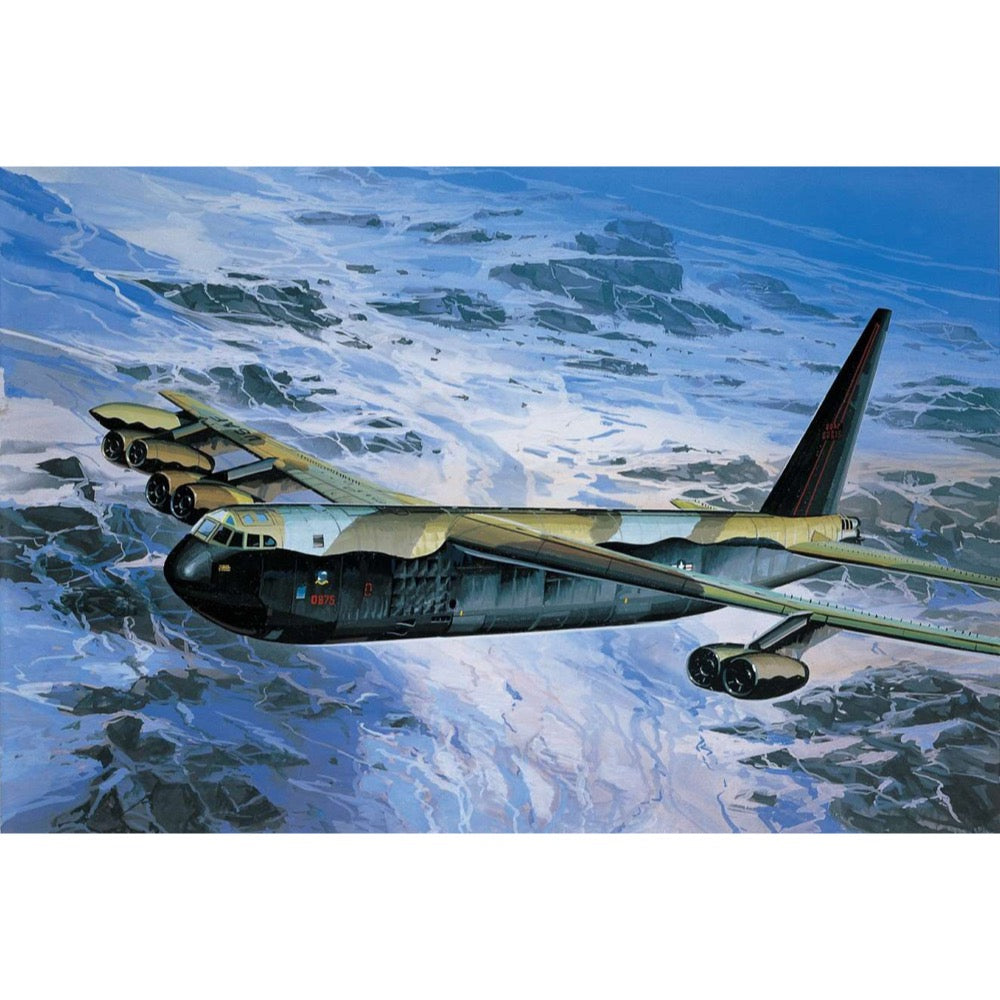
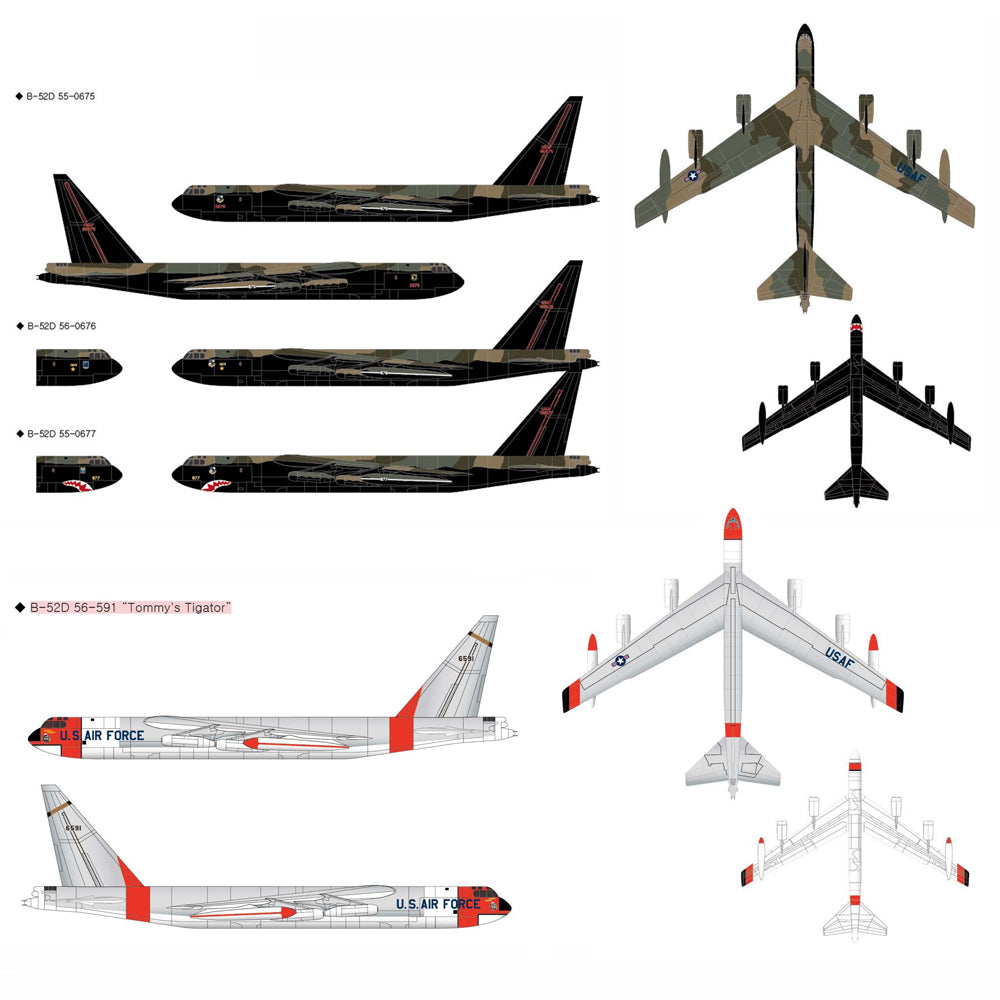
Long-range heavy bomber capable of delivering a nuclear payload, developed by Boeing for the United States Air Force entering military service from 1955. The seventy year old design is expected to remain operational until the 2050s. The B-52D variant was used extensively in the Vietnam war. This release from Academy is from the Minicraft tooling. M117 air-dropped demolition bombs included. Markings for B-52D 55-0675: Retired October 1982, broken up December 1993; 56-0676: The first B-52 to down a MiG-21 in combat (over North Vietnam) and preserved at Fairchild AFB; 55-0677: Preserved at the Yankee Air Museum, Michigan; 56-0591: 4925th Test Group (Atomic) "Tommy's Tigator", crashed June 1959 in the Ochoco National Forest, Oregon. Cause, failure of the horizontal stabilizer (tail plane) during low-level flight tests. The crew of five Boeing employees did not survive.Licensed by Boeing.
This is an injection-plastic jet aircraft model kit.
Features
USAF Strategic Bomber B-52D in 1/144 scale.
Comes with 4 decals (USAF Strategic Air Command/Flight Test Group).
Old Minicraft mold.
Product Specifications: Plastic model kit
Material: Plastic, etc.
ACADEMY
Academy 12625 1/144 AH-64D/...
$15.95
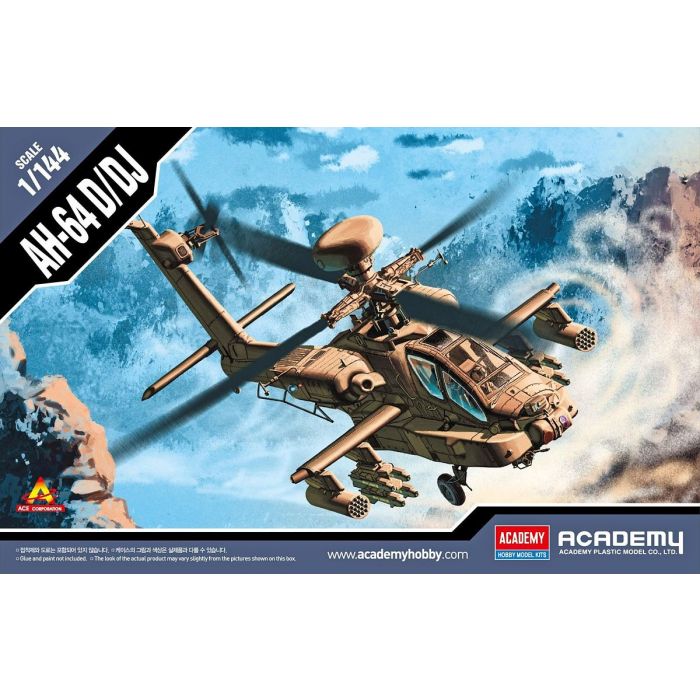
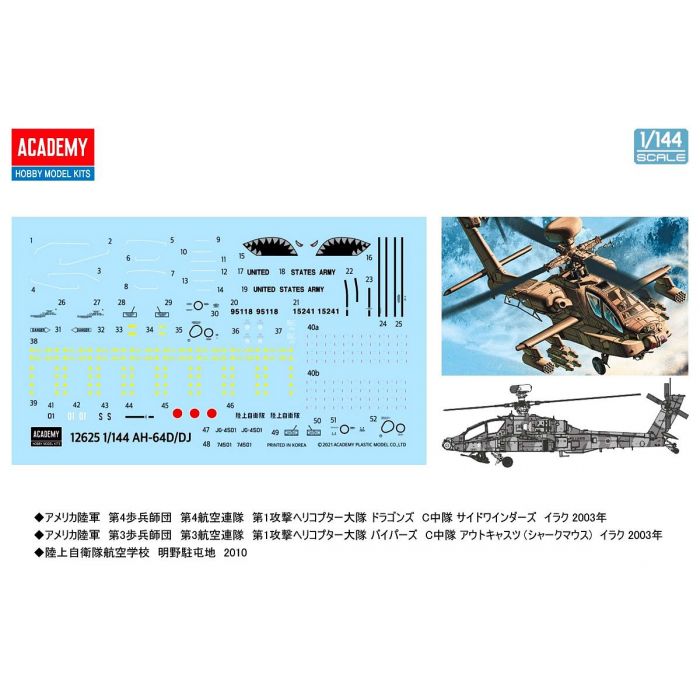
Academy brings us a 1/144-scale model kit of the U.S. Army and Japan Ground Self-Defense Force's attack helicopter, the AH-64D/DJ Apache! The characteristic form is expressed with a precise mold; decals for three versions are included as well (two from U.S. Army attack helicopter battalions, and one from the Japan Ground Self-Defense Force Aviation School at Akeno Air Field).
This is an injection-plastic jet aircraft model kit.
ACADEMY
Academy 12468 1/72 P-40E Wa...
$17.95
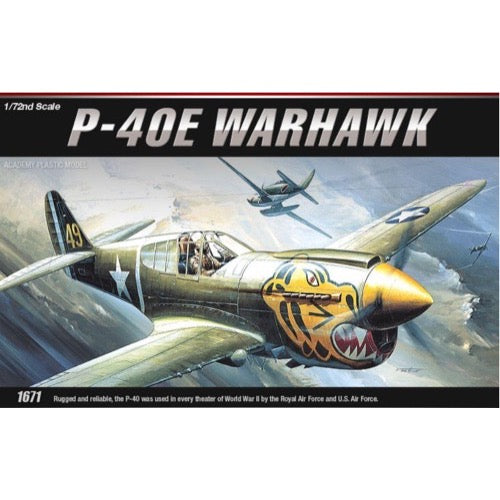
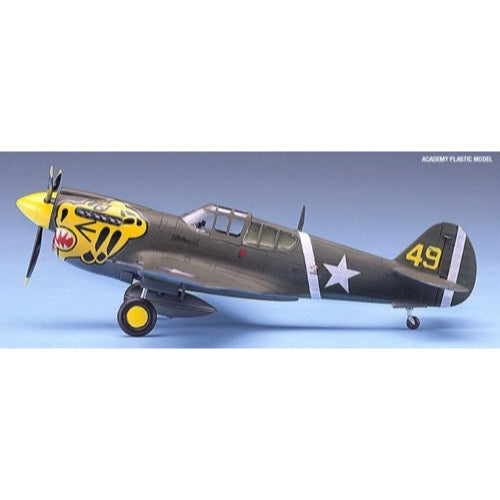
The Curtiss P-40 Warhawk is an American, single-engine, metal fighter-attack aircraft in a low wing configuration with a classic tail. The flight of the prototype took place in 1938, and serial production was carried out in the years 1938-1944. Technical data (P-40E version): length: 9.66m, wingspan: 11.38m, height: 3.76m, maximum speed: 580km / h, rate of climb: 11m / s, maximum range: 1100km, practical ceiling: 8800m, armament: fixed - 6 M2 machine guns, caliber 12.7 mm, suspended - up to 900 kg of cargo.
This is an injection-plastic jet aircraft model kit.
ACADEMY
Academy 12528 1/72 B-29A "E...
$59.95
$74.99
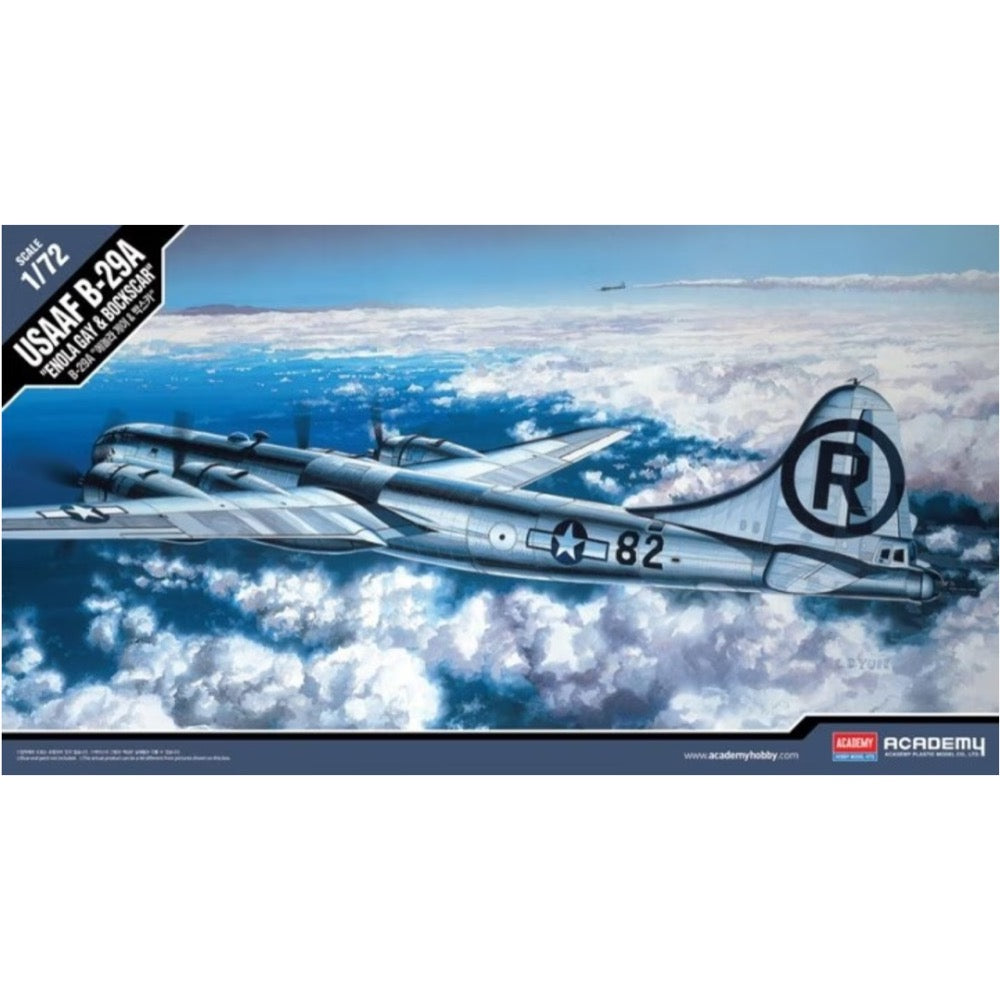
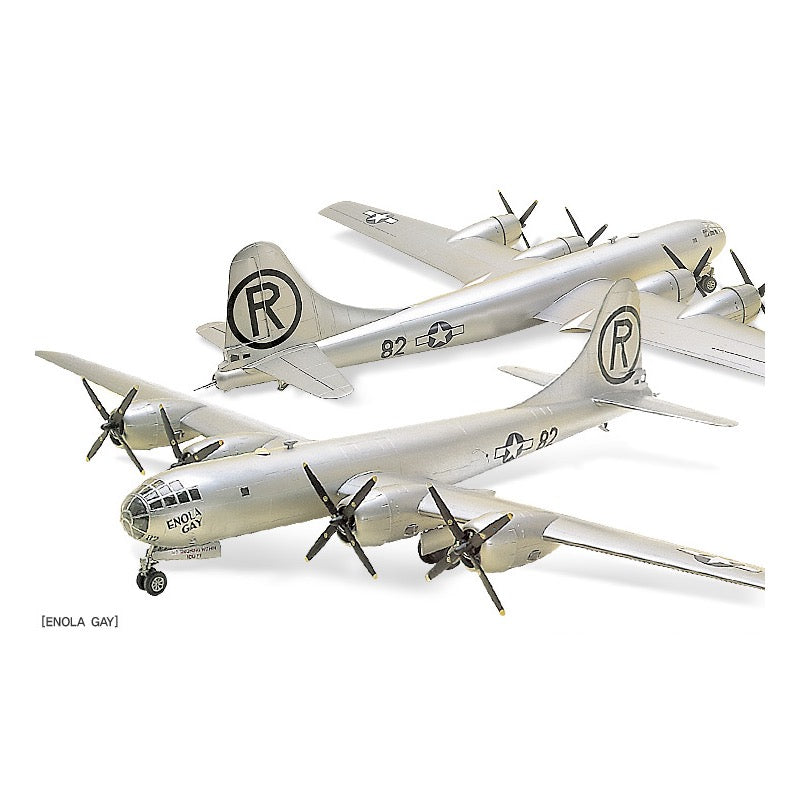
The outbreak of World War II made USAAF strategists realize that they should focus on long-range bomber projects identified as VHB (Very Heavy Bomber). When it turned out that such an aircraft could also be used over the Pacific, the designation VLR (Very Long Range) seemed more appropriate. Such a project was launched in early 1940 by General Henry Arnold. Technical data: Maximum speed: 575 km/h, practical ceiling 9144 m, operational range: 5230 km, armament: fixed - most often 11 Browning machine guns caliber 12.7 mm. underslung - up to 9072 kg of bombs.
This is an injection-plastic jet aircraft model kit.
ACADEMY
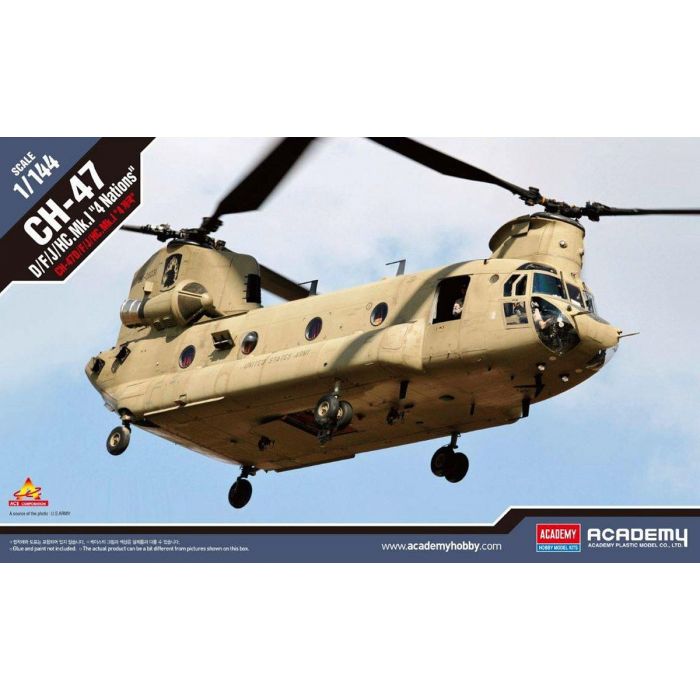
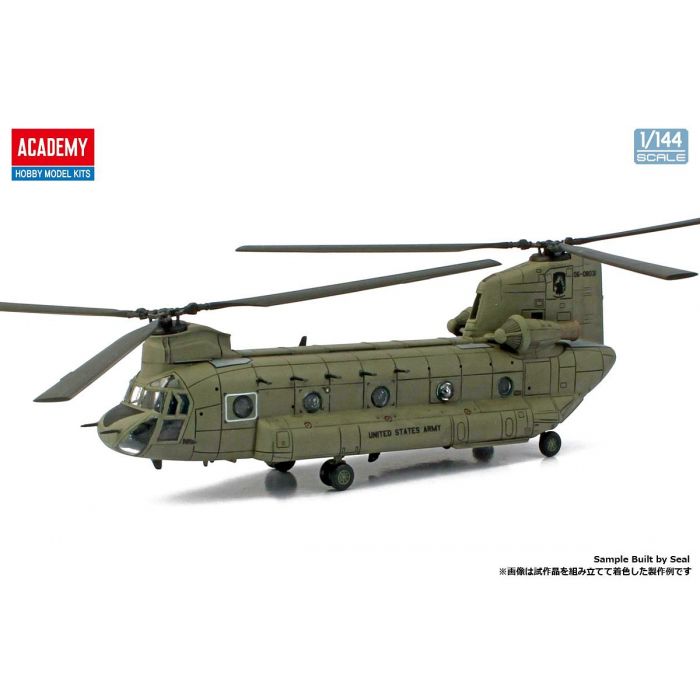
Academy 12624 1/144 CH-47D/...
$21.95
The CH-47 is a large transport helicopter that is active around the world. This model kit from Academy expresses each panel lines with precise molding; decals for five versions are included, including the Japan Ground Self-Defense Force and Air Self-Defense Force, for the squadrons of four different countries.
This is an injection-plastic jet aircraft model kit.


ACADEMY
Academy 12533 1/72 USAAF B-...
$56.95
$69.99
In May 1934, the US Army published the conditions with which it should meet the modern multi-engine bomber it needed. It was required that it could take up to 907 kg of bombs on a route from 1640 to 3540 km, while maintaining a speed of 322 to 402 km / h. While, according to the US Army, the term multi-engine meant that there should be more than one engines, Boeing invited to present its concept adopted the use of four engines for the Boeing 299 (later designated B-17). Work on the machine began in mid-June 1934. On July 28, 1935, the Boeing 299 took off for its first flight. It took place on a 3,380 km route with an average speed of 406 km / h. Technical data (for the B-17G): Maximum speed: 510 km / h, practical ceiling: 10,670 m, operating radius: 1,760 km, armament: fixed - 13 machine guns cal. 12.7 mm, suspended - up to 5800 kg, normally - 2742 kg bombs.Technical data (for the B-17G): Maximum speed: 510 km / h, practical ceiling: 10,670 m, operating radius: 1,760 km, armament: fixed - 13 machine guns cal. 12.7 mm, suspended - up to 5800 kg, normally - 2742 kg bombs.
From Academy comes a 1/72 scale kit of the USAAF B-17E "Pacific Theater". It features a precisely engraved cockpit and landing gear, as well as accurately detailed panel lines and rivets. Decals are included.
This is an injection-plastic jet aircraft model kit.
ACADEMY
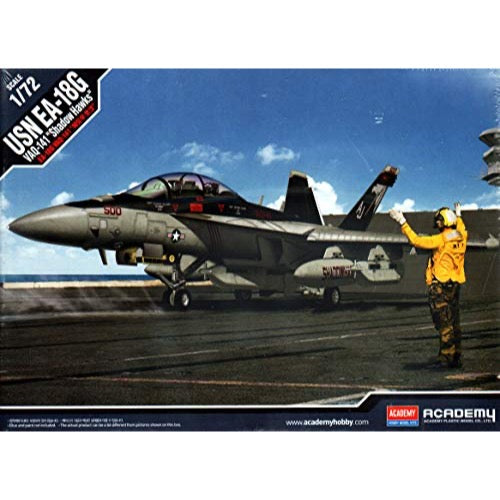
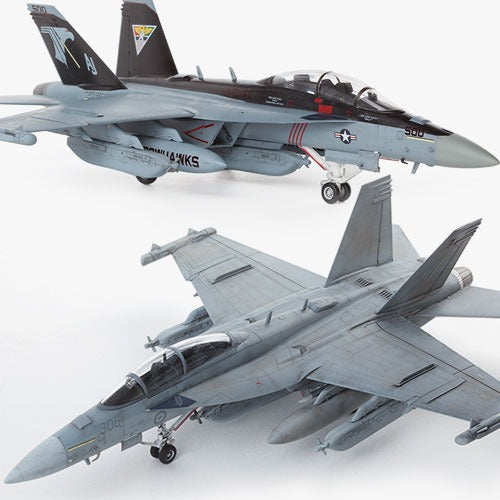
Academy 12560 1/72 Grumman ...
$52.95
$64.99
The Boeing EA-18G Growler is a modern American electronic combat aircraft. The prototype flight took place in 2006. Three years later, the machine entered the line in the US Navy and is still in it. In total, about 100 examples of this aircraft were built. The drive is provided by two motors turbofan General Electric F414-GE-400 . The aircraft has a maximum speed of 1.8 Ma and a maximum range of 3,300 kilometers. The unit price of the aircraft is $ 68.2 million (USD).
The Boeing EA-18G Growler was created to replace the EA-6B Prowler in the US Navy. It was developed on the basis of the F / A-18 F Super Hornet machine and shares 90% of its components with it. However, it was created for completely different purposes and tasks - namely to disrupt and destroy all means of detection (mainly radars) of the enemy and thus increase the chances of success of US Navy combat missions. The main weapons of the Boeing EA-18G Growler are modern ALQ-99 jamming containers, but also anti-radar missiles (AGM-88) and a self-defense missile (AIM-120). Currently, the main user of the EA-18G is the US Navy. The only foreign recipient so far turned out to be Australia.
The electronic fighter EA-18G Growler as adopted by the U.S. Navy gets a new model kit from Academy, complete with decals by Cartograf for three different aircraft from the VAQ-141 Shadow Hawks squadron, as well as decals for the Australian Air Force 6th Squadron.
This is an injection-plastic jet aircraft model kit.


ACADEMY
Academy 12576 1/72 Lockheed...
$35.95
The Lockheed F-104 Starfighter is an American supersonic interceptor and fighter-bomber. The F-104 is the fruit of the American experience of the Korean War, where most air victories were achieved in one surprising blow. This, in turn, meant that the new USAAF fighter should, above all, be fast and have a high rate of climb. It is also a reflection of the concept of "plane-missile with a man on board", which also functioned in the Soviet and British aviation in the second half of the 1950s and early 1960s. The flight of the prototype, created by Clarence "Kelly" Johnson, took place on February 7 1954, and entry into line units began in 1958. The serial plane was powered by a General Electric J79 turbojet engine with thin, trapezoidal wings and R21G / H radar. The F-104 was produced in several versions. The basic one is the F-104A, acting as a fighter plane, and the F-104C, i.e. a fighter-bomber. Subsequent versions were primarily produced for export. F-104G, with a more powerful J79-GE-11 engine and improved avionics went to Germany, the CF-104 is a license version of the F-104G, but with the J79-OEL-7 engine, produced in Canada, the F-104S is an aircraft produced in Italy licensed with the J79-GE-19 engine. Finally, the F-104J was produced for the Japanese Air Force with the J79-IHI-11A engine at Mitsubishi plants. The plane designed to train test pilots was the NF-104 Rocket Starfighter. The F-104 was an airplane that was incredibly difficult to pilot and "unforgiving" mistakes. It has suffered many crashes - in the german aviation alone, 110 of the 238 F-104 planes were crashed! Technical data (version F-104G): Maximum speed: 2137 km / h, speed of climb: max. 254 m / s, maximum altitude 27,400 m, maximum range: 2,920 km, armament: fixed - one 20mm six-barrel M61A-1 cannon, suspended - up to 1,814 kg of cargo.
The F-104C Starfighter has been adopted by the U.S. Air Force and other countries around the world. This model kit from Academy precisely reproduces its cockpit, panel lines and main gear; decals for four versions are included, featuring the Japan Air Self-Defense Force 207th Squadron.
This is an injection-plastic jet aircraft model kit.
ACADEMY
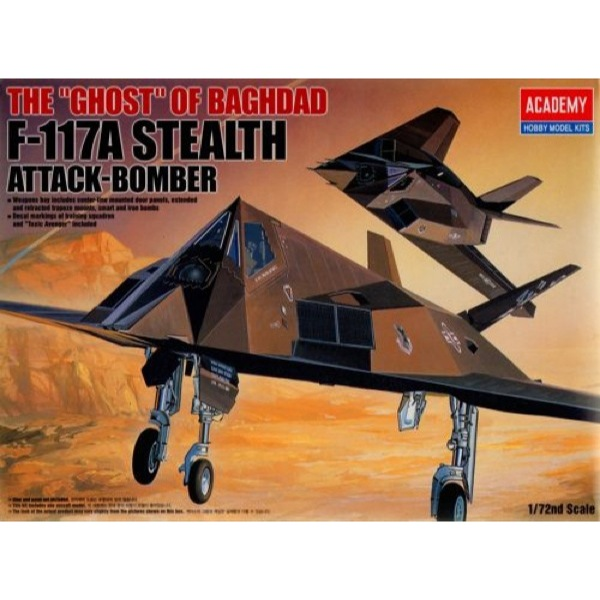
Academy 12475 1/72 F-117A S...
$27.95
The Lockheed F-117 Nighthawk is one of the most innovative designs in the history of aviation and the first mass-produced aircraft with Stealth properties. The concept of an aircraft invisible to radars appeared already during World War II, but it was not until the 1970s that the development of technology made it possible to implement it. In the F-117 it was achieved thanks to the use of many parallel actions. Technical data: Maximum speed: 1040 km / h, operating ceiling 13 700 m, maximum range: 1850 km, armament: fixed - the aircraft has no fixed armament.
This is an injection-plastic jet aircraft model kit.
ACADEMY
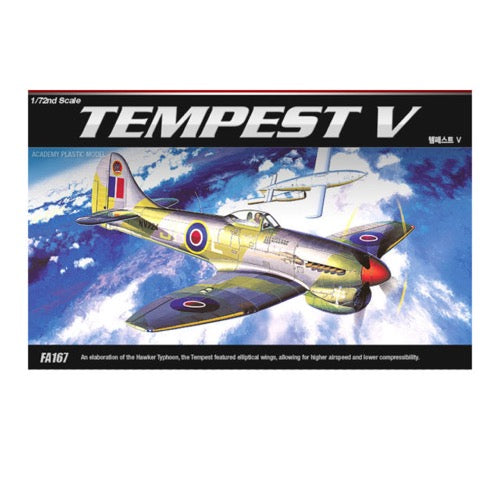
Academy 12466 1/72 Tempest V
$18.95
The Hawker Typhoon did not perform well as a fighter plane, but later served as a bombing fighter, especially when it was equipped with rocket launchers. High-altitude flight performance and climb were unsatisfactory, and in 1941 an attempt was made to counter this by using a wing with a thinner profile and elliptical contour. Technical data: length: 10.26m, wingspan: 12.49m, height: 4.9m, maximum speed: 695km / h, climb speed: 23.9m / s, maximum range: 1190km, maximum ceiling 11125m, armament: permanent - 4 20mm Hispano Mk.II cannons, sling - up to 454 kg of bombs or 8 RP-3 missiles.
This is an injection-plastic jet aircraft model kit.
ACADEMY
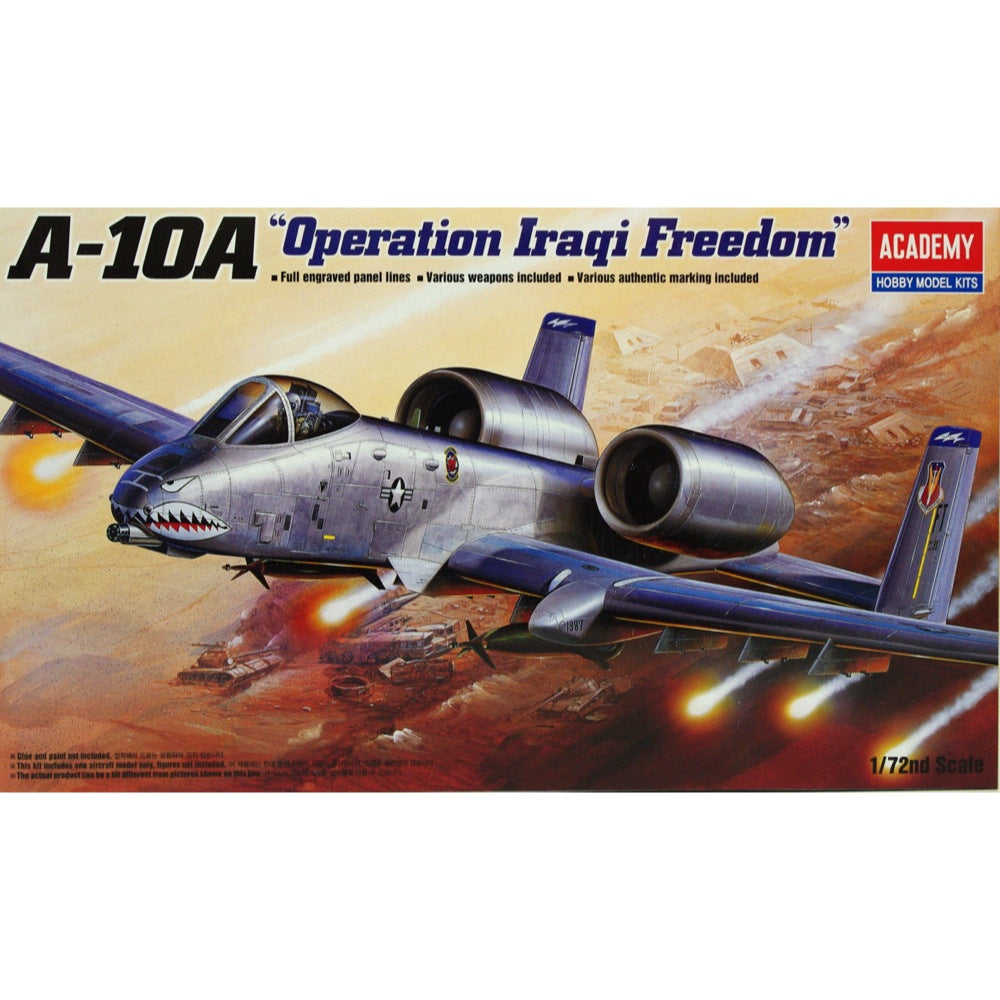
Academy 12402 1/72 A-10A "O...
$22.95
The Fairchild-Republic A-10 Thunderbolt II is a turbo-fan powered single-seater attack aircraft. The prototype flight took place in 1972, and serial production took place in 1975-1984. In total, 715 examples of this aircraft were built. The main task of the A-10 was to combat armor of the Warsaw Pact in central and western Europe. It was also supposed to balance the quantitative advantage of the USSR over NATO troops in armored weapons. Such a task resulted in the fact that the plane is characterized by a great resistance to damage, unheard of in other assault machines, the armor of the cockpit and a very high overall durability of the structure. The A-10 is also manoeuvrable - at 275 km / h, the turning radius is 300 meters, increasing to just 400m with a speed increase of 550 km / h. The main armament is the 30mm GAU-8 / A rapid-fire cannon. In addition, the plane can carry from 6,500 to 7,300 kg of weapons depending on the amount of fuel transferred. The A-10 Thunderbolt II was used in combat in Operation Desert Storm, where it performed excellently and proved its high value. Technical data: Top speed: 706 km / h; maximum range: 3950 kg, climb speed 30.5 m / s.
This is an injection-plastic jet aircraft model kit.
ACADEMY
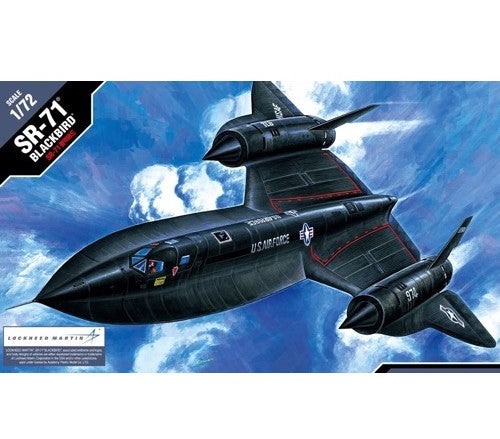
Academy 12448 1/72 SR-71 Bl...
$45.95
The Lockheed SR-71A is a long-range espionage aircraft operated by the United States Air Force with an enormous maximum speed of over Mach 3. Work on the A-11 (prototype YF-12 / SR-71) began in secret in 1959 according to guidelines given by the CIA, which needed a spy plane even more perfect than the U-2, and it is believed that by 1968, when it was completed production, about 30 machines were assembled, including the training SR-71B. The nickname Blackbird, of course, comes from the black paint that is completely painted on the plane. It has a dual role to play. Firstly, it is a special material that makes it difficult to detect Blackbird by radar, and secondly, the black color is most effective in neutralizing the huge temperatures to which the fuselage is exposed during flights at 3 times the speed of sound. The planes were officially withdrawn from service in the USAF in the late 1980s, and some of them went to NASA. Technical data: length: 32.74m, wingspan: 16.94m, height: 5.64m, maximum speed: 3.56Ma, rate of climb: 60m / s, maximum ceiling: 36500m, maximum range: 5150km, armament: permanent- the plane is unarmed.
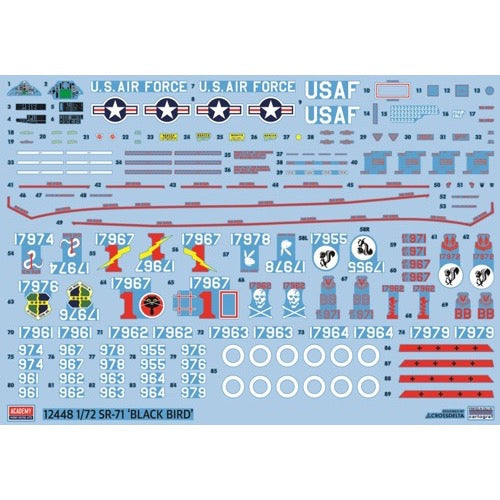
The SR-71 supersonic, high-altitude strategic reconnaissance aircraft that was adopted by the U.S. Air Force is now available as a 1/72 kit from Academy! Each panel line of the product is expressed with precise molding. Decals (made by Cartograf) include 12 types, including the 9th Strategic Reconnaissance Wing "Ichiban" that had been deployed to Kadena Air Base.
This is an injection-plastic jet aircraft model kit.


ACADEMY
Academy 12138 1/35 USMC UH-...
$79.95
US Marines UH-1Y Venom Utility Helicopter
The Academy 1/35 scale UH-1Y Venom kit replicates the modernised Huey operated by the United States Marine Corps. Equipped with upgraded engines, a four-blade rotor, and advanced avionics, the UH-1Y excels in troop transport, close air support, and medevac roles. This kit captures the versatility and modern features of this key USMC utility helicopter.
The UH-1Y Venom was developed as part of the H-1 upgrade program to replace the ageing UH-1N Hueys. Entering service in the late 2000s, the Venom shares over 80% of its components with the AH-1Z Viper, reducing logistical challenges while improving combat readiness. With its advanced avionics, enhanced survivability, and greater lift capacity, the UH-1Y has been widely used in Iraq, Afghanistan, and beyond, demonstrating reliability in both combat and humanitarian missions. As the modern incarnation of the legendary Huey, the Venom continues to serve as a critical asset to the United States Marine Corps.
Features
A highly modernized version of the legendary UH-1 "Huey," featuring a new four-bladed composite rotor system for enhanced performance and durability.
Shares a high degree of parts commonality (85%) with the AH-1Z Viper, simplifying maintenance and reducing logistical costs for the Marine Corps.
Equipped with a modern "glass" cockpit and advanced avionics, providing pilots with superior situational awareness.
A versatile multi-role platform, capable of performing a wide range of missions, including troop transport, medical evacuation, and fire support.
Contents
Plastic parts for assembling the USMC UH-1Y Venom
Instruction sheet
Paint layout sheet
Five distinct decal schemes
ACADEMY
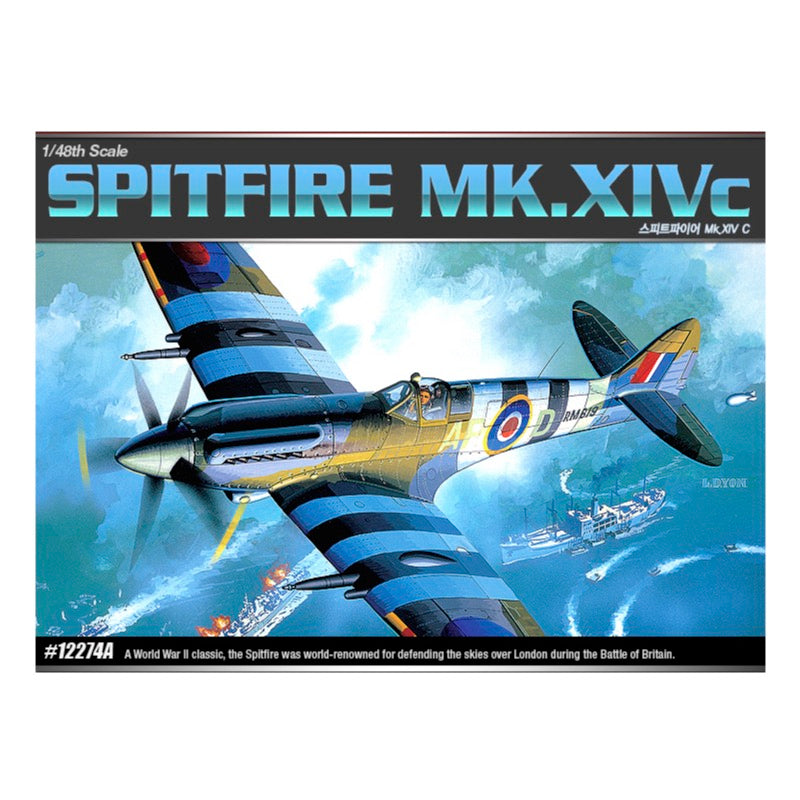
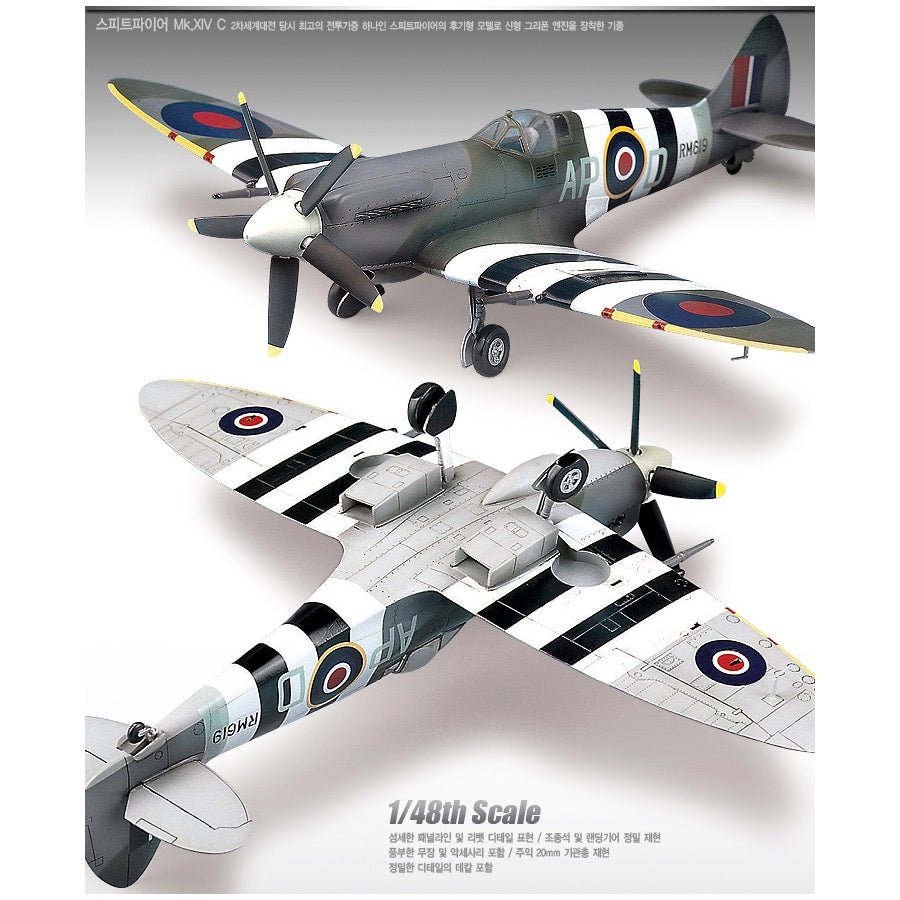
Academy 12274 1/48 Spitfire...
$31.95
History was forever made on October 5, 1944 when a Spitfire XIV of No.610 Squadron was the first Allied aircraft to shoot down a turbojet-powered Messerschmitt 262A Swallow!
Designed as an experimental Mark V fore-runner of future Griffin-engined Spitfires, it proved so promising, it was named the Mark XIV and rushed into production. Over 1,000 aircraft of this type were manufactured and deployed before the end of World War II.
It was the Mark XIV that finally had the range and maneuverability to go against the FW-190 on equal terms. Powered by the two-stage Griffin type 65 engine, the Mark XIV differed from the earlier Spitfires by its larger rudder and elevators, five-bladed ROTOL propeller and four 20mm cannon mounted in its type "C" or "E" wing.
Besides its successful battle history, in particular shooting down over 300 V-1 Flying Bombs, many aviation enthusiasts regard the Spitfire Mark XIV as one of the most beautiful fighter airplanes ever designed.
Features
Fully engraved panel lines and rivet detail.
Highly detailed cockpit interior and cannon bays..
Optional position canopy, weighted tires, fuel tank and weapons bay covers.
ACADEMY
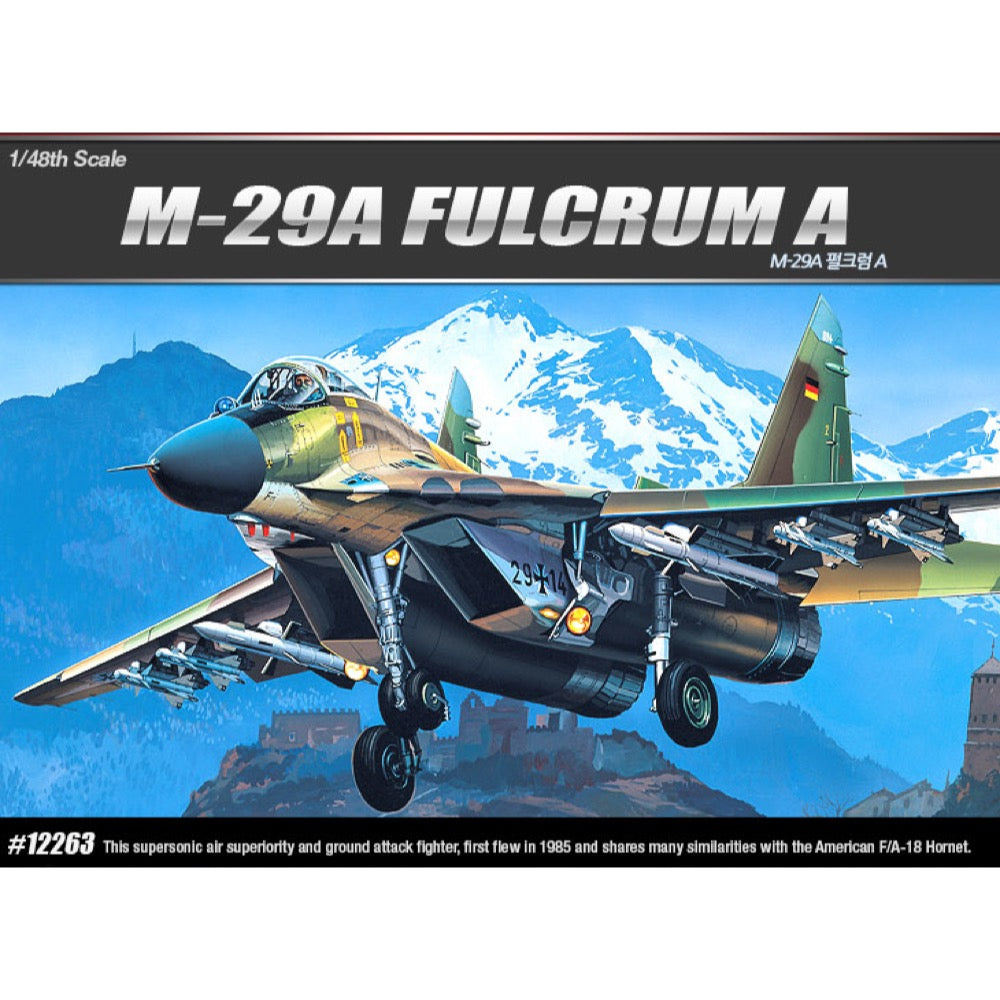
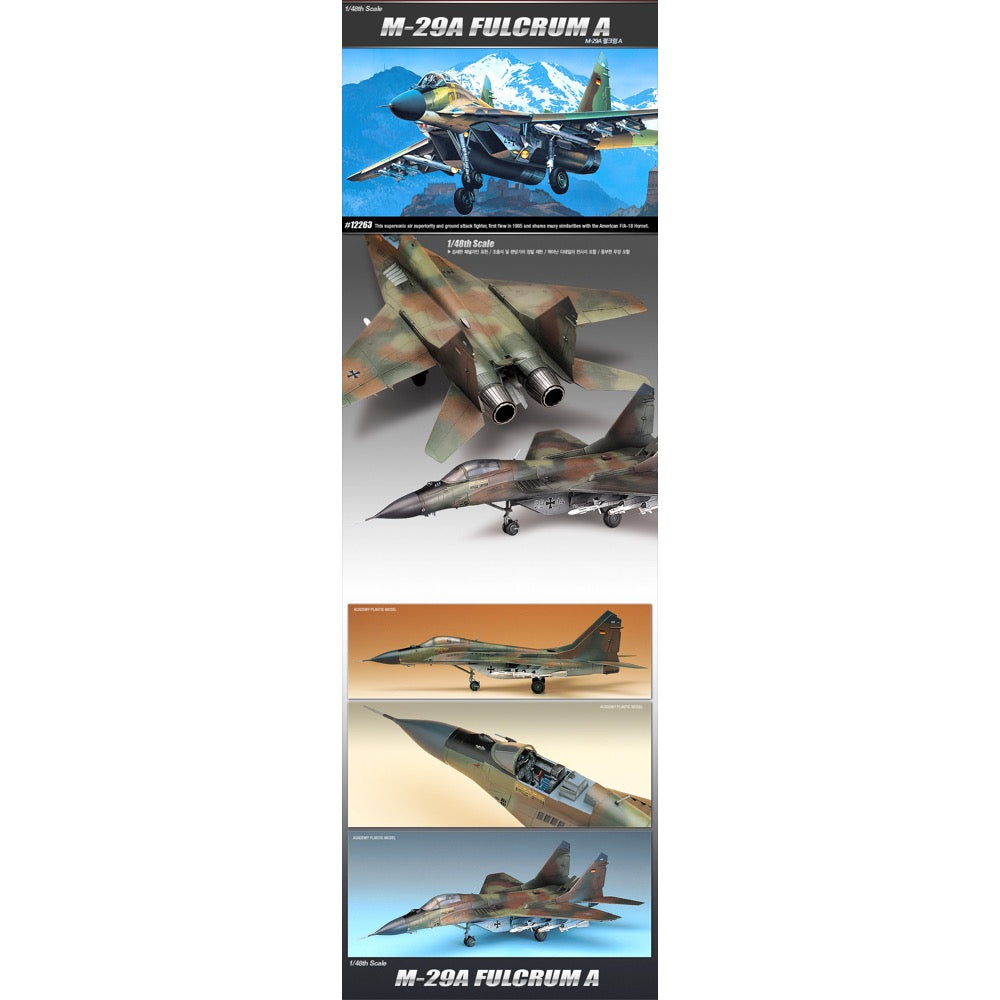
Academy 12263 1/48 M-29A Fu...
$39.95
Academy's very nice MiG-29A, widely regarded as the best kit of this aircraft in 1/48 scale.
Features
Detailed cockpit
Full weapons load and optional position FOD screens and airbrakes.
Markings are given for 1 aircraft each of the East German Air Force and post-reunification German Luftwaffe.


ACADEMY
Academy 12573 1/72 USN PBY-...
$46.95
In October 1933, the US Navy placed an order with Consolidated and Douglas for prototypes of new machines. The prototype constructed by Consolidated, designated XP3Y-1, became a flying boat built in the largest number of copies. The internal designation assigned to the structure by the company is Consolidated 28. The aircraft, just like its predecessor - P2Y - had a high wing system. The new design, however, uses a system of internal stiffening curvatures, which made the wing look like a free-bearing structure. The only exception was the two small, profiled supports on both sides of the plane, between the fuselage and the center wing. As a result, version 28 was devoid of sources of additional aerodynamic drag, generated in earlier designs by struts and stiffening straps, which were the cause of lower flight parameters. Another aerodynamic innovation limiting drag was the use of stabilizing floats, which were folded up during flight to form a profiled wing tip. The hull with two redans was very similar to that of the P2Y, but in the 28 version it had a streamlined, cross-shaped self-supporting tail. The prototype was powered by two 836HP Pratt-Whitney R-1830-54 Twin Wasp engines, installed on the leading edge of the wing. The armament consisted of four 7.62 mm machine guns and a bomb load of up to 907 kg. The first flight took place on March 28, 1935, after which the XP3Y-1 was promptly handed over to the US Navy for operational evaluation. The tests proved the significant advantage of the P3Y-1 over the patrol flying boats used so far. The long range and improved properties when taking off from land-based airfields meant that the US Navy expressed interest in the further development of the structure so that it could be used as a patrol-bomber. Therefore, in October 1935, the prototype returned to the parent plant to continue construction work on it. They included i.a. development of new R-1830-64 engines with a capacity of 912HP. A redesigned vertical tail was also introduced and a new prototype, designated XPBY-1, was flew on May 19, 1936, and soon the serial PBY-1 began to be delivered to the US Navy. After minor changes, the planes ordered in July 1936 received the designation PBY-2, and the following PBY-3 and PBY-4 were fitted with the R-1830-66 (1014KM) and R-1830-72 (1065KM) engines, respectively. In April 1939, the last of the PBY-4 machines was returned to the production plants for the installation of a wheeled chassis. Such equipment made the plane amphibious, extending the possibilities of its use. This specimen, leaving the production plant in November 1939 after the modification was completed, received the designation XPBY-5A. Test flights confirmed the advantage of this version over the previous one. Therefore, the planes ordered by the US Navy as PBY-5 were equipped as amphibians in accordance with the PBY-5A standard. Intensive use led to the thought that the plane could have significantly improved characteristics by redesigning the fuselage. The necessary tests and design works were carried out by Naval Aircraft Factory and the next, last production version of Catalina was already called PBY-6A. Technical data (PBY-5A version): length: 19.46m, wingspan: 31.7m, height: 6.15m, maximum speed: 314km / h, rate of climb: 5.1m / s, practical ceiling: 4000m, range maximum: 4050 km, armament: fixed - 3 machine guns caliber 7.62 mm and 2 machine guns caliber 12.7 mm, suspended - up to 1814 kg of bombs.
Academy brings us a model kit of the PBY-5A Catalina, a flying boat that was active in the U.S. Navy Air Corps for anti-submarine patrol, coast guard duties, and salvage. Each panel line is realistically expressed thanks to precision molding; a canopy masking sticker is included, as are decals for two U.S. Army and Navy Air Corps versions.
This is an injection-plastic jet aircraft model kit.

ACADEMY
Academy 12535 1/72 USN F/A-...
$49.95
McDonnell-Douglas / Northrop F / A-18 Hornet is an on-board fighter and attack aircraft capable of operating in all weather conditions. The roots of the F / A-18 go back to 1974 and the F-17 prototype, which was of interest to the US Navy command this year. The contract for the serial construction of the aircraft was concluded in 1976. In order to accelerate the work, the Northrop concern entered into cooperation with the McDonnell-Douglas concern. As a result, on November 18, 1978, the test flight of the prototype took place, and a year later, successful landings on the aircraft carrier. Since 1982, the aircraft has been delivered to linear units with General Electric F404-GE-402 engines as the propulsion unit. Technical data (version F / A-18 C): Maximum speed: 1915 km / h, speed of climb: 254 m / s, practical ceiling 15 240 m, maximum range: 3340 km, operating radius: 280-740 km, armament: fixed- Single 20mm M61A-1 six-barrel cannon, underslung - up to 7700 kg of cargo.
Strike Fighter Squadron 103 (abbreviation VFA-103) is an American in-flight air unit created in May 1952. Currently, the most characteristic hallmark of the VFA-103 aircraft is the pirate flag, in English called Jolly Rogers, on the horizontal stabilizers. It was also the source of the squadron's unofficial name. The first aircraft on which the VFA-103 pilots flew were the FG-1D Corsair. In 1957, the unit was rearmed with the F-8 Crusader, as one of the first in the US Navy. At the turn of 1964/1965, the VFA-103 began to be armed with the new F-4 Phantom machines. In 1983, however, it was rearmed with the new Grumman F-14A Tomcat fighters, armed with AIM-54 Phoenix missiles. Currently, the basic aircraft of the unit is the F / A-18F Super Hornet. Strike Fighter Squadron 103 pilots took an active part in the Vietnam War (1964 / 195-1975) and in both Persian Gulf Wars (1990-1991 and 2003).
This is an injection-plastic jet aircraft model kit.

ACADEMY
Academy 12520 1/72 USMC F/A...
$39.95
McDonnell-Douglas / Northrop F / A-18 Hornet is an on-board fighter and attack aircraft capable of operating in all weather conditions. The roots of the F / A-18 go back to 1974 and the F-17 prototype, which was of interest to the US Navy command this year. The contract for the serial construction of the aircraft was concluded in 1976. In order to accelerate the work, the Northrop concern entered into cooperation with the McDonnell-Douglas concern. As a result, on November 18, 1978, the test flight of the prototype took place, and a year later, successful landings on the aircraft carrier. Since 1982, the aircraft has been delivered to linear units with General Electric F404-GE-402 engines as the propulsion unit. The plane is produced in several versions. The first were the F-18A (fighter) and F-18B (training). Foreign orders from Spain, Canada and Australia appeared quickly. In 1987, a version of the F-18C was created, adapted to the use of AMRAAM missiles. A year later, the F / A-18D, a two-seat version of the F-18, entered service in all weather conditions, and could be used as an attack aircraft. On its basis, the reconnaissance version of the R / F-18D was created. The newest versions (the so-called Super Hornet) -F / A-18E and F / A-18F are very modified versions of the F / A-18D. They are characterized by an increased length of the fuselage, wingspan and their surface. They also have new General Electric F414 engines and a decidedly expanded and modernized avionics. They were presented for the first time in 1995. The EA-18G Growler electronic warfare plane was also created on the basis of the F-18. All versions of the F / A-18 met with favor of pilots, they are characterized by low failure rate, ease of use and very good flight parameters. Hornets took part in the operation against Libya in 1986 and in the Operation Desert Storm in 1991. Technical data (version F / A-18 C): Maximum speed: 1915 km / h, speed of climb: 254 m / s, practical ceiling 15 240 m, maximum range: 3340 km, operating radius: 280-740 km, armament: fixed- Single 20mm M61A-1 six-barrel cannon, underslung - up to 7700 kg of cargo.
This is an injection-plastic jet aircraft model kit.


ACADEMY
Academy 12542 1/72 ME262A-1...
$35.95
The Messerschmitt Me-262A Schwalbe (German: swallow) is a German twin-engine fighter-bomber with a metal structure in a low wing configuration. The Me-262 was the first combat jet in the history of aviation. The first flight with piston engines took place in 1941, and with turbojet engines on July 18, 1942. The first design of the airframe, designated P.1065, was presented in 1939 and, surprisingly, differed significantly from the final version. It was quickly decided to use oblique wings and test the airframe in flight with piston engines (Jumo210), which was successfully completed in 1941. As a result of problems with the target power unit (BMW003 engine), the first jet flight on the Me-262 took place with Junkers Jumo004 engines. Interestingly, the Me-262 was structurally ready for serial production at the end of 1942. However, his entry into the line was significantly delayed. Firstly, due to material deficiencies (especially tungsten and chrome deficiencies), which forced technological changes, secondly, because of the failure of the BMW003 engines, and third, because of Hitler's resistance to the Me-262 being a fast bomber, not a fighter. As a result of all factors, the plane entered the line only in 1944! Given the already overwhelming advantage of the Allies in the air, the shortage of fuel and trained crews of the Me-262 could not have had a major impact on the course of the war. Undoubtedly, it was technologically superior to enemy aircraft, and the loss ratio was 1: 9 in favor of the Me-262. A total of about 1,400 machines were built, but only about 300 entered service. Several development versions of this revolutionary aircraft were created: a bomber (A-2a), reconnaissance (A-1a / U3 and A-4a), day fighter (A-1a) and night fighter (B-1a / U1). Technical data (version Me-262A-1a): length: 10.6m, wingspan: 12.6m, height: 3.5m, maximum speed: 900km / h, speed of climb: 20m / s, maximum range: 1050km, ceiling maximum 11450m, armament: fixed - 4 30mm MK108 cannons, underslung - 24 R4M rockets, 55mm caliber, up to 1000 kg of bombs.
This is an injection-plastic jet aircraft model kit.
ACADEMY
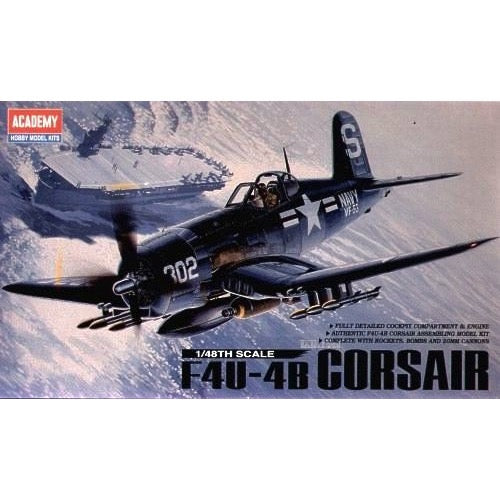
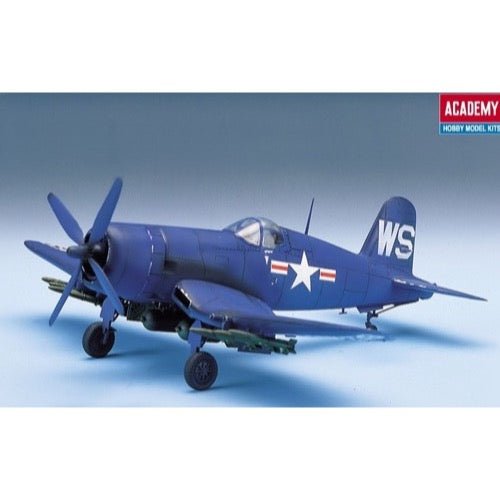
Academy 12267 1/48 Vought F...
$27.95
The Corsair, which the Japanese called Whispering Death, is a legend of the Second World War. The Vought F4U Corsair was powered by a Pratt & Whitney 2,000 HP radial engine. This powerful engine required a large Hamilton Standard 13' 4" Propeller to use the full power of the engine. The F4U was the first American fighter aircraft to exceed 400 MPH. This model faithfully recreates the F4U-4B Corsair in a 1/48 scale.
Features
1/48 scale model kit
High-quality plastic parts
Features highly detailed interior, cockpit and engine
Consistent with bombs, rockets and 20mm cannons
Includes
Plastic and transparent parts to assemble F4U-4B Corsair
Arsenal of Air-Air Weapons
Waterslide decals
Detailed manual
ACADEMY
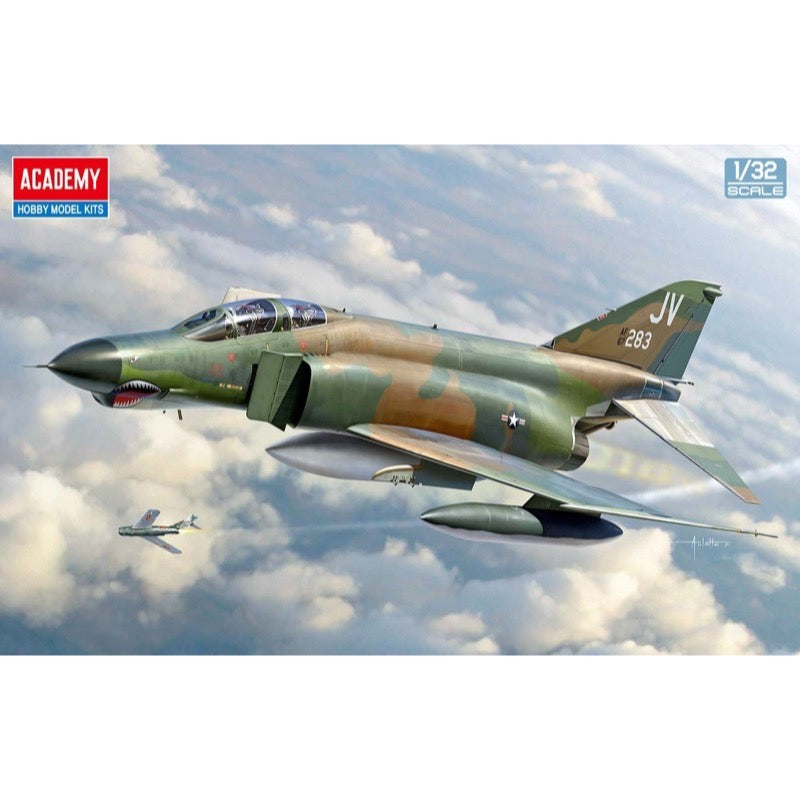
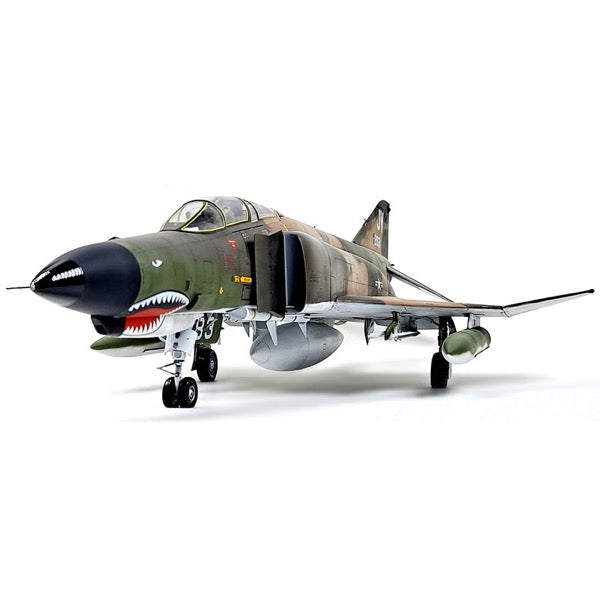
Academy 12133 1/32 USAF F-4...
$147.95
4E Phantom II is here at last! This precisely molded kit expresses each panel line and rivet, with a highly detailed cockpit and landing gear as well. Decals for seven different versions are included, too.
Features
Accurately detailed cockpit and landing gear
Various air-to-air weapons
Some metal parts
Contains seven marking options including USAF, ROKAF, and JASDF
Highly detailed TISEO and various antennas
Includes
7 markings options:
USAF The 388th TFW 469th TFS F-4E "Iceman 03' 67-0283 1972
USAF The 388th TFW 469th TFS F-4E 67-0283 1970's
ROKAF F-4E 67-0283 1970's
USAF The 52nd TFW 480th TFS F-4E 74-1645 1986
USAF The 51st CW(T) F-4E 68-0453 DAEGU AB 1980's
JASDF The 6th Air Wing 303rd SQ F-4EJ 47-8335, mid 1980's
JASDF The 6th Air Wing 303rd SQ F-4EJ 37-8313, mid 1980's


Hobbies Online
Academy 12367 1/48 Cessna 1...
$32.95
Features
Precisely designed cockpit and passenger seats
Intricately engraved panel lines and rivets
Cowlong can be selectively assembled to enable engine display
Masking Seal included
Includes U.S. Civil Air Patrol (CAP) and Korean Air Force Decal

HASEGAWA
Hasegawa 10745 1/200 Japan ...
$26.95
An accurate 1/200 scale injection molded model kit reproducing the JAL Boeing 737-800 in domestic livery. Molded parts include a white fuselage and gray wings. The fuselage is split into left and right halves for straightforward assembly. Windows are provided as decals and a display stand is included for presentation. Ideal for collectors and aviation model enthusiasts.
Specifications
Scale: 1/200
Subject: JAL Boeing 737
800 domestic livery
Material: Injection molded plastic
Molded colors: white fuselage, gray wings
Fuselage construction: left and right halves
Windows: decal representation
Display stand: included
Finished dimensions: 197.5 mm length x 179 mm wingspan (19.75 cm x 17.9 cm)
Assembly required


HASEGAWA
Hasegawa 60117 Egg Plane P-...
$11.95
This new kit really captures the "look" of the plane while also being seriously deformed! Hasegawa really got the art of doing this down years ago, but now, using the latest in molding technology, they can do it better than ever!
This kit features separate, slightly hollowed exhausts, an impressive "pilot" figure, drop tanks, and decals for two aircraft, all while still keeping the ease of assembly for which the line is famous.